Department of Microbiology, Institute for Immunology and Immunological Disease, Brain Korea 21 PLUS Project for Medical Science, Yonsei University College of Medicine, Seoul, South Korea.
National Primate Research Center, Korea Research Institute of Bioscience and Biotechnology, Cheongju, South Korea.
Virulence. 2020 Dec;11(1):430-445. doi: 10.1080/21505594.2020.1766401.
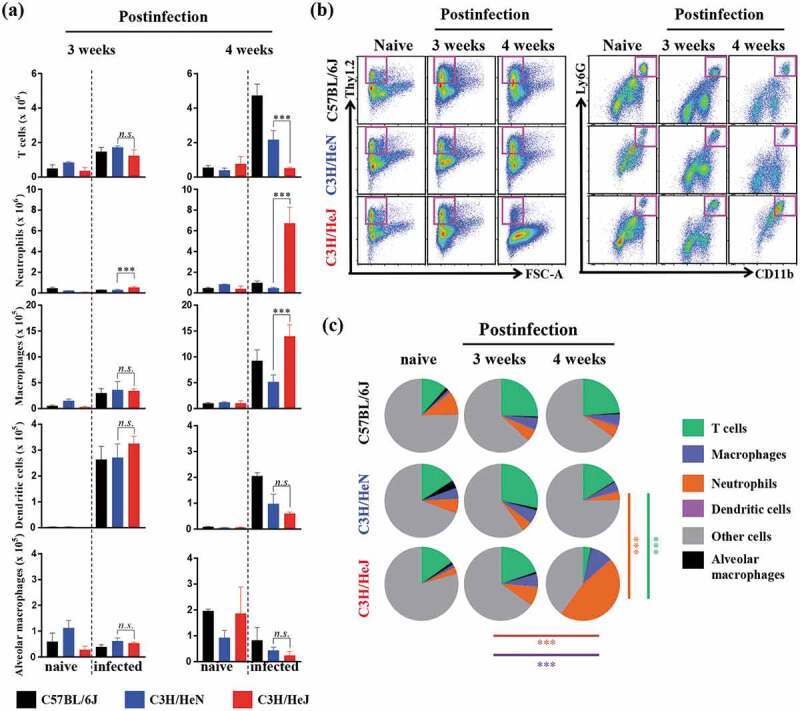
Toll-like receptors (TLRs) play critical roles in the innate recognition of (Mtb) by host immune cells. However, controversy has arisen regarding the role of TLR4 in determining the outcomes of Mtb infection. To address this controversy, the function of TLR4 in the induction of an optimal protective immune response against the highly virulent Mtb K-infection was comparatively investigated in C3 H/HeJ (TLR4-deficient mutant) and C3 H/HeN (TLR4-competent wild-type) mice. Interestingly, following Mtb infection, C3 H/HeJ mice showed a more severe disease phenotype than C3 H/HeN mice, exhibiting reduced weight and a marked increase in bacterial burden along with necrotic lung inflammation. Analysis of the immune cell composition revealed significantly increased neutrophils in the lung and significant production of IL-10 accompanied by the impairment of the protective Th1 response in C3 H/HeJ mice. Reducing the neutrophil numbers by treating C3 H/HeJ mice with an anti-Ly6 G monoclonal antibody (mAb) and blocking IL-10 signaling with an anti-IL-10 receptor mAb reduced the excessive lung inflammation and bacterial burden in C3 H/HeJ mice. Therefore, abundant IL-10 signaling and neutrophils have detrimental effects in TLR4-deficient mice during Mtb infection. However, the blockade of IL-10 signaling produced an increase in the CD11bLy6 G neutrophil population, but the phenotypes of these neutrophils were different from those of the CD11bLy6 G neutrophils from mice with controlled infections. Collectively, these results show that TLR4 positively contributes to the generation of an optimal protective immunity against Mtb infection. Furthermore, investigating the TLR4-mediated response will provide insight for the development of effective control measures against tuberculosis.
Toll 样受体 (TLR) 在宿主免疫细胞对结核分枝杆菌 (Mtb) 的先天识别中发挥关键作用。然而,TLR4 在决定 Mtb 感染结局中的作用存在争议。为了解决这一争议,本研究比较了 TLR4 缺陷型 C3H/HeJ(TLR4 缺失突变体)和 TLR4 野生型 C3H/HeN(TLR4 功能正常野生型)小鼠中 TLR4 在诱导针对高毒力 Mtb K 感染的最佳保护性免疫应答中的作用。有趣的是,在 Mtb 感染后,C3H/HeJ 小鼠表现出比 C3H/HeN 小鼠更严重的疾病表型,表现为体重减轻,细菌负荷显著增加,伴有坏死性肺炎症。免疫细胞组成分析显示,C3H/HeJ 小鼠肺部中性粒细胞显著增加,IL-10 产生显著增加,同时保护性 Th1 应答受损。用抗 Ly6G 单克隆抗体(mAb)处理 C3H/HeJ 小鼠以减少中性粒细胞数量,并使用抗 IL-10 受体 mAb 阻断 IL-10 信号转导,可减少 C3H/HeJ 小鼠过度的肺部炎症和细菌负荷。因此,在 Mtb 感染期间,TLR4 缺失型小鼠中丰富的 IL-10 信号和中性粒细胞具有有害作用。然而,阻断 IL-10 信号转导会增加 CD11bLy6G 中性粒细胞群体,但这些中性粒细胞的表型与受控制感染的小鼠中的 CD11bLy6G 中性粒细胞不同。总之,这些结果表明 TLR4 对产生针对 Mtb 感染的最佳保护性免疫具有积极作用。此外,研究 TLR4 介导的反应将为开发针对结核病的有效控制措施提供启示。