Cardiac Intensive Care Unit, Department of Thoracic and Cardiovascular Surgery, Shanghai Children's Medical Center, Shanghai Jiao Tong University School of Medicine, 1678 Dongfang Road, Shanghai, 200127, China.
Department of Pediatric Surgery, Shanghai Children's Medical Center, Shanghai Jiao Tong University School of Medicine, 1678 Dongfang Road, Shanghai, 200127, China.
BMC Pediatr. 2020 May 13;20(1):213. doi: 10.1186/s12887-020-02124-7.
The study aimed to investigate the risk factors of malnutrition in children with congenital heart defect (CHD) in China.
This cohort study was performed at the biggest pediatric heart center in China; 3252 patients with CHD who underwent cardiac surgeries in 2013 were included. Anthropometric measurements included weight for age Z score (WAZ), weight for height Z score (WHZ), and height for age Z score (HAZ). The patients were classified as normal nutritional status and malnutrition, based on a cut-off Z score of <- 2. Factors associated with malnutrition were determined using logistic regression analysis.
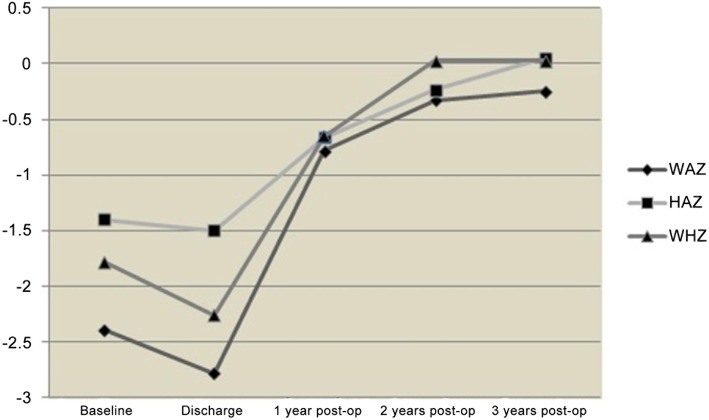
The prevalence of preoperative WAZ < -2 (underweight), HAZ < -2 (stunting), and WHZ < -2 (wasting) was 23.3, 23.3, and 14.3%, respectively. The multivariable analysis of preoperative malnutrition showed that hospitalization, age at surgery, risk adjustment for congenital heart surgery-1 > 3, mechanical ventilation, pulmonary hypertension, and acyanotic heart disease were associated with underweight. Parents' height, single ventricle, and cyanotic heart disease were associated with stunting. Hospitalization and pulmonary hypertension were associated with wasting. After surgery, the patients presented a significant improvement in growth within the first year in all three parameters and grew to the normal range of WAZ (- 0.3 ± 0.9, P < 0.001), HAZ (0.2 ± 0.8, P = 0.001), and WHZ (0.03 ± 0.6, P < 0.001) at 2 years after surgery. The prevalence of underweight, stunted, and wasting declined to 3.2, 2.7, and 1.9% 3 years after surgery. Malnutrition after surgery was associated with cardiac residual cardiac abnormalities (OR = 35.3, p < 0.0001), high Ross classification of heart function (OR = 27.1, p < 0.0001), and long-term taking oral diuretics (OR = 20.5, P = 0.001).
Malnutrition is still a problem in children with CHD in China, especially before the surgery. There is need to strengthen the nutrition support for children with CHD before surgery. Hemodynamic factors were found to be the risk factors associated with malnutrition after operation.
本研究旨在探讨中国先天性心脏病(CHD)患儿营养不良的危险因素。
本队列研究在中国最大的儿科心脏中心进行;纳入了 2013 年接受心脏手术的 3252 例 CHD 患儿。人体测量学指标包括体重年龄 Z 评分(WAZ)、体重身高 Z 评分(WHZ)和身高年龄 Z 评分(HAZ)。根据 Z 评分<-2 的截断值,将患儿分为正常营养状态和营养不良。使用 logistic 回归分析确定与营养不良相关的因素。
术前 WAZ<-2(体重不足)、HAZ<-2(发育迟缓)和 WHZ<-2(消瘦)的发生率分别为 23.3%、23.3%和 14.3%。术前营养不良的多变量分析显示,住院、手术年龄、先天性心脏病风险调整-1>3、机械通气、肺动脉高压和非发绀性心脏病与体重不足有关。父母身高、单心室和发绀性心脏病与发育迟缓有关。住院和肺动脉高压与消瘦有关。手术后,患儿在第一年的所有三个参数中均显著改善生长,WAZ(-0.3±0.9,P<0.001)、HAZ(0.2±0.8,P=0.001)和 WHZ(0.03±0.6,P<0.001)在手术后 2 年达到正常范围。手术后体重不足、发育迟缓、消瘦的发生率分别下降至 3.2%、2.7%和 1.9%,手术后 3 年。术后营养不良与心脏残余心脏异常(OR=35.3,p<0.0001)、高罗斯心功能分级(OR=27.1,p<0.0001)和长期口服利尿剂(OR=20.5,P=0.001)有关。
中国 CHD 患儿仍存在营养不良问题,尤其是术前。有必要加强术前 CHD 患儿的营养支持。血流动力学因素是术后与营养不良相关的危险因素。