Seoul National University Hospital Biomedical Research Institute, Seoul, 03080, Republic of Korea.
Cancer Research Institute, Seoul National University College of Medicine, Seoul, 03080, Republic of Korea.
BMC Cancer. 2018 Dec 10;18(1):1232. doi: 10.1186/s12885-018-5152-5.
The purpose of this study was to investigate the role of malignant ascites tumor microenvironment in ovarian cancer progression and chemoresistance.
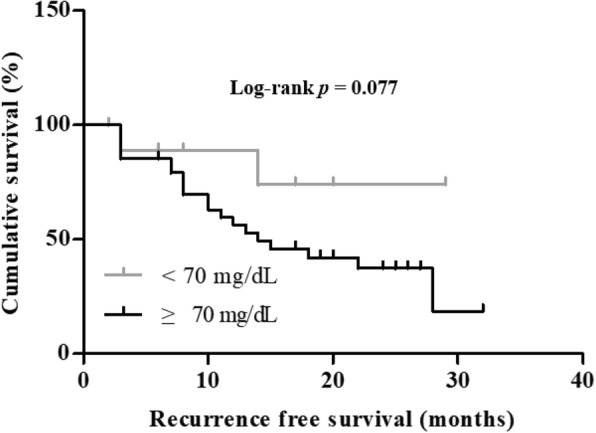
A total of 45 patients with ovarian cancer and three benign ascites were collected at the time of clinical intervention. Ascites cholesterol levels were quantitated using cholesterol quantitation kit and recurrence free survival (RFS) of ovarian cancer patients were collected. The sensitivity of ovarian cancer cells to cisplatin (CDDP) and paclitaxel (PAC) were assessed by viability assay, flow cytometry and protein expression. Receiver operating characteristics (ROC) curve and Youden index analysis were applied to calculate the optimal cut-off values for ascites cholesterol. Kaplan-Meier curve were applied to compare RFS between high and low ascites cholesterol levels in ovarian cancer patients.
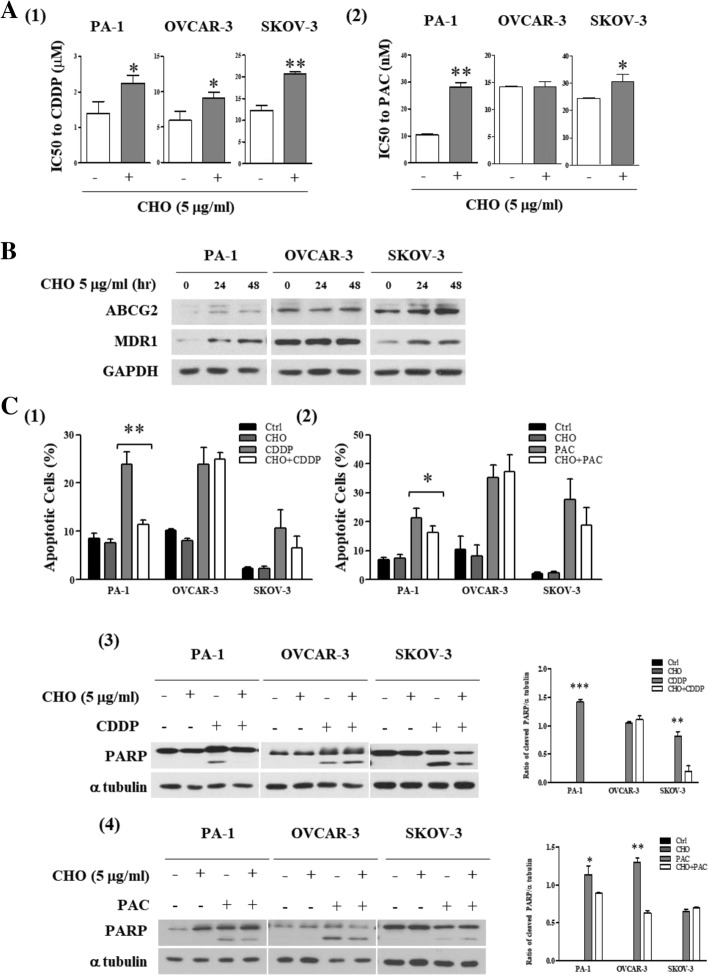
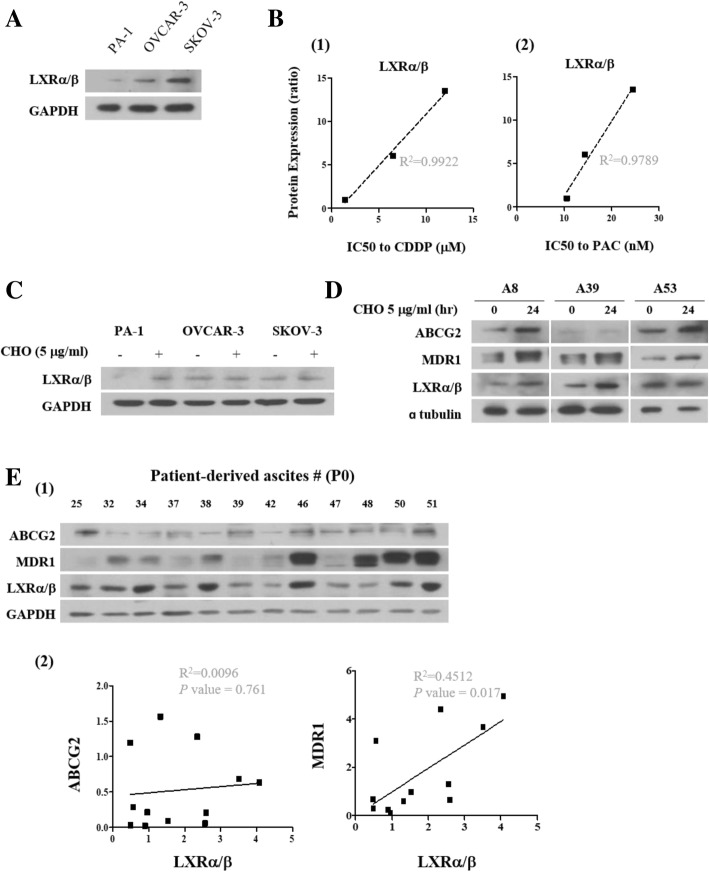
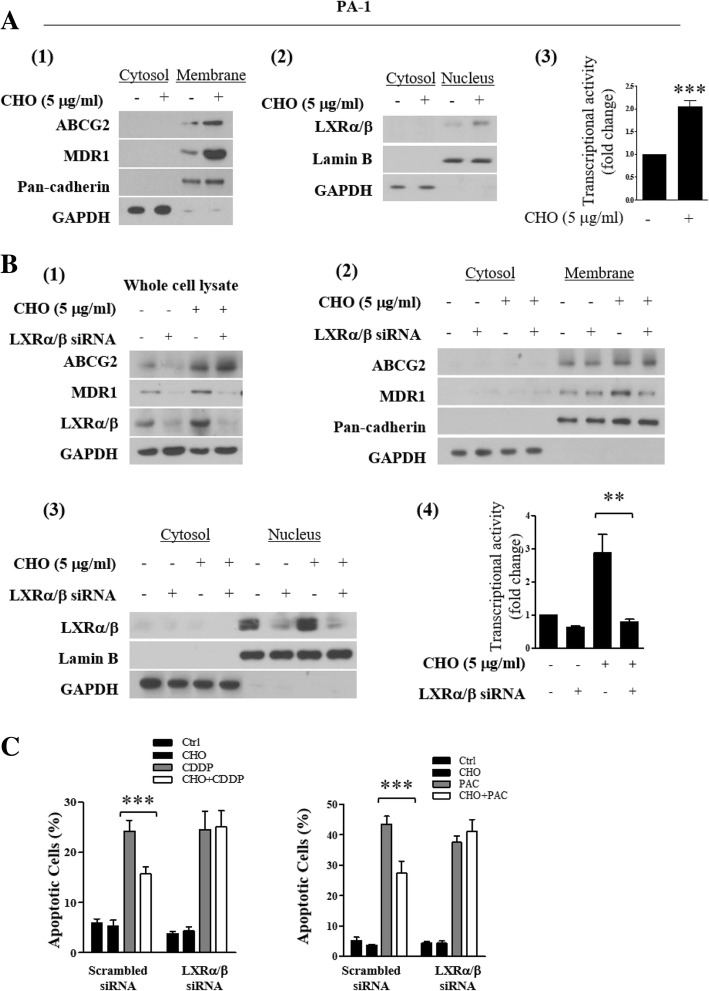
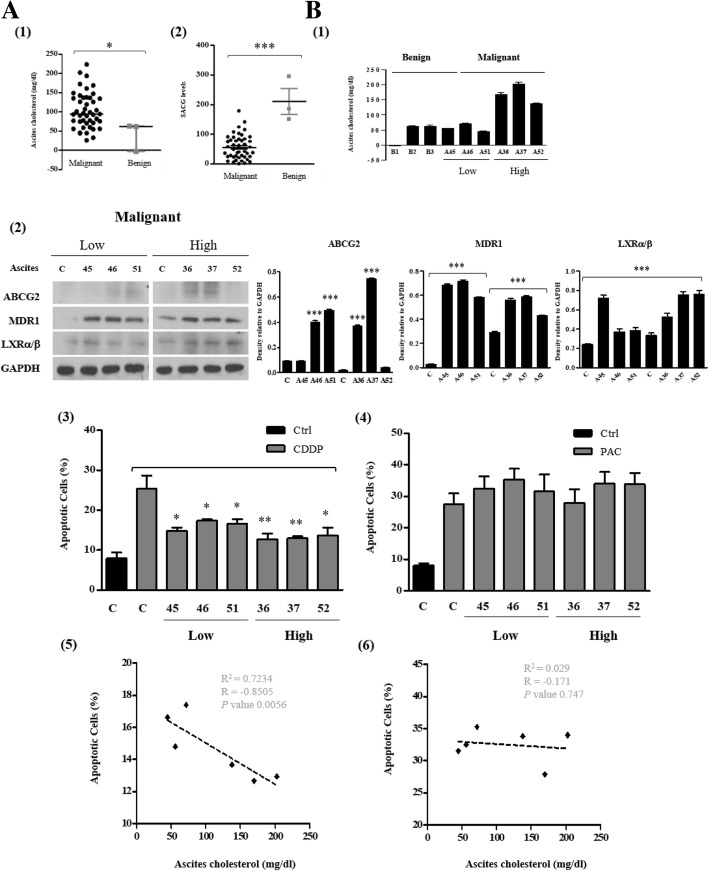
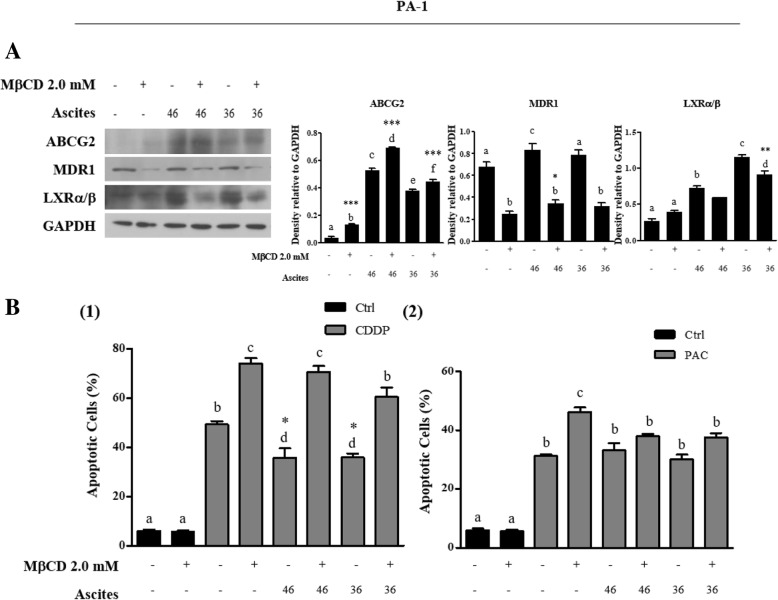
Here we show that cholesterol is elevated in malignant ascites and modulates the sensitivity of ovarian cancer cells to CDDP and PAC by upregulating the expression of drug efflux pump proteins, ABCG2 and MDR1, together with upregulation of LXRɑ/β, the cholesterol receptor. Transfection of LXRɑ/β siRNA inhibited cholesterol-induced chemoresistance and upregulation of MDR1. In addition, the cholesterol level in malignant ascites was negatively correlated with number of CDDP-induced apoptotic cell death, but not with that of PAC-induced apoptotic cell death. Cholesterol depletion by methyl beta cyclodextrin (MβCD) inhibited malignant ascites-induced chemoresistance to CDDP and upregulation of MDR1 and LXRɑ/β. For patients with ovarian cancer, high cholesterol level in malignant ascites correlated with short RFS.
High cholesterol in malignant ascites contributes to poor prognosis in ovarian cancer patients, partly by contributing to multidrug resistance through upregulation of MDR1 via activation of LXRɑ/β.
本研究旨在探讨恶性腹水肿瘤微环境在卵巢癌进展和化疗耐药中的作用。
本研究共收集了 45 例卵巢癌患者和 3 例良性腹水患者在临床干预时的腹水。采用胆固醇定量试剂盒定量检测腹水胆固醇水平,并收集卵巢癌患者的无复发生存率(RFS)。通过细胞活力测定、流式细胞术和蛋白表达评估卵巢癌细胞对顺铂(CDDP)和紫杉醇(PAC)的敏感性。应用受试者工作特征(ROC)曲线和 Youden 指数分析计算腹水胆固醇的最佳截断值。Kaplan-Meier 曲线用于比较卵巢癌患者腹水胆固醇水平高低与 RFS 的关系。
我们发现恶性腹水中胆固醇水平升高,并通过上调药物外排泵蛋白 ABCG2 和 MDR1 的表达,以及上调胆固醇受体 LXRɑ/β,调节卵巢癌细胞对 CDDP 和 PAC 的敏感性。LXRɑ/β siRNA 转染抑制胆固醇诱导的化疗耐药和 MDR1 的上调。此外,恶性腹水中的胆固醇水平与 CDDP 诱导的凋亡细胞死亡的数量呈负相关,但与 PAC 诱导的凋亡细胞死亡的数量无关。用甲基-β-环糊精(MβCD)耗竭胆固醇抑制恶性腹水诱导的 CDDP 耐药和 MDR1 和 LXRɑ/β 的上调。对于卵巢癌患者,恶性腹水中的高胆固醇水平与较短的 RFS 相关。
恶性腹水中的高胆固醇水平与卵巢癌患者的不良预后有关,部分原因是通过激活 LXRɑ/β 上调 MDR1 导致多药耐药。