Nadimi Hoda, Djazayery Abolghassem, Javanbakht Mohammad Hassan, Dehpour Ahmadreza, Ghaedi Ehsan, Derakhshanian Hoda, Mohammadi Hamed, Mousavi Seyedeh Neda, Djalali Mahmoud
Department of Cellular and Molecular Nutrition, School of Nutritional Sciences and Dietetics, Tehran University of Medical Sciences, Tehran, Iran.
Department of Community Nutrition, School of Nutritional Sciences and Dietetics, Tehran University of Medical Sciences, Tehran, Iran.
Iran J Basic Med Sci. 2020 Jan;23(1):117-123. doi: 10.22038/IJBMS.2019.38170.9068.
Cyclic AMP (adenosine monophosphate) response element-binding protein (CREB) and Brain-derived neurotrophic factor (BDNF) are reported to broadly involve in learning capacity and memory. BDNF exerts its functions via tropomyosin receptor kinase B (TrkB). BDNF transcription is regulated by stimulating CREB phosphorylation. The CREB-TrkB-BDNF pathway is reported to be affected by diabetes, which may contribute to its cognitive deficits. This study was conducted to investigate the effect of vitamin D supplementation on the hippocampal fraction of this pathway in an animal model of type-1 diabetes mellitus (T1DM).
Thirty-six adult male Sprague-Dawley rats were randomly divided into 4 groups as follows: Group 1: normal healthy rats (n=8); group 2: normal healthy rats receiving sesame oil supplementation as placebo (n=8); Group 3: diabetic rats receiving sesame oil (n=10); and Group 4: diabetic rats treated with 4300 IU/kg/week vitamin D dissolved in sesame oil (n=10). Diabetes was induced by intraperitoneal (IP) injection of streptozotocin. Blood and hippocampal samples were acquired at the end of the experiment. RNA was extracted from the hippocampus, and real-time PCR (polymerase chain reaction) was performed for BDNF and TrkB gene expression.
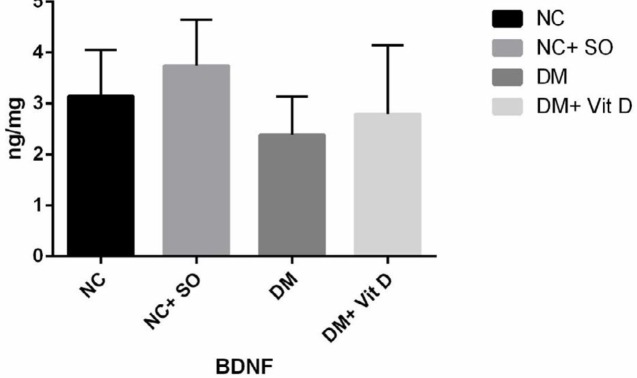
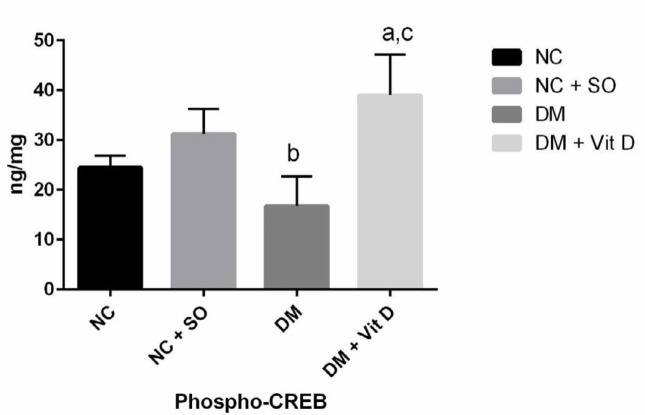
Administration of vitamin D (4300 IU/kg/week) in a T1DM animal model increased CREB phosphorylation in the hippocampus, but the serum and hippocampal BDNF levels and TrkB and BDNF gene expression did not change significantly.
Vitamin D increased hippocampal CREB phosphorylation in a T1DM animal model. Our findings showed that vitamin D might be protective against central nervous system complications in diabetes. However, future studies are warranted.
据报道,环磷酸腺苷(cAMP)反应元件结合蛋白(CREB)和脑源性神经营养因子(BDNF)广泛参与学习能力和记忆过程。BDNF通过原肌球蛋白受体激酶B(TrkB)发挥其功能。BDNF转录受CREB磷酸化刺激的调节。据报道,CREB-TrkB-BDNF通路受糖尿病影响,这可能是其认知缺陷的原因之一。本研究旨在探讨补充维生素D对1型糖尿病(T1DM)动物模型中该通路海马部分的影响。
36只成年雄性Sprague-Dawley大鼠随机分为4组,如下:第1组:正常健康大鼠(n = 8);第2组:接受芝麻油补充作为安慰剂的正常健康大鼠(n = 8);第3组:接受芝麻油的糖尿病大鼠(n = 10);第4组:用溶解于芝麻油中的4300 IU/kg/周维生素D治疗的糖尿病大鼠(n = 10)。通过腹腔注射链脲佐菌素诱导糖尿病。在实验结束时采集血液和海马样本。从海马中提取RNA,并对BDNF和TrkB基因表达进行实时聚合酶链反应(PCR)。
在T1DM动物模型中给予维生素D(4300 IU/kg/周)可增加海马中CREB的磷酸化,但血清和海马BDNF水平以及TrkB和BDNF基因表达没有显著变化。
维生素D增加了T1DM动物模型中海马CREB的磷酸化。我们的研究结果表明,维生素D可能对糖尿病中枢神经系统并发症具有保护作用。然而,还需要进一步的研究。