Elsissy Joseph, Kutzner Andrew, Danisa Olumide
Department of Orthopedic Surgery, Loma Linda University School of Medicine, Loma Linda, California.
Department of Orthopedic Surgery, Spectrum Health-Michigan State University, Grand Rapids, Michigan.
J Orthop Case Rep. 2019;9(4):84-87. doi: 10.13107/jocr.2019.v09.i04.1492.
Traumatic cervical instability, which includes bilateral facet dislocation, unilateral facet dislocation, and bilateral facet perch or subluxation, is generally treated expeditiously. Treatment is focused on providing stability of the cervical spine and mitigating sequelae such as spinal cord injury, nerve injury, cervical deformity, chronic pain, and even death. Surgical stabilization of traumatic bilateral cervical facet subluxation is the norm. There is not much-published literature concerning late treatment of neglected cervical facet subluxations or dislocations.
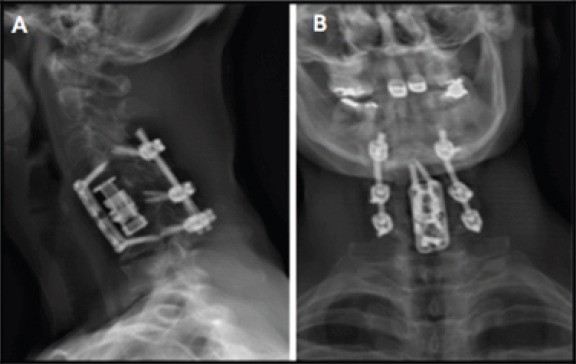
We present the case of a 53-year-old female who sustained cervical spine injury in 2010 after a single car motor vehicle accident. She did not seek immediate medical care but rather self-medicated with heroin, non-prescribed oral opiates and alcohol. She also wore a store-bought soft collar for support. She presented to our office in 2016 with persistent severe neck pain along with neck stiffness, fixed cervical flexion deformity, dysphagia, and left C6 radiculopathy. Plain radiographs demonstrated regional cervical kyphosis from C4 to C6 measuring 50°as well as autofusion at the C5/6 level. Cervical computed tomography (CT) confirmed traumatic ankylosis of C5/6 and anterolisthesis at C4/5. Cervical magnetic resonance imaging revealed multilevel cervical disc degeneration, moderate central stenosis at C4/5, and multilevel foraminal stenosis. We performed circumferential surgery: Anterior C5 and C6 corpectomy, placement of an expandable cage, and anterior C4 to C6 plating. This was followed by posterior decompression, lateral mass instrumentation, and fusion from C4-7. We were able to restore forward gaze, eliminate her dysphagia and the left C6 radiculopathy, and diminish the global neck pain.
Neglect of unstable cervical injuries portends poor clinical results. In this case, the neglect was self-induced in part from the patient's lifestyle, social situation, and lack of early access to healthcare. Despite the delayed treatment, surgical intervention was able to improve her quality of life and decrease her deformity.
创伤性颈椎不稳,包括双侧小关节脱位、单侧小关节脱位以及双侧小关节交锁或半脱位,通常需迅速治疗。治疗重点在于提供颈椎稳定性并减轻诸如脊髓损伤、神经损伤、颈椎畸形、慢性疼痛甚至死亡等后遗症。创伤性双侧颈椎小关节半脱位的手术稳定是常规治疗方法。关于被忽视的颈椎小关节半脱位或脱位的延迟治疗,发表的文献不多。
我们报告一例53岁女性病例,该患者在2010年单次汽车交通事故后发生颈椎损伤。她未立即寻求医疗救治,而是自行使用海洛因、非处方口服阿片类药物和酒精进行自我治疗。她还佩戴了从商店购买的软颈托以提供支撑。2016年她前来我们科室就诊,伴有持续严重的颈部疼痛、颈部僵硬、固定的颈椎前屈畸形、吞咽困难以及左侧C6神经根病。X线平片显示C4至C6节段颈椎后凸50°,以及C5/6水平自体融合。颈椎计算机断层扫描(CT)证实C5/6创伤性融合以及C4/5椎体前滑脱。颈椎磁共振成像显示多节段颈椎间盘退变、C4/5节段中度中央管狭窄以及多节段椎间孔狭窄。我们进行了环形手术:前路C5和C6椎体次全切除、植入可扩张椎间融合器以及C4至C6前路钢板固定。随后进行后路减压、侧块内固定以及C4至C7融合术。我们成功恢复了患者的前视能力,消除了吞咽困难和左侧C6神经根病,并减轻了整体颈部疼痛。
忽视不稳定的颈椎损伤预示着不良的临床结果。在本病例中,忽视部分是由患者的生活方式、社会状况以及缺乏早期医疗救治导致的。尽管治疗延迟,但手术干预仍能够改善她的生活质量并减轻畸形。