Saif Muhammad Wasif, Romano Alicia, Smith Melissa H, Patel Rachana, Relias Valerie
Department of Medical Oncology, Northwell Health Cancer Institute, Donald and Barbara Zucker School of Medicine at Hofstra and Feinstein Institute for Medical Research, USA.
Tufts Medical Center, Boston, MA, USA.
Cancer Med J. 2020;3(2):75-84. Epub 2020 Apr 27.
Somatostatin Analogues (SSAs) are used to treat Gastroenteropancreatic neuroendocrine tumors (GEP-NETs) and acromegaly. Side effects of SAAs usually include biliary disorders, gastrointestinal disorders, injection-site pain and hyperglycemia. Exocrine Pancreatic Insufficiency (EPI) is often misdiagnosed as disease progression or failure to SAAs or diagnosed after a delay in patients receiving SAAs. We present our experience with EPI developing in patients following use of SAAs.
We reviewed chart and pharmacy records of 110 GEP-NETs patients who received SSAs. Data was collected including demographics, pathology, stage, dose/duration of long and short-acting SA, use of antidiarrheal, pancreatic enzyme replacement (PER), proton pump inhibitors (PPI) or H2 blockers). Laboratory data include chromogranin-A (CgA), urine 5-HIAA and quantitative fecal fat test (QFFT) or fecal elastase test (FE). EPI was defined by a FE below normal level OR by a reduction of ≥ 21.2% or steatorrhea on QFFT. Patients who were identified to develop EPI were treated with pancreatic exocrine replacement therapy (PERT).
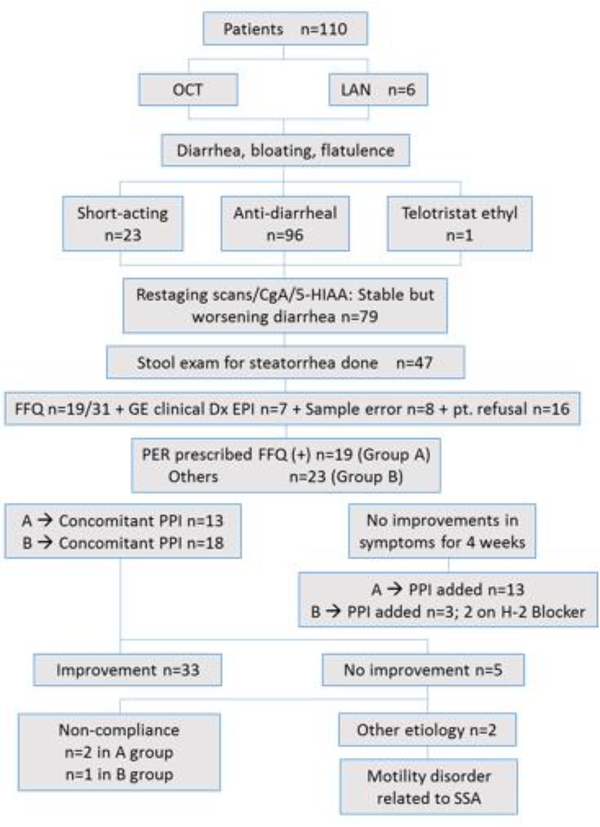
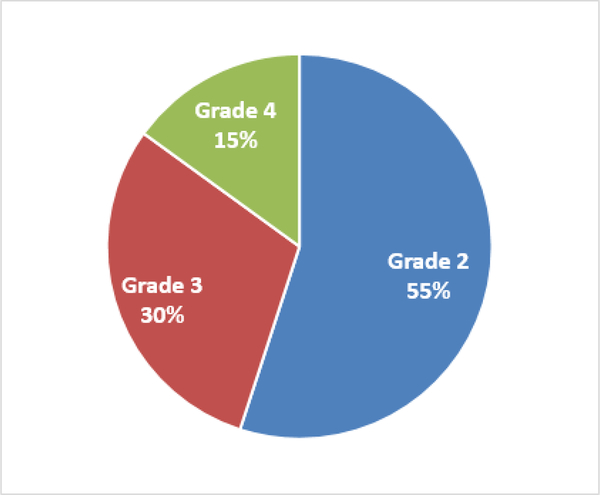
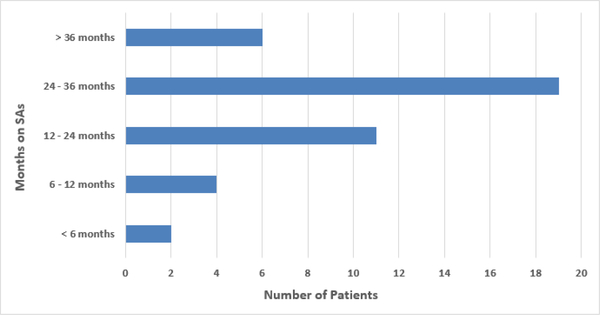
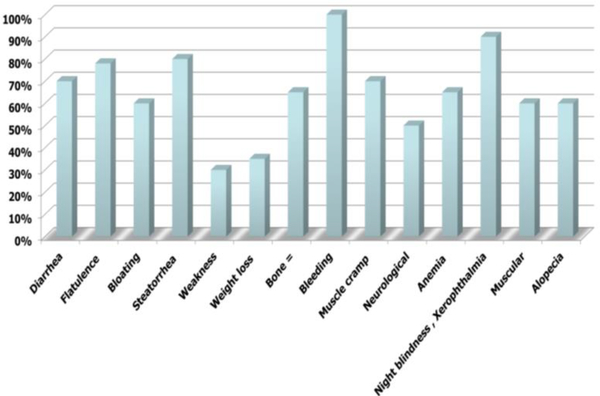
Among, 110 GEP-NETs patients, 104 received LA Octreotide and 6 Somatuline Depot Injection. Of these, 23 received short-acting SSA for worsening diarrhea, 96 had intensification of antidiarrheal and 1 got telotristat ethyl. QFFT confirmed EPI in 19, 11 based on clinical symptoms, and 16 had sample error or refusal to collect specimen. CTCAE 4.0 grades of EPI were: grade 2(69%), grade 3(22%) and grade 4(9%). Median time to development of EPI was 12 months (95%CI 3 - 23). Except 1, all patients received PERT either with concomitant PPI (13) or later if no improvement with PERT (6) and 2 on H2 blockers. 37% of the patients had improvement in EPI within 4-8 weeks. Deficiency of vitamins and trace elements was found in 11 of 19 patients, who received supplementation.
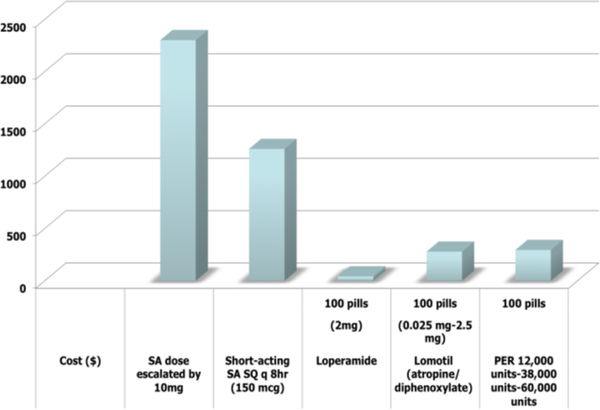
Our experience constitutes the first and the largest study addressing EPI as a rare but serious complication of chronic use of SAAs. Although SAAs are used to treat diarrhea, paradoxically they can worsen diarrhea secondary to EPI. Early recognition and diagnosis of this under-diagnosed and under-reported side effect of SAAs, such as EPI, can improve not only diarrhea and weight loss in these patients but also can reduce cost of using short-acting SAAs and antidiarrheal.
生长抑素类似物(SSAs)用于治疗胃肠胰神经内分泌肿瘤(GEP-NETs)和肢端肥大症。SSAs的副作用通常包括胆道疾病、胃肠道疾病、注射部位疼痛和高血糖。外分泌性胰腺功能不全(EPI)常被误诊为疾病进展或对SSAs治疗无效,或在接受SSAs治疗的患者中延迟诊断。我们介绍了使用SSAs后患者发生EPI的经验。
我们回顾了110例接受SSAs治疗的GEP-NETs患者的病历和药房记录。收集的数据包括人口统计学、病理学、分期、长效和短效SA的剂量/持续时间、止泻药的使用、胰酶替代治疗(PER)、质子泵抑制剂(PPI)或H2受体阻滞剂的使用情况。实验室数据包括嗜铬粒蛋白A(CgA)、尿5-羟吲哚乙酸(5-HIAA)和定量粪脂试验(QFFT)或粪弹性蛋白酶试验(FE)。EPI的定义为FE低于正常水平,或QFFT显示降低≥21.2%或出现脂肪泻。确诊为EPI的患者接受了胰腺外分泌替代治疗(PERT)。
在110例GEP-NETs患者中,104例接受了长效奥曲肽治疗,6例接受了索马杜林长效注射剂治疗。其中,23例因腹泻加重接受了短效SSA治疗,96例加强了止泻治疗,1例使用了艾塞那肽乙酯。QFFT确诊1十九例EPI,11例根据临床症状确诊,16例存在样本误差或拒绝采集标本。EPI的CTCAE 4.0分级为:2级(69%)、3级(22%)和4级(9%)。EPI发生的中位时间为12个月(95%CI 为3-23)。除1例患者外,所有患者均接受了PERT治疗,其中13例同时使用了PPI,6例在PERT治疗后无改善时使用,2例使用了H2受体阻滞剂。37%的患者在4-8周内EPI有所改善。19例接受补充治疗的患者中有11例发现维生素和微量元素缺乏。
我们的经验构成了第一项也是最大规模的研究,将EPI作为长期使用SSAs的一种罕见但严重的并发症进行探讨。尽管SSAs用于治疗腹泻,但矛盾的是,它们会加重EPI继发的腹泻。早期识别和诊断这种SSAs未被充分诊断和报告的副作用,如EPI,不仅可以改善这些患者的腹泻和体重减轻,还可以降低使用短效SSAs和止泻药的成本。