Kim Min Tae, Lee Jae-Hun, Carpena Nathaniel T, Lee Min Young, Chung Phil-Sang, Jung Jae Yun
Department of Otolaryngology-Head and Neck Surgery, Dankook University Hospital, Cheonan, Korea.
Department of Otolaryngology-Head and Neck Surgery, Dankook University College of Medicine, Cheonan, Korea.
Clin Exp Otorhinolaryngol. 2021 Feb;14(1):61-68. doi: 10.21053/ceo.2019.01662. Epub 2020 May 15.
The relationship of estrogen (the primary female sex hormone) with hearing function has been studied in both humans and animals. However, whether estrogen levels affect hearing remains uncertain. Therefore, in this study, we investigated changes in the vulnerability of hearing to acoustic overexposure in ovariectomized female rats.
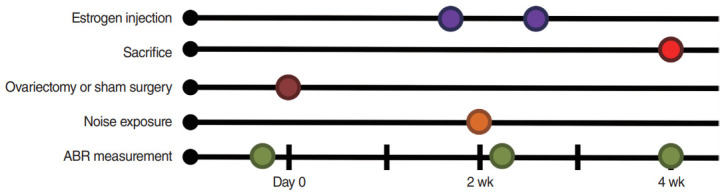
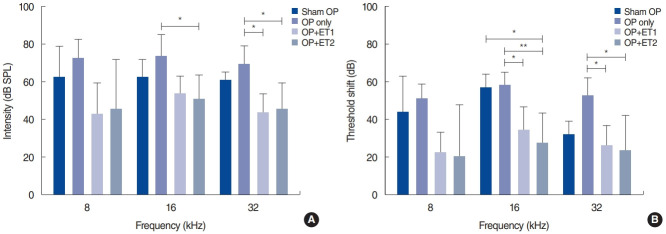
Eighteen 8-week-old female Sprague-Dawley rats were separated into four groups as follows: sham ovariectomy (OP), OP only, and OP treated with low (10 µg/kg) or high doses (100 µg/kg) of estrogen. Rats in the estrogen replacement groups were given two intraperitoneal injections. Hearing thresholds were measured before noise exposure, and at 1 day and 2 weeks after exposure.
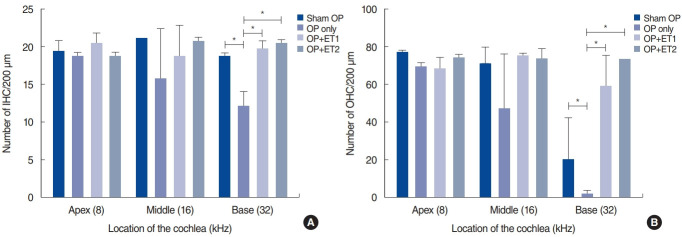
The hearing thresholds of the sham OP and OP-only groups were not significantly different. However, both estrogen groups showed a lower threshold shift than the OP-only group. Histological immunostaining analyses showed that hair cell loss in the 32 kHz region was more severe in the sham OP group than in the OP-only group. Furthermore, there was little or no hair cell loss in either estrogen replacement group and significantly more hair cell loss in the OP-only group.
These results suggest that estrogen replacement may reduce the vulnerability of hearing to noise exposure in menopausal women.
雌激素(主要的女性性激素)与听力功能之间的关系已在人类和动物中进行了研究。然而,雌激素水平是否会影响听力仍不确定。因此,在本研究中,我们调查了去卵巢雌性大鼠听力对声学过度暴露的易感性变化。
将18只8周龄的雌性Sprague-Dawley大鼠分为四组,如下:假卵巢切除术(OP)组、单纯OP组以及接受低剂量(10μg/kg)或高剂量(100μg/kg)雌激素治疗的OP组。雌激素替代组的大鼠接受两次腹腔注射。在噪声暴露前、暴露后1天和2周测量听力阈值。
假OP组和单纯OP组的听力阈值无显著差异。然而,两个雌激素组的阈值变化均低于单纯OP组。组织学免疫染色分析表明,假OP组32kHz区域的毛细胞损失比单纯OP组更严重。此外,两个雌激素替代组几乎没有或没有毛细胞损失,而单纯OP组的毛细胞损失明显更多。
这些结果表明,雌激素替代可能会降低绝经后女性听力对噪声暴露的易感性。