Leier Andre, Bedwell David M, Chen Ann T, Dickson George, Keeling Kim M, Kesterson Robert A, Korf Bruce R, Marquez Lago Tatiana T, Müller Ulrich F, Popplewell Linda, Zhou Jiangbing, Wallis Deeann
Department of Genetics, University of Alabama at Birmingham, Birmingham, AL 35294, USA.
Department of Biochemistry and Molecular Genetics, University of Alabama at Birmingham, Birmingham, AL 35294, USA.
Mol Ther Nucleic Acids. 2020 Jun 5;20:739-753. doi: 10.1016/j.omtn.2020.04.012. Epub 2020 Apr 29.
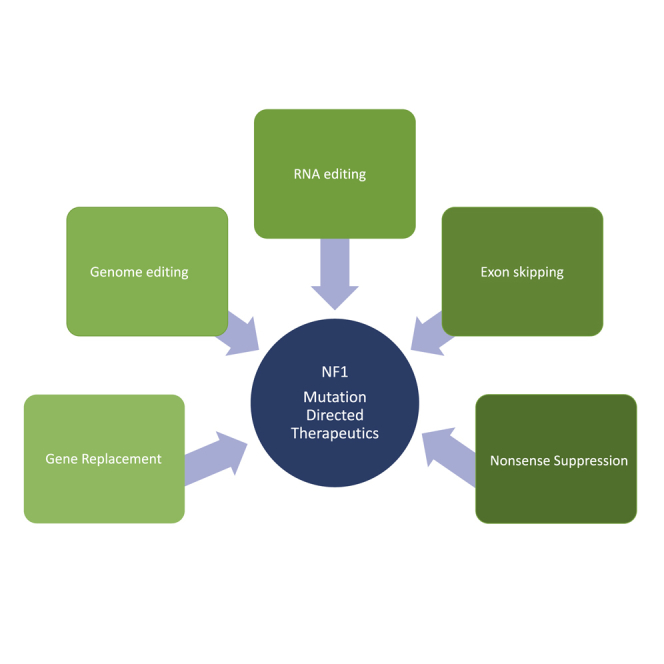
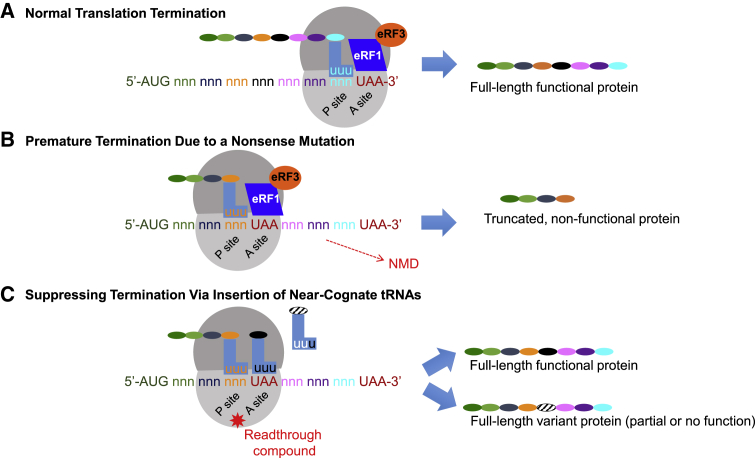
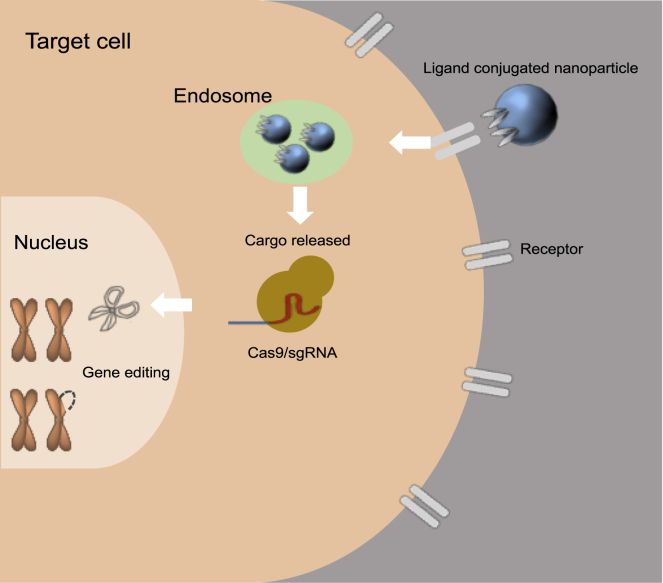
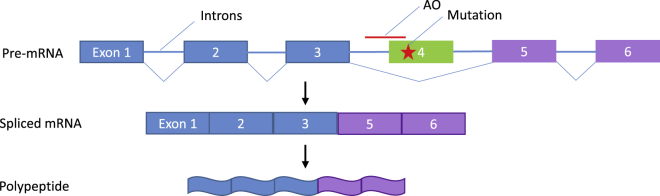
Significant advances in biotechnology have led to the development of a number of different mutation-directed therapies. Some of these techniques have matured to a level that has allowed testing in clinical trials, but few have made it to approval by drug-regulatory bodies for the treatment of specific diseases. While there are still various hurdles to be overcome, recent success stories have proven the potential power of mutation-directed therapies and have fueled the hope of finding therapeutics for other genetic disorders. In this review, we summarize the state-of-the-art of various therapeutic approaches and assess their applicability to the genetic disorder neurofibromatosis type I (NF1). NF1 is caused by the loss of function of neurofibromin, a tumor suppressor and downregulator of the Ras signaling pathway. The condition is characterized by a variety of phenotypes and includes symptoms such as skin spots, nervous system tumors, skeletal dysplasia, and others. Hence, depending on the patient, therapeutics may need to target different tissues and cell types. While we also discuss the delivery of therapeutics, in particular via viral vectors and nanoparticles, our main focus is on therapeutic techniques that reconstitute functional neurofibromin, most notably cDNA replacement, CRISPR-based DNA repair, RNA repair, antisense oligonucleotide therapeutics including exon skipping, and nonsense suppression.
生物技术的重大进展已促成了多种不同的突变导向疗法的发展。其中一些技术已成熟到可以在临床试验中进行测试的水平,但只有少数技术获得了药物监管机构的批准用于治疗特定疾病。尽管仍有各种障碍需要克服,但最近的成功案例已证明了突变导向疗法的潜在力量,并燃起了为其他遗传疾病寻找治疗方法的希望。在这篇综述中,我们总结了各种治疗方法的最新进展,并评估了它们对I型神经纤维瘤病(NF1)这种遗传疾病的适用性。NF1是由神经纤维瘤蛋白功能丧失引起的,神经纤维瘤蛋白是一种肿瘤抑制因子,也是Ras信号通路的下调因子。这种疾病具有多种表型特征,包括皮肤斑点、神经系统肿瘤、骨骼发育异常等症状。因此,根据患者情况,治疗方法可能需要针对不同的组织和细胞类型。虽然我们也讨论了治疗方法的递送,特别是通过病毒载体和纳米颗粒,但我们的主要重点是重建功能性神经纤维瘤蛋白的治疗技术,最显著的是cDNA替代、基于CRISPR的DNA修复、RNA修复、包括外显子跳跃的反义寡核苷酸疗法以及无义抑制。