Department of anesthesiology and pain medicine, Hallym University Sacred Heart Hospital, Hallym University School of Medicine, 22, Gwanpyeong-ro 170 beon-gil, Dong-gu, Anyang-si, Gyeonggi-do, 14068, Republic of Korea.
Clinical assistant professor, Department of anesthesiology and pain medicine, Asan Medical Center, University of Ulsan College of Medicine, 88, Olympic-ro 43-gil, Songpa-gu, Seoul, 05505, Republic of Korea.
BMC Anesthesiol. 2020 May 14;20(1):114. doi: 10.1186/s12871-020-01021-x.
Immobilization with cervical spine worsens endotracheal intubation condition. Though various intubation devices have been demonstrated to perform well in oral endotracheal intubation, limited information is available concerning nasotracheal intubation (NTI) in patients with cervical spine immobilization. The present study compared the performance of the C-MAC D-Blade videolaryngoscope with the McCoy laryngoscope for NTI in patients with simulated cervical spine injuries.
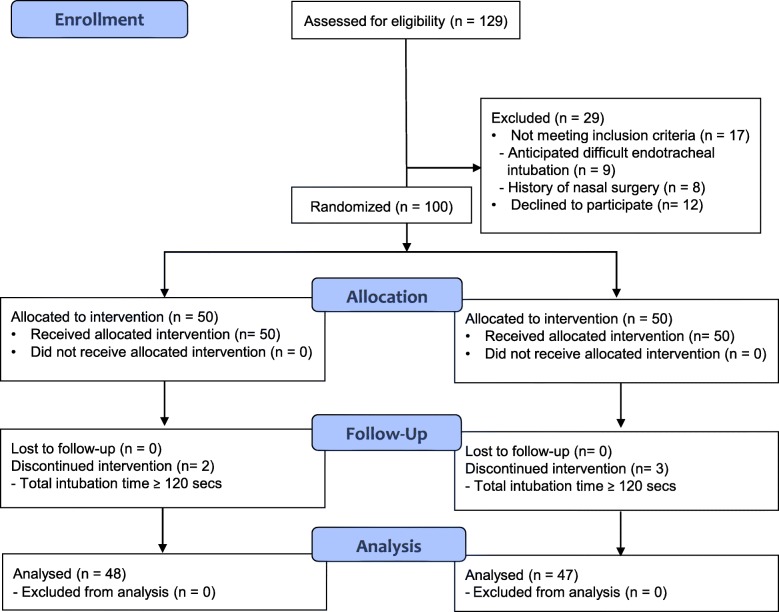
This was a prospective, randomized, controlled, study done in a tertiary hospital. Ninety-five patients requiring NTI were included in data analysis: McCoy group (group M, n = 47) or C-MAC D-Blade videolaryngoscope group (group C, n = 48). A Philadelphia neck collar was applied before anesthetic induction to immobilize the cervical spine. Single experienced anesthesiologist performed NTI. The primary outcome was duration of intubation divided by three steps: nose to oropharynx; oropharynx into glottic inlet; and glottic inlet to trachea. Secondary outcomes included glottic view as percentage of glottis opening (POGO) score and Cormack-Lehance (CL) grade, modified nasal intubation-difficulty scale (NIDS) rating, hemodynamic changes before and after intubation, and complications.
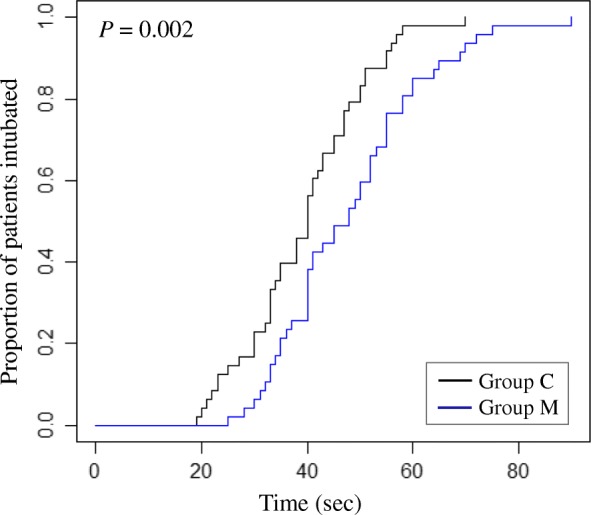
Total intubation duration was significantly shorter in group C (39.5 ± 11.4 s) compared to group M (48.1 ± 13.9 s). Group C required significantly less time for glottic visualization and endotracheal tube placement in the trachea. More patients in group C had CL grade I and higher POGO scores (P < 0.001, for both measures). No difficulty in NTI (modified NIDS = 0) was more in group C than group M. Hemodynamic changes and incidence of complications were comparable between groups.
The C-MAC D-Blade videolaryngoscope is an effective tool for NTI in a simulated difficult airway, which improves glottic visualization and shortens intubation time relative to those with McCoy laryngoscope.
Clinical Research Information Service of the Korea National Institute of Health, Identification number: KCT 0004535, Registered December 10, 2019, Retrospectively registered, http://cris.nih.go.kr.
颈椎固定会使气管插管的情况恶化。尽管已经证明各种插管设备在口腔气管插管方面表现良好,但有关颈椎固定患者经鼻气管插管(NTI)的信息有限。本研究比较了 C-MAC D-Blade 视频喉镜和 McCoy 喉镜在模拟颈椎损伤患者中进行 NTI 的性能。
这是一项在三级医院进行的前瞻性、随机、对照研究。95 例需要 NTI 的患者纳入数据分析:McCoy 组(M 组,n=47)或 C-MAC D-Blade 视频喉镜组(C 组,n=48)。在麻醉诱导前使用费城颈托固定颈椎。由一位经验丰富的麻醉师进行 NTI。主要结局是插管时间除以三个步骤:从鼻子到口咽;口咽进入声门入口;声门入口到气管。次要结局包括声门显露百分比(POGO)评分和 Cormack-Lehance(CL)分级、改良鼻插管困难评分(NIDS)评分、插管前后血流动力学变化以及并发症。
C 组总插管时间明显短于 M 组(39.5±11.4s 比 48.1±13.9s)。C 组在声门可视化和气管内插管方面所需时间明显减少。C 组更多患者的 CL 分级为 I 级和更高的 POGO 评分(两者均 P<0.001)。C 组较 M 组更无 NTI 困难(改良 NIDS=0)。两组间血流动力学变化和并发症发生率无差异。
C-MAC D-Blade 视频喉镜是一种有效的困难气道 NTI 工具,与 McCoy 喉镜相比,可改善声门可视化并缩短插管时间。
韩国国立卫生研究院临床研究信息服务,识别号:KCT 0004535,注册于 2019 年 12 月 10 日,回顾性注册,http://cris.nih.go.kr。