Department of Environmental Sciences, University of Virginia, Charlottesville, VA, USA.
Department of Environmental Science, Policy, and Management, University of California Berkeley, Berkeley, CA, USA.
Sci Rep. 2020 May 14;10(1):7961. doi: 10.1038/s41598-020-64766-y.
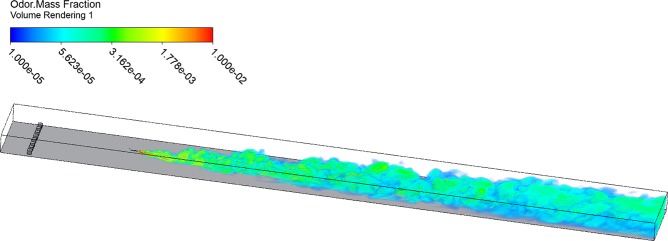
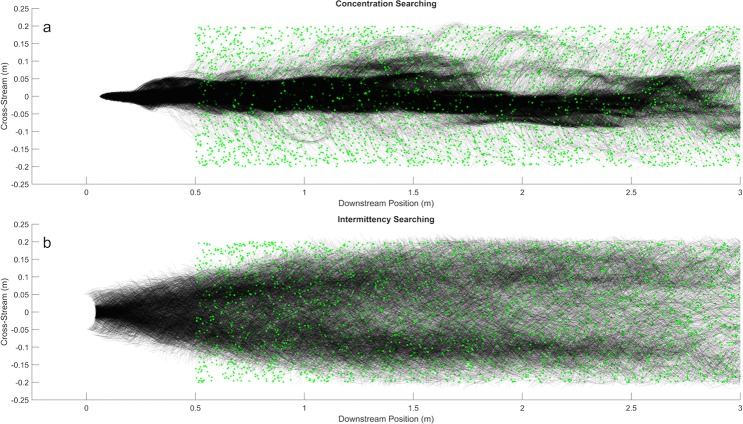
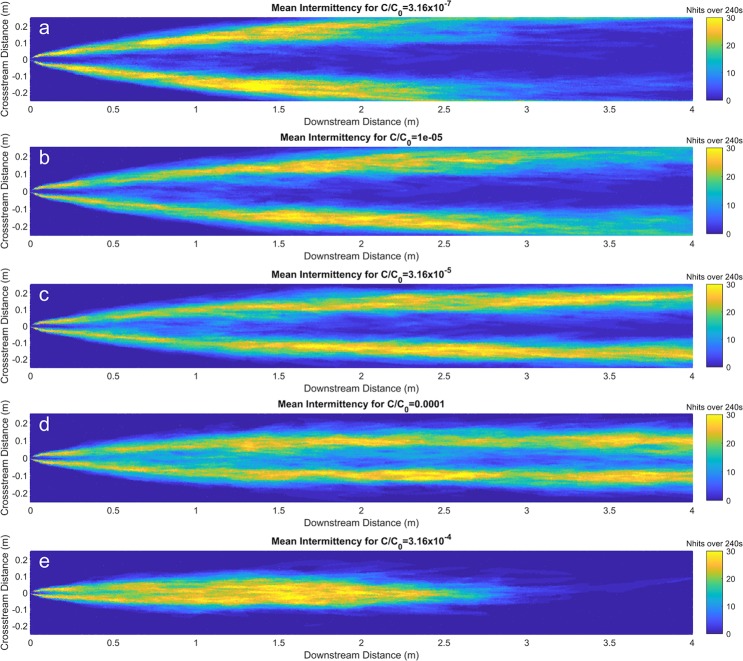
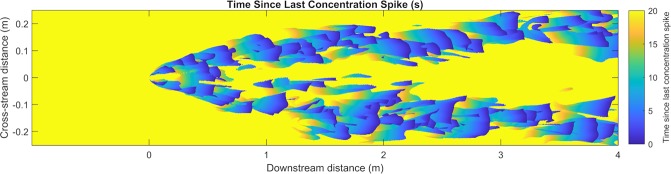
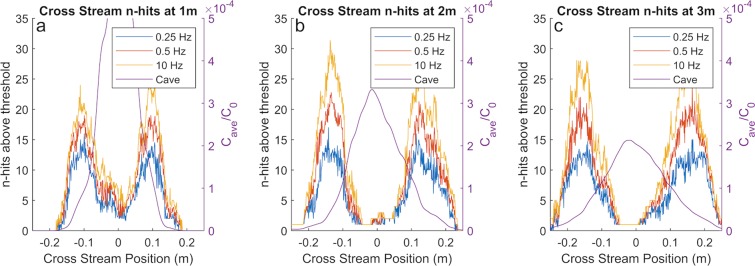
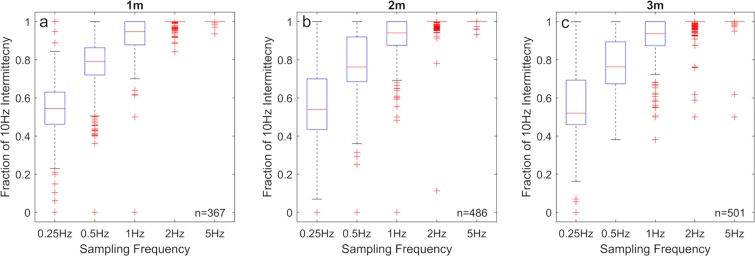
In aquatic and terrestrial environments, odorants are dispersed by currents that create concentration distributions that are spatially and temporally complex. Animals navigating in a plume must therefore rely upon intermittent, and time-varying information to find the source. Navigation has typically been studied as a spatial information problem, with the aim of movement towards higher mean concentrations. However, this spatial information alone, without information of the temporal dynamics of the plume, is insufficient to explain the accuracy and speed of many animals tracking odors. Recent studies have identified a subpopulation of olfactory receptor neurons (ORNs) that consist of intrinsically rhythmically active 'bursting' ORNs (bORNs) in the lobster, Panulirus argus. As a population, bORNs provide a neural mechanism dedicated to encoding the time between odor encounters. Using a numerical simulation of a large-scale plume, the lobster is used as a framework to construct a computer model to examine the utility of intermittency for orienting within a plume. Results show that plume intermittency is reliably detectable when sampling simulated odorants on the order of seconds, and provides the most information when animals search along the plume edge. Both the temporal and spatial variation in intermittency is predictably structured on scales relevant for a searching animal that encodes olfactory information utilizing bORNs, and therefore is suitable and useful as a navigational cue.
在水生和陆地环境中,气味会被水流分散,从而形成空间和时间都很复杂的浓度分布。在羽流中导航的动物因此必须依靠间歇性的、随时间变化的信息来找到源头。导航通常被视为一个空间信息问题,其目的是朝着平均浓度更高的方向移动。然而,这种空间信息本身,如果没有羽流时间动态的信息,不足以解释许多动物追踪气味的准确性和速度。最近的研究已经确定了一小部分嗅觉受体神经元 (ORNs),它们由龙虾 Panulirus argus 中内在有节奏地活跃的“爆发”ORNs (bORNs) 组成。作为一个群体,bORNs 提供了一种专门用于编码气味相遇之间时间的神经机制。该研究使用大规模羽流的数值模拟,以龙虾为框架构建了一个计算机模型,以检查羽流内间歇性对定向的效用。结果表明,当以秒为单位采样模拟气味时,羽流间歇性可以可靠地检测到,而当动物沿着羽流边缘搜索时,它提供的信息最多。间歇性的时间和空间变化在与利用 bORNs 编码嗅觉信息的搜索动物相关的尺度上具有可预测的结构,因此作为一种导航线索是合适且有用的。