Department of Radiation Oncology, University Medical Center Mannheim, Medical Faculty Mannheim, Heidelberg University, Theodor-Kutzer-Ufer 1-3, 68167, Mannheim, Germany.
University Medical Center Freiburg, Medical Faculty Freiburg, Freiburg University, Freiburg, Germany.
Radiat Oncol. 2020 May 14;15(1):110. doi: 10.1186/s13014-020-01559-7.
Soft tissue sarcomas (STS) treatment remains a therapeutic challenge. Intraoperative radiotherapy (IORT) resembles a safe and efficient for STS treatment. The first data on electronic-IORT (eIORT) using low-energy photons is herein presented.
Thirty-one patients with newly and recurrent STS were retrospectively assessed. EIORT was applied with low-energy photons during surgery. The dose was either prescribed to the applicator surface (spherical applicators) or 5 mm depth (flat applicators). Overall progression-free survival (O-PFS), local progression-free survival (L-PFS), overall survival (OS) and adverse events were evaluated.
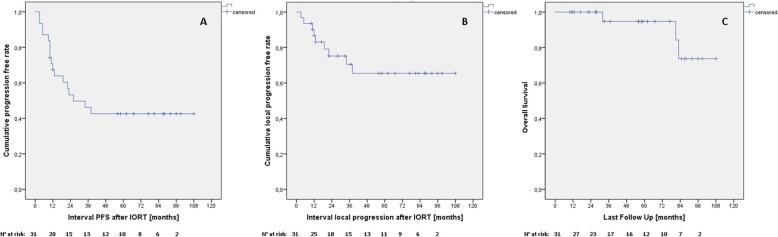
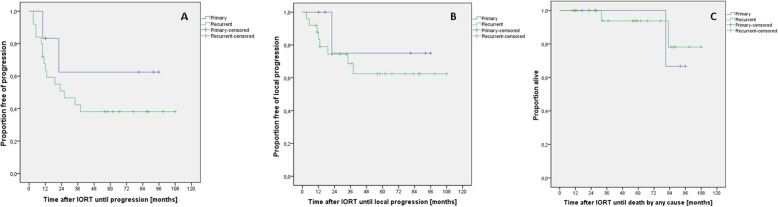
Median follow-up was 4.88 (1.0-8.95) years. Twenty-five patients (80.6%) had recurrent STS with prior treatment. The resection status was R1 in 25.8% and R2 in 6.5%. The distribution was 51.7% for extremities, 35.5% for abdomen and pelvis, 9.7% for thorax and 3.2% for head and neck tumors. The median O-PFS was 11.0 months, with 42.6% 5-year estimated O-PFS. The only local recurrence in the primary setting occurred after 22 months. Median L-PFS in recurrent STS was 12.5 months, with 65.5% 5-year estimated L-PFS. The 5-year OS estimated rate was 94.7% (3 events after 7 years). No G3 toxicity related to eIORT was observed. Two patients exhibited G2 acute neuropathic pain. Late neuropathic pain was seen in 6 patients being 3 graded as G1 and 3 as G2. No wound-related toxicity was found.
Electronic IORT with low-energy photons is a safe treatment option for STS, yielding similar outcomes as historical series reporting IORT with electrons or HDR brachytherapy.
软组织肉瘤(STS)的治疗仍然是一个治疗挑战。术中放疗(IORT)是一种治疗 STS 的安全有效的方法。本文首次报告了使用低能光子的电子术中放疗(eIORT)的初步数据。
回顾性评估了 31 例新诊断和复发性 STS 患者。在手术期间应用低能光子进行 eIORT。剂量要么规定为施源器表面(球形施源器),要么规定为 5mm 深度(扁平施源器)。评估总无进展生存率(O-PFS)、局部无进展生存率(L-PFS)、总生存率(OS)和不良事件。
中位随访时间为 4.88 年(1.0-8.95 年)。25 例患者(80.6%)为复发性 STS,并有既往治疗史。切除状态为 R1 占 25.8%,R2 占 6.5%。分布为:51.7%为四肢,35.5%为腹部和骨盆,9.7%为胸部,3.2%为头颈部肿瘤。O-PFS 的中位值为 11.0 个月,5 年估计 O-PFS 为 42.6%。在原发部位唯一的局部复发发生在 22 个月后。复发性 STS 的中位 L-PFS 为 12.5 个月,5 年估计 L-PFS 为 65.5%。5 年 OS 估计率为 94.7%(7 年后发生 3 例事件)。未观察到与 eIORT 相关的 G3 毒性。2 例患者出现 G2 急性神经病理性疼痛。6 例患者出现迟发性神经病理性疼痛,其中 3 例为 G1,3 例为 G2。未发现与伤口相关的毒性。
低能电子术中放疗是 STS 的一种安全治疗选择,其结果与报告电子或 HDR 近距离放疗的 IORT 的历史系列相似。