Department of Epidemiology and Biostatistics, University of Georgia, Athens, Georgia, USA.
Department of Psychiatry, College of Osteopathic Medicine, Michigan State University, East Lansing, MI, USA.
BMC Public Health. 2020 May 14;20(1):684. doi: 10.1186/s12889-020-08842-y.
Toxic stress (TS), minority race and their interaction are evaluated as determinants of change in quality of life (QOL) over 8 years follow-up in a nationally representative sample of United States (US) adults (≥50 years old) with heart disease (HD) and/or type-2 diabetes (T2DM) diagnosed by 2006 as part of the Health and Retirement Study (HRS).
Recent and life-course stress plus experiences of lifetime discrimination were measured every 2 years using the stressful life experiences questionnaire. QOL was assessed by participant self-rated health (SRH) and operationally defined as improved, unchanged or declined in current year versus two years prior. Repeated measures multinomial logistic regressionusing generalized estimating equations (GEEs) was implemented to estimate race-, TS and their interaction- related odds of worse SRH from2006-2014. Odds ratios (OR) and 95% confidence intervals (CIs) were calculated with adjustment for time, age, sex and socio-economic status.
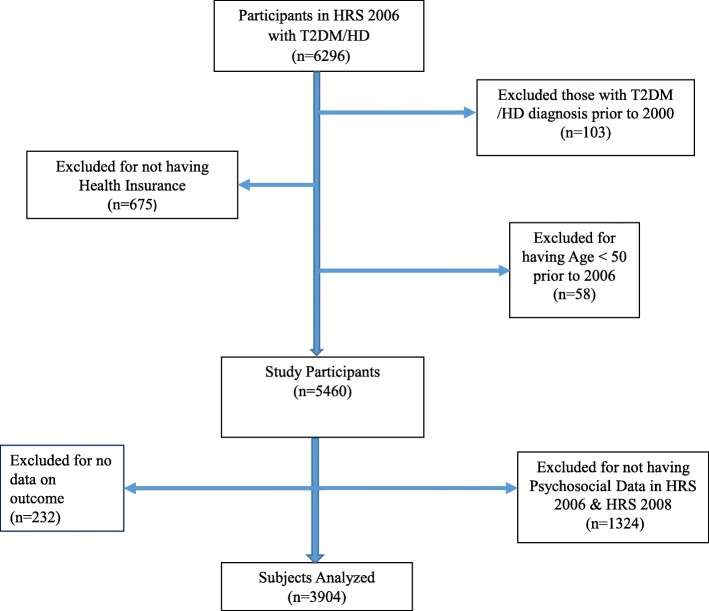
Three thousand nine hundred four adults with HD/T2DM, mean age 71.1 ± 9.3 years old, 80.9, 14.7 and 4.4% that respectively self-identified as Caucasian, African-American and Other race, were included. Over the eight-year follow-up, the odds of worse SRH for African-American and Other race were respectively 1.46 (95% CI: 1.25-1.70) and 1.43 (95% CI, 1.10-1.86) times higher relative to Caucasians. Relative to older Americans that reported ≥2 lifetime discrimination events, the odds of poor SRH was respectively 33% (OR = 0.67, 95%CI: 0.50-0.89) and 17% (OR = 0.83, 95%CI: 0.59-1.17) lower for those that reported none vs one lifetime discrimination experience. Furthermore, the relationship of life-course stress to SRH decline over 8 years varied by race (timestressrace, p = 0.1173). Specifically, increasing life-course stress predicted worse QOL among Caucasians (p = 0.0063) and among African-American (p = 0.0820) but not among Other race (p = 0.9943).
Toxic stress and minority race are social determinants of deterioration in QOL among older Americans with chronic diseases (HD/T2DM). The types and prevalence of toxic stressors varied by race/ethnicity. Policy interventions to address root causes of TS while targeted at proximate drivers of TS by race/ethnicity represent a viable strategy for mitigating racial disparities in overall wellbeing and improving QOL in all aging Americans regardless of race.
有毒压力(TS)、少数民族和它们之间的相互作用被评估为影响美国(美国)成年人(≥50 岁)心脏病(HD)和/或 2 型糖尿病(T2DM)患者 8 年随访期间生活质量(QOL)变化的决定因素,这些成年人是通过 2006 年健康与退休研究(HRS)中的研究确诊的。
最近和生活过程中的压力加上一生的歧视经历,每两年使用压力生活经历问卷进行测量。QOL 通过参与者的自我报告健康(SRH)来评估,并根据当年与前两年相比是否有所改善、保持不变或下降来进行操作定义。使用广义估计方程(GEE)的重复测量多项逻辑回归来估计种族、TS 及其与较差 SRH 的交互作用的可能性,时间范围从 2006 年至 2014 年。使用时间、年龄、性别和社会经济地位进行调整后,计算优势比(OR)和 95%置信区间(CI)。
共有 3904 名患有 HD/T2DM 的成年人,平均年龄为 71.1±9.3 岁,分别有 80.9%、14.7%和 4.4%的人自我认定为白种人、非裔美国人和其他种族。在八年的随访中,非裔美国人和其他种族的 SRH 较差的几率分别是非裔美国人的 1.46 倍(95%CI:1.25-1.70)和 1.43 倍(95%CI:1.10-1.86)。与报告≥2 次终身歧视事件的较年长美国人相比,报告没有一次终身歧视经历的人的不良 SRH 几率分别降低了 33%(OR=0.67,95%CI:0.50-0.89)和 17%(OR=0.83,95%CI:0.59-1.17)。此外,种族之间生活过程压力与 8 年内 SRH 下降的关系也不同(时间压力种族,p=0.1173)。具体来说,生活过程中压力的增加预示着白种人(p=0.0063)和非裔美国人(p=0.0820)的 QOL 较差,但其他种族(p=0.9943)则不然。
有毒压力和少数民族是美国慢性病(HD/T2DM)老年患者生活质量恶化的社会决定因素。有毒压力源的类型和流行程度因种族/族裔而异。针对 TS 的根本原因并针对 TS 的近因按种族/族裔采取政策干预措施,是减轻整体幸福感方面种族差异和改善所有美国老年人生活质量的可行策略,无论其种族如何。