Hribal Marta Letizia, Mancuso Elettra, Arcidiacono Gaetano Paride, Greco Annalisa, Musca Donatella, Procopio Teresa, Ruffo Mariafrancesca, Sesti Giorgio
Department of Medical and Surgical Sciences, University Magna Græcia of Catanzaro, Catanzaro, Italy.
Department of Medicine, University of Padua, Padua, Italy.
Int J Endocrinol. 2020 Jan 3;2020:1027386. doi: 10.1155/2020/1027386. eCollection 2020.
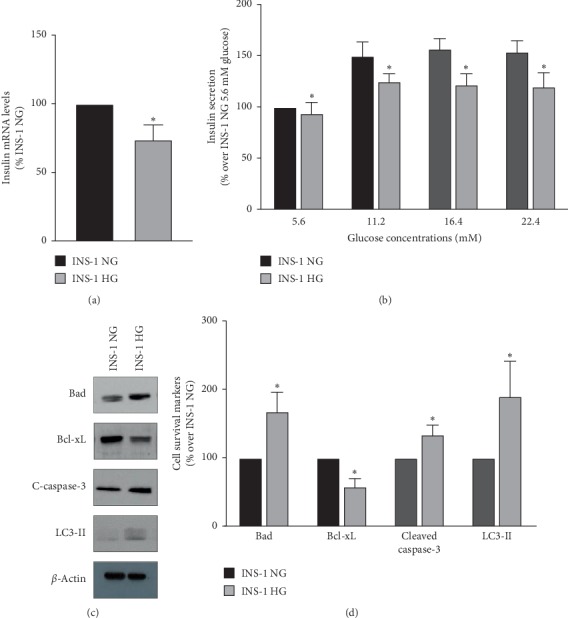
Currently available antidiabetic treatments fail to halt, and may even exacerbate, pancreatic -cell exhaustion, a key feature of type 2 diabetes pathogenesis; thus, strategies to prevent, or reverse, -cell failure should be actively sought. The serine threonine kinase Akt has a key role in the regulation of -cell homeostasis; among Akt modulators, a central role is played by pleckstrin homology domain leucine-rich repeat protein phosphatase (PHLPP) family. Here, taking advantage of an in vitro model of chronic exposure to high glucose, we demonstrated that PHLPPs, particularly the second family member called PHLPP2, are implicated in the ability of pancreatic cells to deal with glucose toxicity. We observed that INS-1 rat pancreatic cell line maintained for 12-15 passages at high (30 mM) glucose concentrations (INS-1 HG) showed increased expression of PHLPP2 and PHLPP1 both at mRNA and protein level as compared to INS-1 maintained for the same number of passages in the presence of normal glucose levels (INS-1 NG). These changes were paralleled by decreased phosphorylation of Akt and by increased expression of apoptotic and autophagic markers. To investigate if PHLPPs had a casual role in the alteration of INS-1 homeostasis observed upon chronic exposure to high glucose concentrations, we took advantage of shRNA technology to specifically knock-down PHLPPs. We obtained proof-of-concept evidence that modulating PHLPPs expression may help to restore a healthy cell mass, as the reduced expression of PHLPP2/1 was accompanied by a recovered balance between pro- and antiapoptotic factor levels. In conclusion, our data provide initial support for future studies aimed to identify pharmacological PHLPPs modulator to treat beta-cell survival impairment. They also contribute to shed some light on -cell dysfunction, a complex and unsatisfactorily characterized phenomenon that has a central causative role in the pathogenesis of type 2 diabetes.
目前可用的抗糖尿病治疗方法无法阻止甚至可能加剧胰腺β细胞耗竭,这是2型糖尿病发病机制的一个关键特征;因此,应积极寻求预防或逆转β细胞功能衰竭的策略。丝氨酸苏氨酸激酶Akt在β细胞内稳态调节中起关键作用;在Akt调节剂中,富含亮氨酸重复序列的pleckstrin同源结构域蛋白磷酸酶(PHLPP)家族发挥着核心作用。在此,利用慢性高糖暴露的体外模型,我们证明了PHLPPs,特别是第二个家族成员PHLPP2,与胰腺β细胞应对葡萄糖毒性的能力有关。我们观察到,在高(30 mM)葡萄糖浓度下维持传代12 - 15次的INS-1大鼠胰腺β细胞系(INS-1 HG)与在正常葡萄糖水平下维持相同传代次数的INS-1(INS-1 NG)相比,在mRNA和蛋白质水平上PHLPP2和PHLPP1的表达均增加。这些变化伴随着Akt磷酸化的减少以及凋亡和自噬标志物表达的增加。为了研究PHLPPs在慢性高糖暴露后观察到的INS-1内稳态改变中是否具有因果作用,我们利用短发夹RNA(shRNA)技术特异性敲低PHLPPs。我们获得了概念验证证据,即调节PHLPPs表达可能有助于恢复健康的β细胞群,因为PHLPP2/1表达的降低伴随着促凋亡和抗凋亡因子水平之间恢复平衡。总之,我们的数据为未来旨在鉴定治疗β细胞存活受损的药理学PHLPPs调节剂的研究提供了初步支持。它们也有助于阐明β细胞功能障碍,这是一种复杂且特征描述不充分的现象,在2型糖尿病发病机制中具有核心致病作用。