Department of Environmental Toxicology, University of California, Davis, CA, 95616, USA.
Public Health Institute, Berkeley, CA, 94709, USA.
Int J Obes (Lond). 2020 Aug;44(8):1723-1732. doi: 10.1038/s41366-020-0586-7. Epub 2020 May 15.
Obesity is a malnourishment epidemic worldwide. A meta-analysis of prospective human studies across the world demonstrated a consistent positive association between maternal exposure to the pesticide dichlorodiphenyltrichloroethane (DDT) and its metabolite dichlorodiphenyldichloroethylene (DDE) and children with obesity. The present study evaluates the association of maternal exposure to DDT and DDE with the risk of obesity in daughters during their mid-life in a prospective birth cohort with up to 53 years of follow-up.
Gravidas' blood was collected during their 1959-1967 enrollment into the prospective Child Health and Development Studies birth cohort in California. Their daughters aged 44-53 years had their height, weight, and waist circumference measured during a home visit to evaluate associations of daughters' adiposity and relative risk of overweight and obesity with their mothers' prenatal serum levels of DDT and DDE quantified by gas chromatograph-tandem mass spectrometer (n = 511).
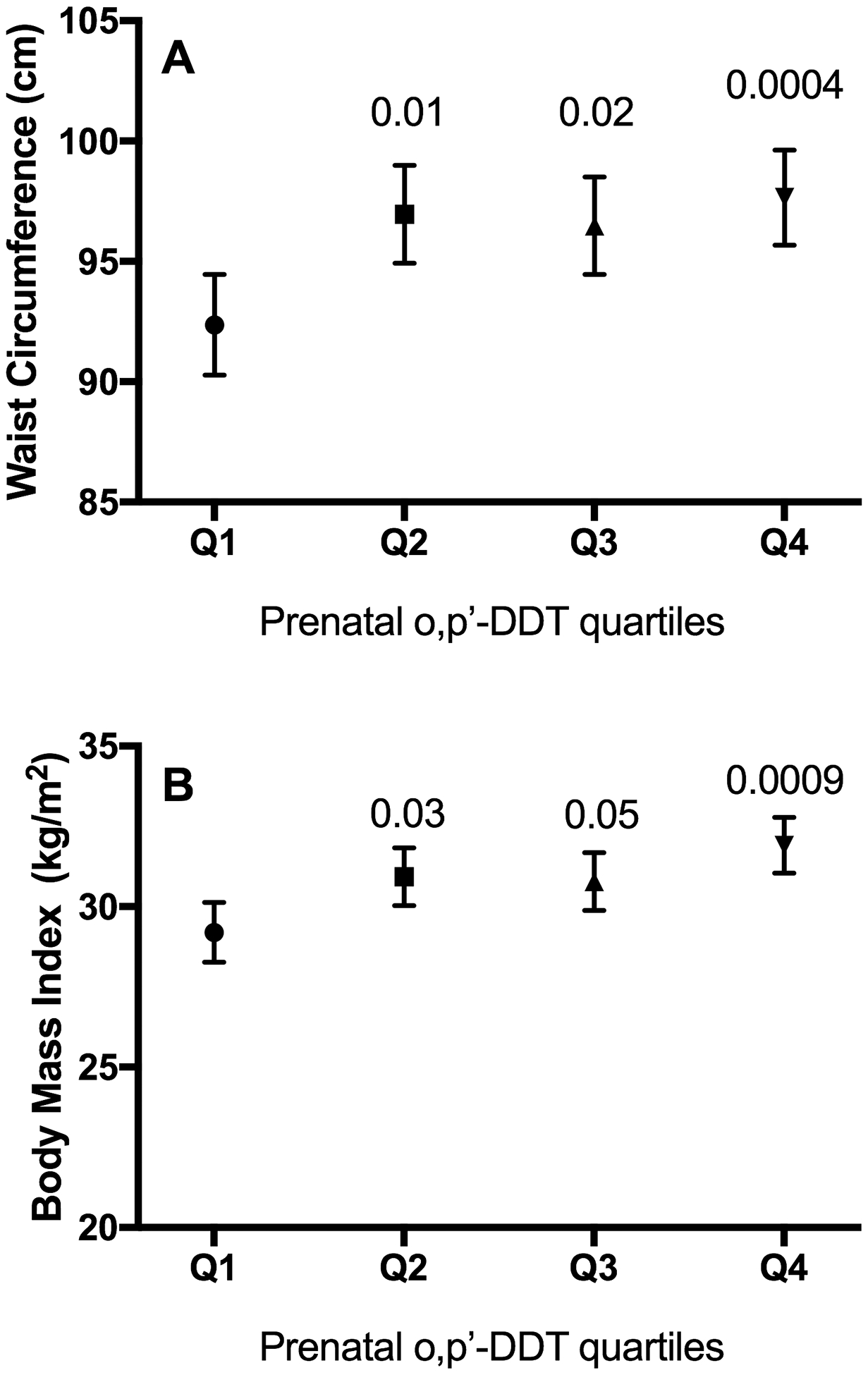
Maternal o,p'-DDT was positively associated with body mass index (β = 0.59 kg/m per ln ng/ml (95th percentile confidence interval, 95% CI: 0.17, 1.00)) and waist circumference (β = 1.19 cm per ln ng/ml (95% CI: 0.26, 2.13)) in multivariable models. Maternal o,p'-DDT was positively associated with a 26% (95% CI: 6-49) to 31% (95% CI: 6-62) higher risk of overweight and the same magnitude of additional risk for obesity, based on waist circumference and BMI definitions respectively, in multivariable models.
These data indicate maternal DDT exposure is significantly associated with increased obesity risk among middle-aged women independent of the obesity definition, confounding, and obesity risk factors. Our findings suggest that policies supporting the use of DDT for malaria vector abatement need to consider the obesity risk as a health cost when weighing the benefits of using DDT in malaria vector control.
肥胖是全球范围内的一种营养不良流行病。一项对全球前瞻性人类研究的荟萃分析表明,母体暴露于杀虫剂滴滴涕(DDT)及其代谢物二氯二苯二氯乙烯(DDE)与肥胖儿童之间存在一致的正相关关系。本研究评估了在加利福尼亚州前瞻性儿童健康与发育研究出生队列中,孕妇接触 DDT 和 DDE 与女儿中年肥胖风险的关系,该队列的随访时间长达 53 年。
在加利福尼亚州参加前瞻性儿童健康与发育研究出生队列的孕妇于 1959-1967 年期间采集血液。她们的女儿在 44-53 岁时进行家访,测量身高、体重和腰围,以评估女儿的肥胖情况,并通过气相色谱-串联质谱(GC-MS/MS)定量分析母亲产前血清中 DDT 和 DDE 水平与女儿超重和肥胖的相对风险(n=511)。
多变量模型分析显示,母体 o,p'-DDT 与体重指数(β=0.59kg/m/lnng/ml(95%置信区间,95%CI:0.17,1.00))和腰围(β=1.19cm/lnng/ml(95%CI:0.26,2.13))呈正相关。多变量模型分析显示,基于体重指数和腰围定义,母体 o,p'-DDT 与超重风险增加 26%(95%CI:6-49)至 31%(95%CI:6-62)相关,肥胖风险也呈相同幅度增加。
这些数据表明,母体 DDT 暴露与中年女性肥胖风险显著相关,与肥胖定义、混杂因素和肥胖危险因素无关。我们的研究结果表明,在权衡使用 DDT 控制疟疾媒介的益处时,支持使用 DDT 消灭疟疾媒介的政策需要考虑肥胖风险作为一种健康成本。