Center for Reproductive Medicine, Amsterdam Reproduction and Development, Amsterdam UMC, University of Amsterdam, Amsterdam, The Netherlands.
Department of Animal Sciences, Human and Animal Physiology, Wageningen University, Wageningen, The Netherlands.
Andrology. 2020 Sep;8(5):1265-1276. doi: 10.1111/andr.12817. Epub 2020 Jun 1.
Origin of human adult Leydig cells (ALCs) is not well understood. This might be partly due to limited data available on the identification and location of human precursor and stem Leydig cells (SLCs) which hampers the study on the development of ALCs.
The aim of the present study was to investigate whether described human (PDGFRα, NGFR) and rodent (NES, PDGFRα, THY1, NR2F2) SLC markers are expressed by a common cell population within human adult testicular interstitial cells in vivo and before and after in vitro propagation.
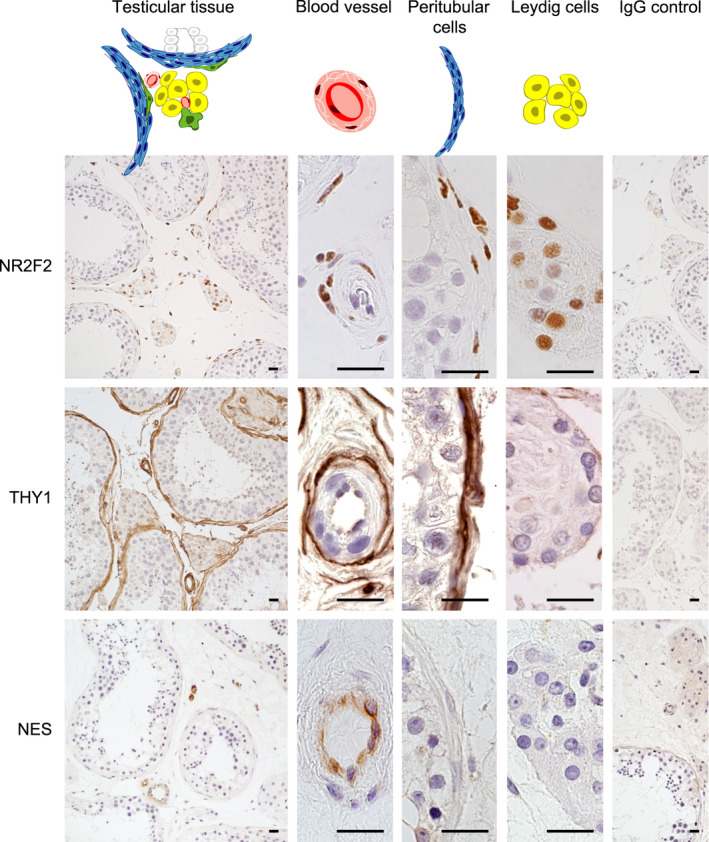
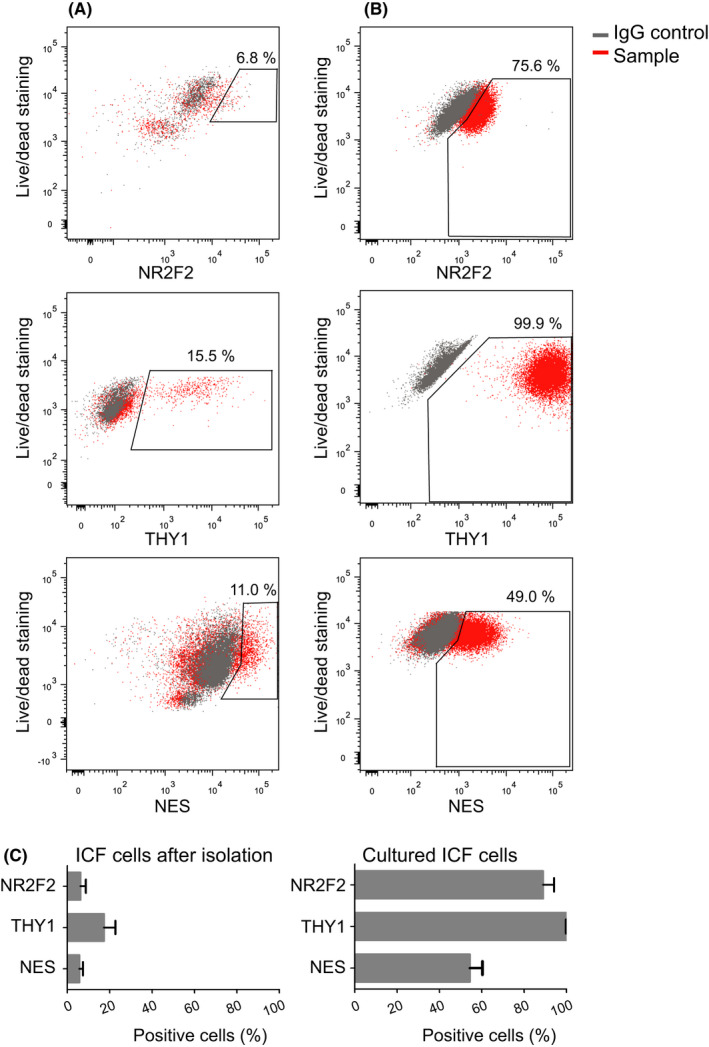
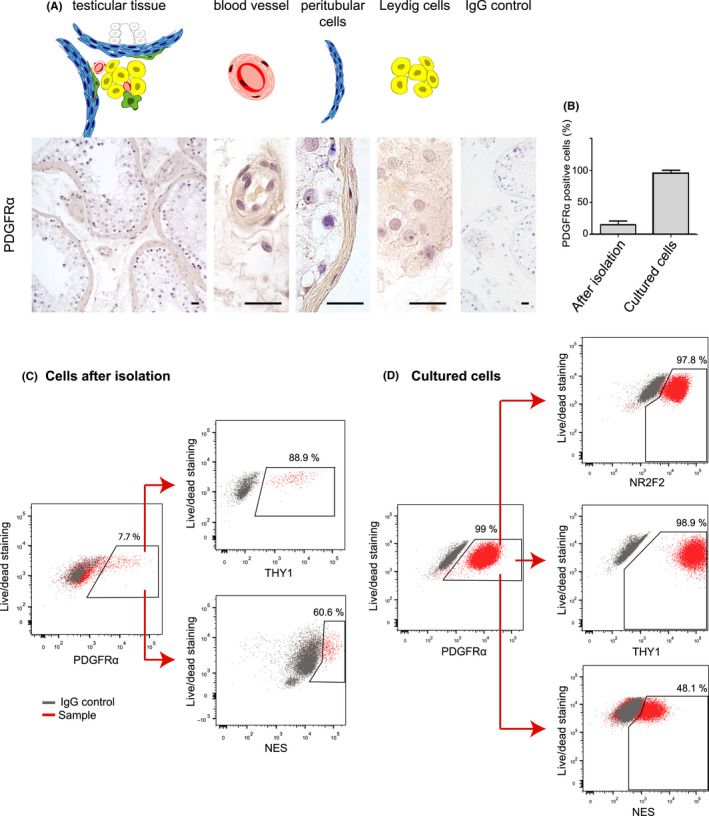
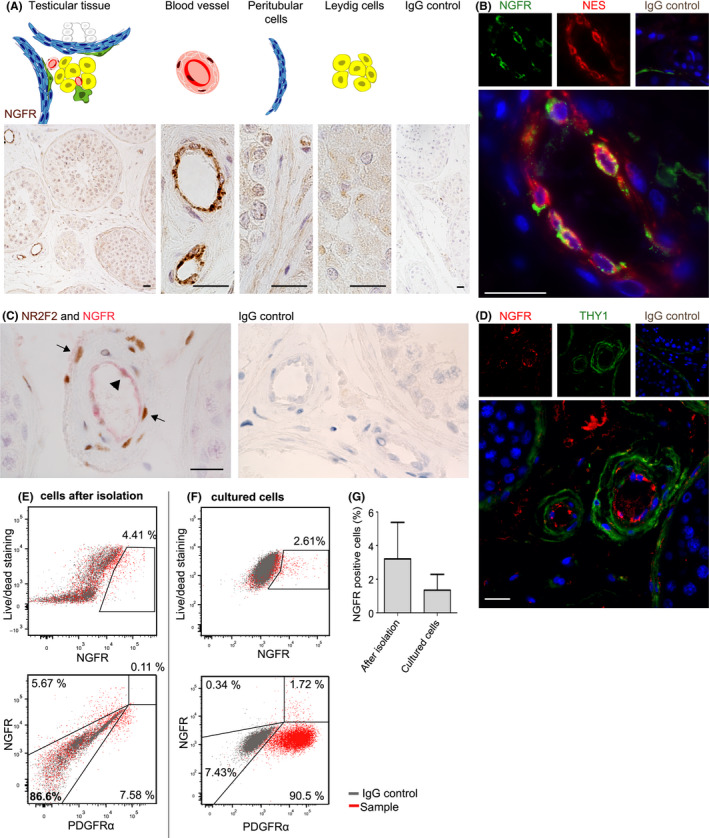
Immunohistochemical analyses were used to identify localization of human adult testicular interstitial cells expressing described SLC markers. Next, interstitial cells were isolated and cultured. The percentage of cells expressing one or more SLC markers was determined before and after culture using flow cytometry.
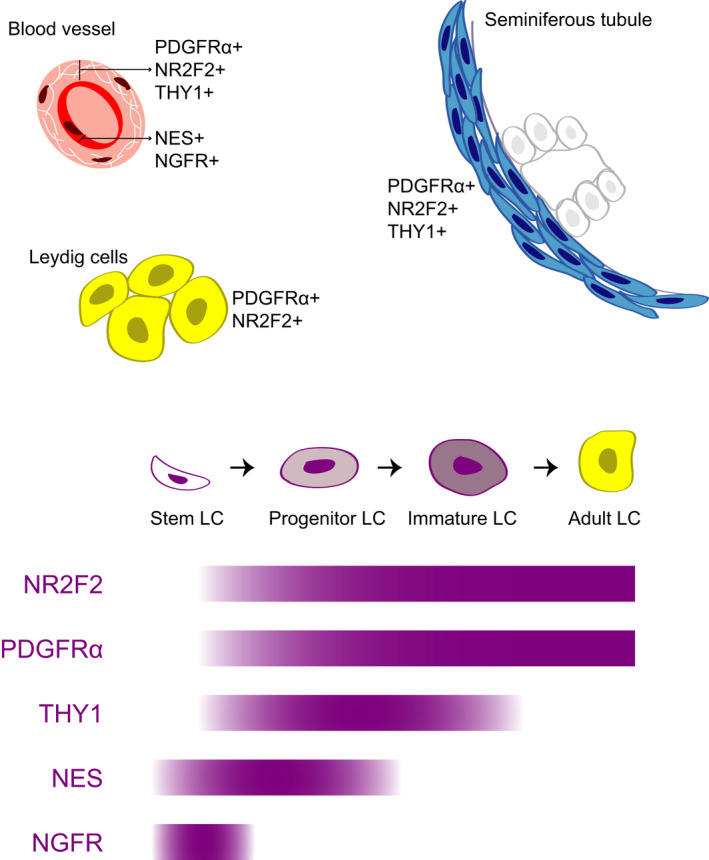
NR2F2 and PDGFRα were present in peritubular, perivascular, and Leydig cells, while THY1 was expressed in peritubular and perivascular cells. Although NES and NGFR were expressed in endothelial cells, co-localization with PDGFRα was found for both in vitro, although for NGFR only after culture. All marker positive cells were able to undergo propagation in vitro.
The partly overlap in localization and overlap in expression in human testicular cells indicate that PDGFRα, NR2F2, and THY1 are expressed within the same ALC developmental lineage from SLCs. Based on the in vitro results, this is also true for NES and after in vitro propagation for NGFR.
Our results that earlier described SLC markers are expressed in overlapping human interstitial cell population opens up further research strategies aiming for a better insight in the Leydig cell lineage and will be helpful for development of strategies to cure ALC dysfunction.
人类成年莱迪希细胞(ALC)的起源尚不清楚。这可能部分归因于目前关于人类前体和干细胞莱迪希细胞(SLC)的鉴定和定位的可用数据有限,这阻碍了对 ALC 发育的研究。
本研究旨在探讨已描述的人类(PDGFRα、NGFR)和啮齿动物(NES、PDGFRα、THY1、NR2F2)SLC 标志物是否在体内和体外增殖前后表达于人类成年睾丸间质细胞中的共同细胞群。
免疫组织化学分析用于鉴定表达已描述的 SLC 标志物的人类成年睾丸间质细胞的定位。然后,分离和培养间质细胞。使用流式细胞术在培养前后确定表达一种或多种 SLC 标志物的细胞的百分比。
NR2F2 和 PDGFRα 存在于小管周围、血管周围和莱迪希细胞中,而 THY1 则存在于小管周围和血管周围细胞中。尽管 NES 和 NGFR 存在于内皮细胞中,但在体外发现两者与 PDGFRα 共表达,尽管 NGFR 仅在培养后才表达。所有标记阳性细胞均能够在体外增殖。
在人类睾丸细胞中的定位部分重叠和表达重叠表明,PDGFRα、NR2F2 和 THY1 是在 SLC 内的相同 ALC 发育谱系中表达的。基于体外结果,这对于 NES 也是如此,并且对于体外培养后的 NGFR 也是如此。
我们的结果表明,先前描述的 SLC 标志物在重叠的人类间质细胞群中表达,这为进一步研究莱迪希细胞谱系提供了更多的研究策略,并有助于开发治疗 ALC 功能障碍的策略。