Department of Neurology, Stroke Center, Neuroscience Center, The First Hospital of Jilin University, Chang Chun, Jilin, China.
Department of Neurology, Clinical Trail and Research Center for Stroke, The First Hospital of Jilin University, Chang Chun, Jilin, China.
Curr Neurovasc Res. 2020;17(4):411-419. doi: 10.2174/1567202617666200517111802.
Platelet-to-neutrophil ratio (PNR) was suggested to be an independent protective predictor for 90-days outcomes in acute ischemic stroke (AIS) patients in previous studies. This study aims to investigate the association between PNR and outcomes of AIS in intravenous thrombolysis (IVT) group.
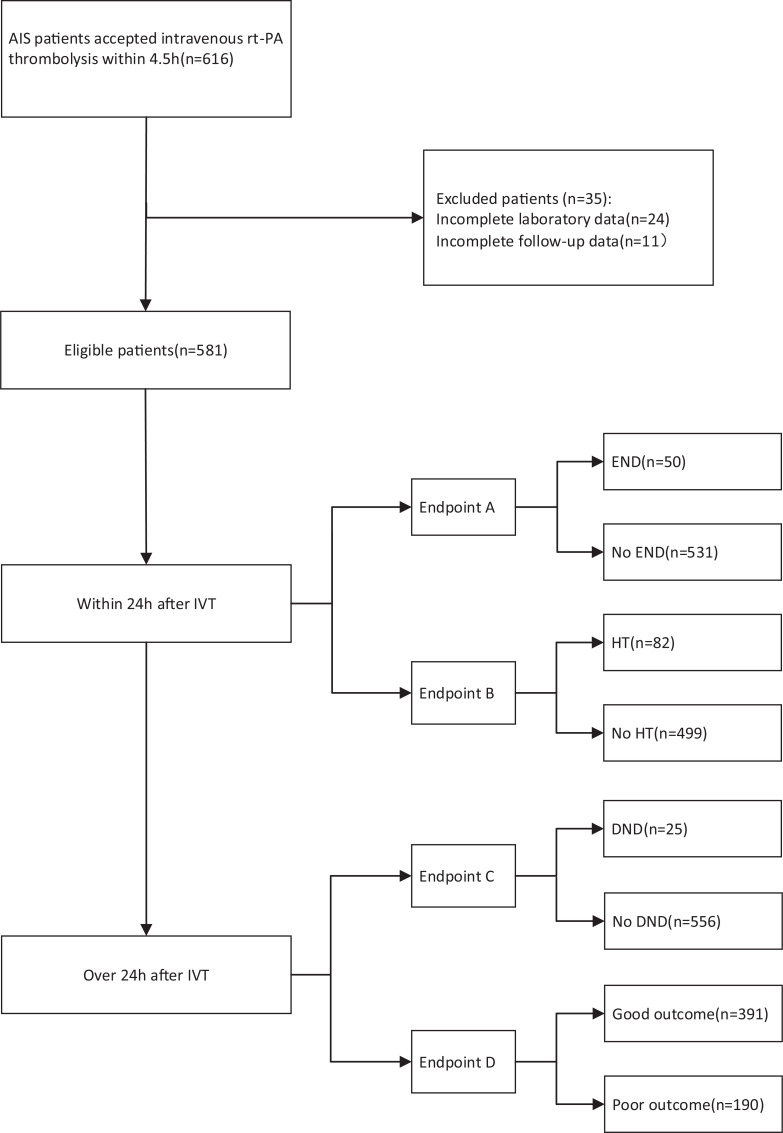
Data on acute ischemic stroke patients who received intravenous thrombolysis from April 2015 to March 2019 were collected. We defined the PNR value at admission as pre-IVT PNR and after IVT within 24 h was defined as post-IVT PNR. Clinical outcome indicators included early neurological deterioration (END), hemorrhagic transformation (HT), delayed neurological deterioration (DND), and poor 3-month outcome (3m-mRS >2).
A total of 581 patients were enrolled in the final analysis. The age was 61(53-69) years, and 423(72.8%) were males. Post-IVT PNR was independently associated with hemorrhagic transformation (OR = 0.974; 95%CI = 0.956-0.992; P=0.006), early neurological deterioration (OR = 0.939; 95%CI = 0.913-0.966; P = 0.01), delayed neurological deterioration (OR = 0.949; 95%CI = 0.912- 0.988; P = 0.011), and poor outcome (OR = 0.962; 95%CI = 0.948-0.976; P<0.001). PNR level was identified as high (at the cut-off value or above) or low (below the cut-off value) according to receiver operating curve (ROC) analyses on each endpoint. Comparison of early neurological deterioration, hemorrhagic transformation, delayed neurological deterioration, and poor 3-month outcome (3m-mRS >2) between patients at high and low levels for platelet-to-neutrophil ratio (PNR) showed statistical differences (p<0.001).
Post-IVT PNR was independently associated with early neurological deterioration, hemorrhagic transformation, delayed neurological deterioration, and poor 3-month outcome. Lower PNR can predict a worse outcome.
血小板与中性粒细胞比值(PNR)在既往研究中被认为是急性缺血性脑卒中(AIS)患者 90 天结局的独立保护预测因子。本研究旨在探讨 PNR 与 AIS 患者静脉溶栓(IVT)后结局的相关性。
收集 2015 年 4 月至 2019 年 3 月接受静脉溶栓的急性缺血性脑卒中患者的数据。我们将入院时的 PNR 值定义为溶栓前 PNR,将溶栓后 24 小时内的 PNR 值定义为溶栓后 PNR。临床结局指标包括早期神经功能恶化(END)、出血性转化(HT)、迟发性神经功能恶化(DND)和 3 个月预后不良(3m-mRS >2)。
共纳入 581 例患者进行最终分析。患者年龄为 61(53-69)岁,423 例(72.8%)为男性。溶栓后 PNR 与出血性转化(OR=0.974;95%CI=0.956-0.992;P=0.006)、早期神经功能恶化(OR=0.939;95%CI=0.913-0.966;P=0.01)、迟发性神经功能恶化(OR=0.949;95%CI=0.912-0.988;P=0.011)和预后不良(OR=0.962;95%CI=0.948-0.976;P<0.001)独立相关。根据每个终点的接收者操作特征曲线(ROC)分析,将 PNR 水平定义为高(在截值或以上)或低(低于截值)。比较高和低血小板与中性粒细胞比值(PNR)水平患者之间的早期神经功能恶化、出血性转化、迟发性神经功能恶化和 3 个月预后不良(3m-mRS >2),差异有统计学意义(p<0.001)。
溶栓后 PNR 与早期神经功能恶化、出血性转化、迟发性神经功能恶化和 3 个月预后不良独立相关。较低的 PNR 可预测更差的结局。