Hôpital Saint-Antoine, Service d'Hématologie Clinique et de Thérapie Cellulaire, Sorbonne University, Paris, France.
Center for Hematology and Oncology, Agaplesion Bethanien Hospital, Frankfurt am Main, Germany.
Eur J Haematol. 2020 Sep;105(3):308-325. doi: 10.1111/ejh.13439. Epub 2020 Jun 9.
The treatment paradigm in newly diagnosed multiple myeloma (NDMM) is evolving toward individualized, risk-directed, and longer duration of therapy (DOT). The objective of this study was to describe treatment patterns and outcomes in non-transplant NDMM in four European countries.
This retrospective chart review included adults with NDMM diagnosed between January 1, 2012, and December 31, 2013 (early cohort), or April 1, 2016, and March 31, 2017 (recent cohort).
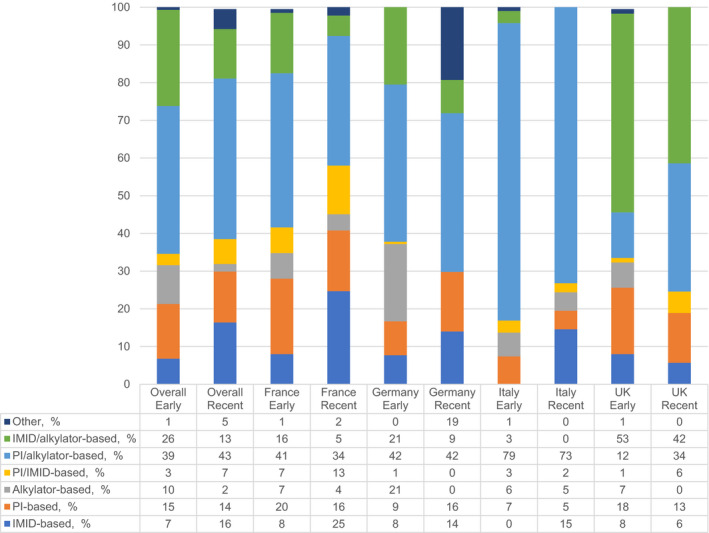
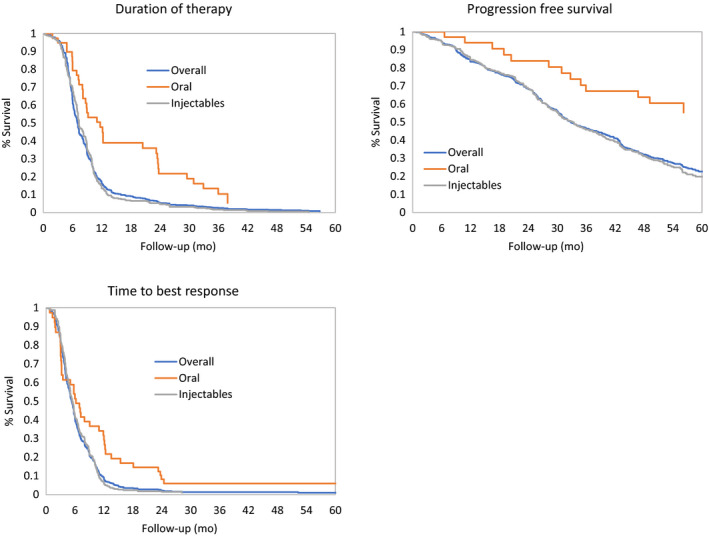
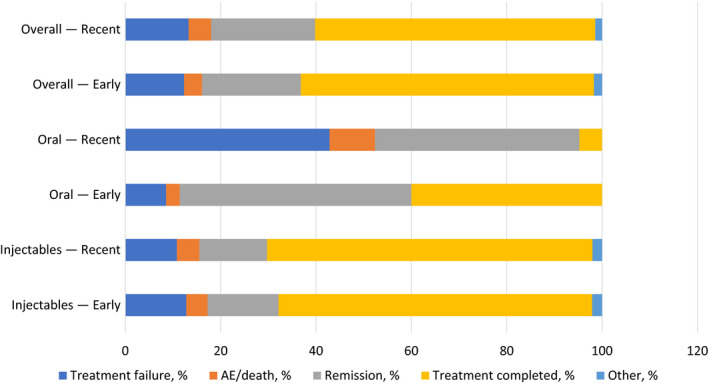
Among 836 patients, molecular testing was performed in 21% and 35% patients of early vs recent cohorts; proteasome inhibitor (PI)/alkylator combinations were the principal first-line (1 L) therapy (39% vs 43%). Use of immunomodulatory drug (IMID)/alkylator combinations declined from early to recent cohort (26% vs 13%) but IMID (7% vs 16%) use increased. Few patients (5%) received 1 L maintenance therapy. Two-thirds of patients were treated with a fixed duration intent, with a median 7-month 1 L DOT and progression-free survival (PFS) of 32.8 months in the early cohort. Both 1 L DOT and PFS were longer with oral compared to injectable regimens.
Although frontline treatment patterns changed significantly, 1 L DOT is short. The uptake of molecular testing and 1 L maintenance is low. These results highlight areas of unmet need in NDMM.
新诊断多发性骨髓瘤(NDMM)的治疗模式正在向个体化、风险导向和延长治疗时间(DOT)的方向发展。本研究的目的是描述四个欧洲国家非移植性 NDMM 的治疗模式和结局。
本回顾性病历研究纳入了 2012 年 1 月 1 日至 2013 年 12 月 31 日(早期队列)或 2016 年 4 月 1 日至 2017 年 3 月 31 日(近期队列)诊断为 NDMM 的成年患者。
在 836 例患者中,早期和近期队列分别有 21%和 35%的患者进行了分子检测;蛋白酶体抑制剂(PI)/烷化剂联合是主要的一线(1L)治疗(39%比 43%)。免疫调节剂(IMID)/烷化剂联合的使用从早期队列下降到近期队列(26%比 13%),但 IMID 的使用增加(7%比 16%)。只有少数患者(5%)接受了 1L 维持治疗。三分之二的患者接受了固定疗程治疗,早期队列的 1L DOT 中位数为 7 个月,无进展生存期(PFS)为 32.8 个月。与注射剂方案相比,口服方案的 1L DOT 和 PFS 均更长。
尽管一线治疗模式发生了重大变化,但 1L DOT 仍较短。分子检测和 1L 维持治疗的采用率较低。这些结果突出了 NDMM 中存在的未满足的需求领域。