• 文献检索
  • 文档翻译
  • 深度研究
  • 学术资讯
  • Suppr Zotero 插件Zotero 插件
  • 邀请有礼
  • 套餐&价格
  • 历史记录
应用&插件
Suppr Zotero 插件Zotero 插件浏览器插件Mac 客户端Windows 客户端微信小程序
定价
高级版会员购买积分包购买API积分包
服务
文献检索文档翻译深度研究API 文档MCP 服务
关于我们
关于 Suppr公司介绍联系我们用户协议隐私条款
关注我们

Suppr 超能文献

核心技术专利:CN118964589B侵权必究
粤ICP备2023148730 号-1Suppr @ 2026

文献检索

告别复杂PubMed语法,用中文像聊天一样搜索,搜遍4000万医学文献。AI智能推荐,让科研检索更轻松。

立即免费搜索

文件翻译

保留排版,准确专业,支持PDF/Word/PPT等文件格式,支持 12+语言互译。

免费翻译文档

深度研究

AI帮你快速写综述,25分钟生成高质量综述,智能提取关键信息,辅助科研写作。

立即免费体验

东亚澳大拉西亚巨型动物群的灭绝与持续的环境恶化相一致。

Extinction of eastern Sahul megafauna coincides with sustained environmental deterioration.

机构信息

Geosciences, Queensland Museum, 122 Gerler Rd., Hendra, QLD, 4011, Australia.

School of BioSciences, Faculty of Science, University of Melbourne, Melbourne, VIC, 3010, Australia.

出版信息

Nat Commun. 2020 May 18;11(1):2250. doi: 10.1038/s41467-020-15785-w.

DOI:10.1038/s41467-020-15785-w
PMID:32418985
原文链接:https://pmc.ncbi.nlm.nih.gov/articles/PMC7231803/
Abstract

Explanations for the Upper Pleistocene extinction of megafauna from Sahul (Australia and New Guinea) remain unresolved. Extinction hypotheses have advanced climate or human-driven scenarios, in spite of over three quarters of Sahul lacking reliable biogeographic or chronologic data. Here we present new megafauna from north-eastern Australia that suffered extinction sometime after 40,100 (±1700) years ago. Megafauna fossils preserved alongside leaves, seeds, pollen and insects, indicate a sclerophyllous forest with heathy understorey that was home to aquatic and terrestrial carnivorous reptiles and megaherbivores, including the world's largest kangaroo. Megafauna species diversity is greater compared to southern sites of similar age, which is contrary to expectations if extinctions followed proposed migration routes for people across Sahul. Our results do not support rapid or synchronous human-mediated continental-wide extinction, or the proposed timing of peak extinction events. Instead, megafauna extinctions coincide with regionally staggered spatio-temporal deterioration in hydroclimate coupled with sustained environmental change.

摘要

对于来自萨赫尔(澳大利亚和新几内亚)的上新世巨型动物灭绝的解释仍然没有定论。尽管萨赫尔超过四分之三的地区缺乏可靠的生物地理或年代数据,但灭绝假说还是提出了气候或人类驱动的情景。在这里,我们展示了来自澳大利亚东北部的新巨型动物化石,这些化石在 40100(±1700)年前的某个时间灭绝。与叶子、种子、花粉和昆虫一起保存的巨型动物化石表明,这里曾经存在一种硬叶森林,林下有茂密的灌丛,是水生和陆生食肉爬行动物以及巨型食草动物的家园,其中包括世界上最大的袋鼠。与年龄相似的南部地区相比,巨型动物的物种多样性更大,如果灭绝是按照人类在萨赫尔大陆上的迁徙路线进行的,这与预期不符。我们的结果不支持快速或同步的人类介导的大陆范围灭绝,也不支持提出的灭绝事件峰值的时间。相反,巨型动物的灭绝与区域上错开的水文气候恶化以及持续的环境变化同时发生。
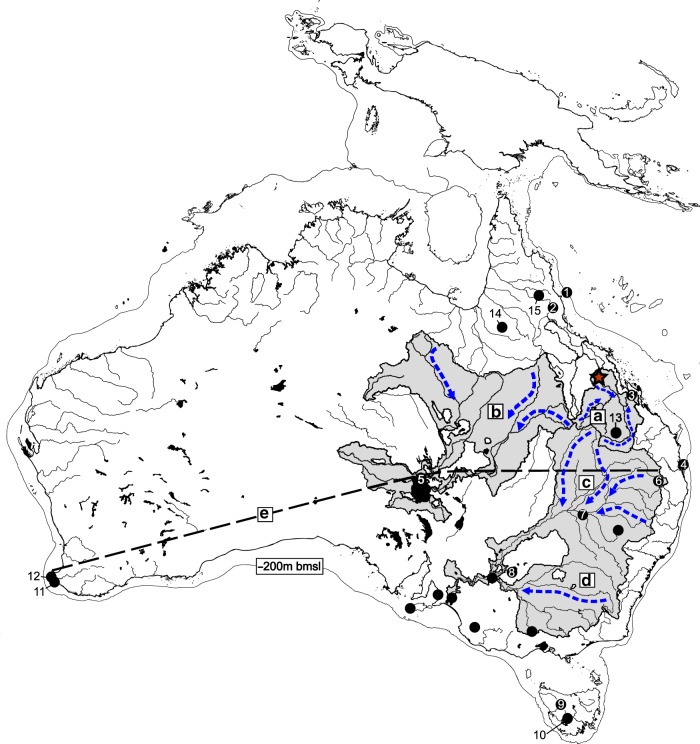
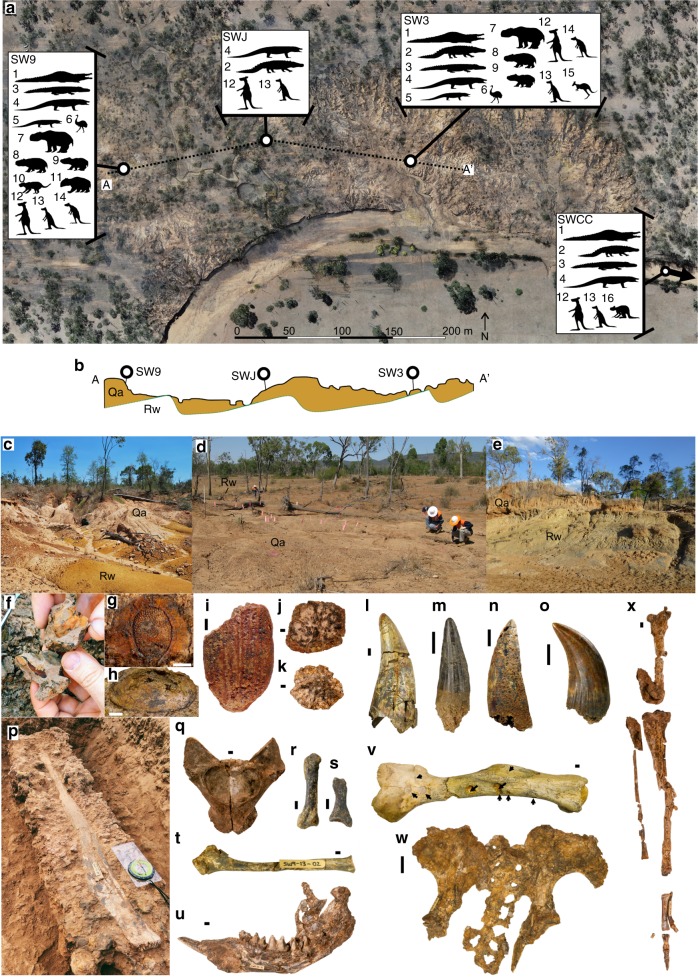
https://cdn.ncbi.nlm.nih.gov/pmc/blobs/c7ef/7231803/abed03afe12b/41467_2020_15785_Fig3_HTML.jpg
https://cdn.ncbi.nlm.nih.gov/pmc/blobs/c7ef/7231803/d75b04e5c269/41467_2020_15785_Fig1_HTML.jpg
https://cdn.ncbi.nlm.nih.gov/pmc/blobs/c7ef/7231803/ed4df6f09a77/41467_2020_15785_Fig2_HTML.jpg
https://cdn.ncbi.nlm.nih.gov/pmc/blobs/c7ef/7231803/abed03afe12b/41467_2020_15785_Fig3_HTML.jpg
https://cdn.ncbi.nlm.nih.gov/pmc/blobs/c7ef/7231803/d75b04e5c269/41467_2020_15785_Fig1_HTML.jpg
https://cdn.ncbi.nlm.nih.gov/pmc/blobs/c7ef/7231803/ed4df6f09a77/41467_2020_15785_Fig2_HTML.jpg
https://cdn.ncbi.nlm.nih.gov/pmc/blobs/c7ef/7231803/abed03afe12b/41467_2020_15785_Fig3_HTML.jpg

相似文献

1
Extinction of eastern Sahul megafauna coincides with sustained environmental deterioration.东亚澳大拉西亚巨型动物群的灭绝与持续的环境恶化相一致。
Nat Commun. 2020 May 18;11(1):2250. doi: 10.1038/s41467-020-15785-w.
2
Climate change frames debate over the extinction of megafauna in Sahul (Pleistocene Australia-New Guinea).气候变化引发了有关萨赫尔地区(更新世澳大利亚-新几内亚)巨型动物灭绝的争论。
Proc Natl Acad Sci U S A. 2013 May 28;110(22):8777-81. doi: 10.1073/pnas.1302698110. Epub 2013 May 6.
3
Climate change not to blame for late Quaternary megafauna extinctions in Australia.气候变化并非澳大利亚第四纪晚期巨型动物灭绝的原因。
Nat Commun. 2016 Jan 29;7:10511. doi: 10.1038/ncomms10511.
4
What caused extinction of the Pleistocene megafauna of Sahul?是什么导致了萨胡尔更新世巨型动物的灭绝?
Proc Biol Sci. 2016 Feb 10;283(1824). doi: 10.1098/rspb.2015.2399.
5
Relative demographic susceptibility does not explain the extinction chronology of Sahul's megafauna.相对人口易感性并不能解释萨赫尔巨型动物群的灭绝时间顺序。
Elife. 2021 Mar 30;10:e63870. doi: 10.7554/eLife.63870.
6
New ages for the last Australian megafauna: continent-wide extinction about 46,000 years ago.澳大利亚最后一批巨型动物群的新时代:约46000年前在整个大陆灭绝。
Science. 2001 Jun 8;292(5523):1888-92. doi: 10.1126/science.1060264.
7
Climate-human interaction associated with southeast Australian megafauna extinction patterns.与东南澳大利亚巨型动物灭绝模式相关的气候-人类相互作用。
Nat Commun. 2019 Nov 22;10(1):5311. doi: 10.1038/s41467-019-13277-0.
8
Seasonal migration of marsupial megafauna in Pleistocene Sahul (Australia-New Guinea).更新世萨胡尔(澳大利亚-新几内亚)有袋类巨型动物的季节性迁徙。
Proc Biol Sci. 2017 Sep 27;284(1863). doi: 10.1098/rspb.2017.0785.
9
Population reconstructions for humans and megafauna suggest mixed causes for North American Pleistocene extinctions.人类和巨型动物群的种群重建表明,北美的更新世灭绝是多种原因造成的。
Nat Commun. 2018 Dec 21;9(1):5441. doi: 10.1038/s41467-018-07897-1.
10
Rapid range shifts and megafaunal extinctions associated with late Pleistocene climate change.快速的范围变化和巨型动物灭绝与晚更新世气候变化有关。
Nat Commun. 2020 Jun 2;11(1):2770. doi: 10.1038/s41467-020-16502-3.

引用本文的文献

1
Using sedimentary ancient DNA in coastal and marine contexts to explore past human-environmental interactions in Australia.利用沿海和海洋环境中的沉积古代DNA探索澳大利亚过去的人类与环境相互作用。
Philos Trans R Soc Lond B Biol Sci. 2025 Jul 10;380(1930):20240032. doi: 10.1098/rstb.2024.0032.
2
The late-Quaternary megafauna extinctions: Patterns, causes, ecological consequences and implications for ecosystem management in the Anthropocene.晚第四纪大型动物灭绝:模式、原因、生态后果及对人类世生态系统管理的启示
Camb Prism Extinct. 2024 Mar 22;2:e5. doi: 10.1017/ext.2024.4. eCollection 2024.
3
Thirty years of ancient DNA and the faunal biogeography of Aotearoa New Zealand: lessons and future directions.

本文引用的文献

1
When did first reach Southeast Asia and Sahul?它(古人类)何时首次到达东南亚和萨胡尔地区?
Proc Natl Acad Sci U S A. 2018 Aug 21;115(34):8482-8490. doi: 10.1073/pnas.1808385115. Epub 2018 Aug 6.
2
Big data little help in megafauna mysteries.大数据对巨型动物谜团帮助不大。
Nature. 2018 Jun;558(7708):23-25. doi: 10.1038/d41586-018-05330-7.
3
First evidence of an extensive Acheulean large cutting tool accumulation in Europe from Porto Maior (Galicia, Spain).首次在西班牙加利西亚省的波托马约尔发现了大量阿舍利大型石器的堆积。
三十年的古DNA研究与新西兰奥特亚罗瓦的动物生物地理学:经验教训与未来方向。
J R Soc N Z. 2022 Jun 30;54(1):75-97. doi: 10.1080/03036758.2022.2093227. eCollection 2024.
4
Genome of the endangered eastern quoll (Dasyurus viverrinus) reveals signatures of historical decline and pelage color evolution.濒危东部袋狼(Dasyurus viverrinus)的基因组揭示了历史衰退和皮毛颜色进化的特征。
Commun Biol. 2024 May 25;7(1):636. doi: 10.1038/s42003-024-06251-0.
5
Physiography, foraging mobility, and the first peopling of Sahul.自然地理、觅食流动性与萨胡尔的首批人类定居
Nat Commun. 2024 Apr 23;15(1):3430. doi: 10.1038/s41467-024-47662-1.
6
Reconstructing Pleistocene Australian herbivore megafauna diet using calcium and strontium isotopes.利用钙和锶同位素重建更新世澳大利亚食草动物巨型动物群的饮食。
R Soc Open Sci. 2023 Nov 22;10(11):230991. doi: 10.1098/rsos.230991. eCollection 2023 Nov.
7
Description of the Pliocene marsupial gen. nov. (Marsupialia: Diprotodontidae) from inland Australia and its locomotory adaptations.来自澳大利亚内陆的上新世有袋类新属(有袋目:双门齿科)描述及其运动适应性
R Soc Open Sci. 2023 May 31;10(5):230211. doi: 10.1098/rsos.230211. eCollection 2023 May.
8
Back to the future: The advantage of studying key events in human evolution using a new high resolution radiocarbon method.回到未来:利用新的高分辨率放射性碳测年方法研究人类进化关键事件的优势。
PLoS One. 2023 Feb 15;18(2):e0280598. doi: 10.1371/journal.pone.0280598. eCollection 2023.
9
Time-calibrated phylogeny and ecological niche models indicate Pliocene aridification drove intraspecific diversification of brushtail possums in Australia.时间校准的系统发育和生态位模型表明,上新世干旱化推动了澳大利亚帚尾袋貂的种内多样化。
Ecol Evol. 2022 Dec 15;12(12):e9633. doi: 10.1002/ece3.9633. eCollection 2022 Dec.
10
Ancient proteins resolve controversy over the identity of eggshell.古蛋白解决了蛋壳身份的争议。
Proc Natl Acad Sci U S A. 2022 Oct 25;119(43):e2109326119. doi: 10.1073/pnas.2109326119. Epub 2022 May 24.
Sci Rep. 2018 Feb 15;8(1):3082. doi: 10.1038/s41598-018-21320-1.
4
Human occupation of northern Australia by 65,000 years ago.6.5 万年前人类已在澳大利亚北部居住。
Nature. 2017 Jul 19;547(7663):306-310. doi: 10.1038/nature22968.
5
Aboriginal mitogenomes reveal 50,000 years of regionalism in Australia.原住民线粒体基因组揭示了澳大利亚 5 万年的地域主义。
Nature. 2017 Apr 13;544(7649):180-184. doi: 10.1038/nature21416. Epub 2017 Mar 8.
6
Humans rather than climate the primary cause of Pleistocene megafaunal extinction in Australia.人类而非气候是导致更新世澳大利亚巨型动物灭绝的主要原因。
Nat Commun. 2017 Jan 20;8:14142. doi: 10.1038/ncomms14142.
7
Cultural innovation and megafauna interaction in the early settlement of arid Australia.干旱澳大利亚早期定居点的文化创新与巨型动物群相互作用。
Nature. 2016 Nov 10;539(7628):280-283. doi: 10.1038/nature20125. Epub 2016 Nov 2.
8
Humans, water, and the colonization of Australia.人类、水与澳大利亚的殖民化
Proc Natl Acad Sci U S A. 2016 Oct 11;113(41):11477-11482. doi: 10.1073/pnas.1608470113. Epub 2016 Sep 26.
9
Estimating times of extinction in the fossil record.估算化石记录中的灭绝时间。
Biol Lett. 2016 Apr;12(4). doi: 10.1098/rsbl.2015.0989.
10
Human predation contributed to the extinction of the Australian megafaunal bird Genyornis newtoni ∼47 ka.人类的捕猎导致了澳大利亚巨型动物鸟类牛顿巨鸟在约4.7万年前灭绝。
Nat Commun. 2016 Jan 29;7:10496. doi: 10.1038/ncomms10496.