Squarre David, Hayashida Kyoko, Gaithuma Alex, Chambaro Herman, Kawai Naoko, Moonga Ladslav, Namangala Boniface, Sugimoto Chihiro, Yamagishi Junya
Research Center for Zoonosis Control, Hokkaido University, Kita-Ku, Sapporo, Hokkaido, 001-0020, Japan.
Wildlife Veterinary Unit, Department of National Parks and Wildlife, P/Bag 1, Chilanga, Zambia.
Int J Parasitol Parasites Wildl. 2020 Apr 23;12:34-41. doi: 10.1016/j.ijppaw.2020.04.005. eCollection 2020 Aug.
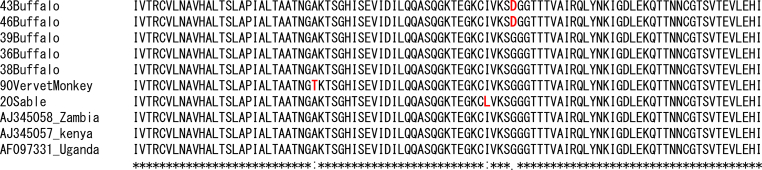
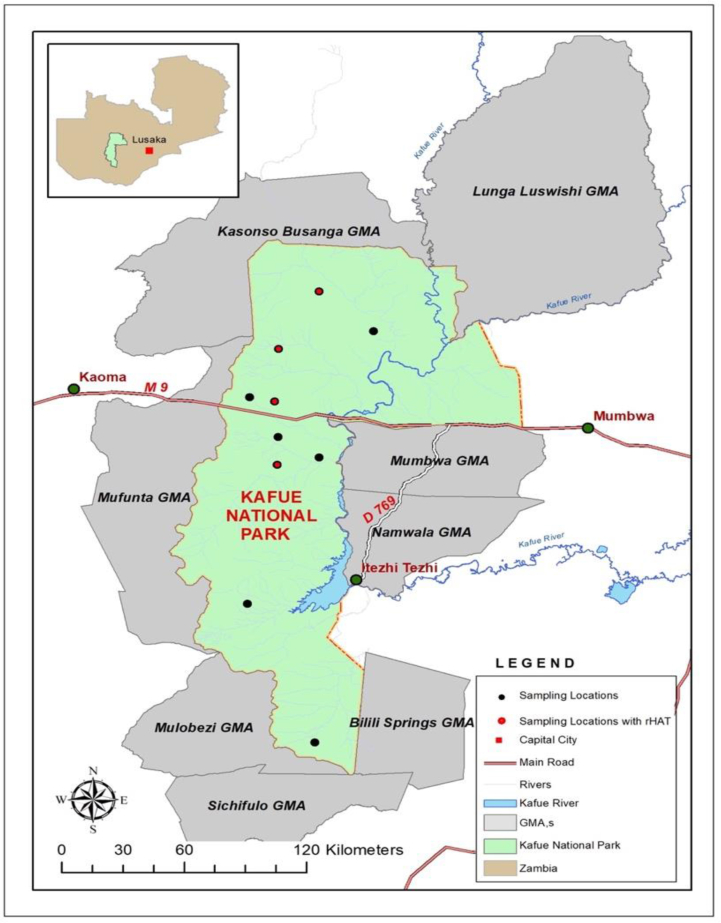
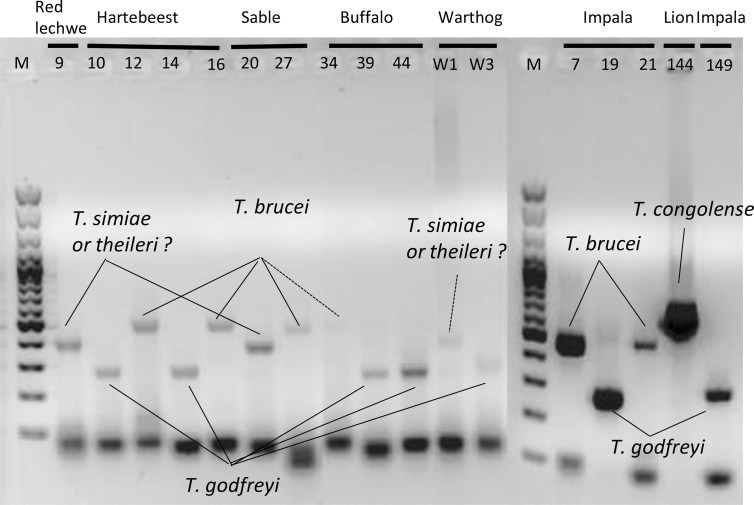
The Kafue ecosystem is a vast conservation protected area comprising the Kafue National Park (KNP) and the Game Management Areas (GMA) that act as a buffer around the national park. The KNP has been neglected as a potential foci for rhodesiense sleeping sickness despite the widespread presence of the tsetse vector and abundant wildlife reservoirs. The aim of this study was to generate information on circulating trypanosomes and their eminent threat/risk to public health and livestock production of a steadily growing human and livestock population surrounding the park. We detected various trypanosomes circulating in different mammalian wildlife species in KNP in Zambia by applying a high throughput ITS1-polymerase chain reaction (PCR)/nanopore sequencing method in combination with serum resistant associated-PCR/Sanger sequencing method. The prevalence rates of trypanosomes in hartebeest, sable antelope, buffalo, warthog, impala and lechwe were 6.4%, 37.2%, 13.2%, 11.8%, 2.8% and 11.1%, respectively. A total of six trypanosomes species or subspecies were detected in the wildlife examined, including , , , and . Importantly we detected human infective in buffalo and sable antelope with a prevalence of 9.4% and 12.5%, respectively. In addition, was found in the only vervet monkey analyzed. The study thus reaffirmed that the Kafue ecosystem is a genuine neglected and re-emerging foci for human African trypanosomiasis. This is the first assessment of the trypanosome diversity circulating in free-ranging wildlife of the KNP.
卡富埃生态系统是一个广阔的保护区域,由卡富埃国家公园(KNP)和作为国家公园周边缓冲区的野生动物管理区(GMA)组成。尽管采采蝇媒介广泛存在且野生动物宿主丰富,但卡富埃国家公园一直被忽视,未被视为罗德西亚昏睡病的潜在疫源地。本研究的目的是获取有关循环锥虫的信息,以及它们对公园周边不断增长的人类和牲畜群体的公共卫生和牲畜生产构成的重大威胁/风险。我们通过应用高通量ITS1聚合酶链反应(PCR)/纳米孔测序方法,并结合血清抗性相关PCR/桑格测序方法,检测了赞比亚卡富埃国家公园不同哺乳动物野生动物物种中循环的各种锥虫。在高角羚、貂羚、水牛、疣猪、黑斑羚和水羚中锥虫的感染率分别为6.4%、37.2%、13.2%、11.8% 和11.1%。在所检测的野生动物中总共检测到六种锥虫物种或亚种,包括 、 、 、 、 和 。重要的是,我们在水牛和貂羚中检测到了可感染人类的 ,感染率分别为9.4%和12.5%。此外,在唯一一只被分析的绿猴中发现了 。因此,该研究再次证实卡富埃生态系统是人类非洲锥虫病真正被忽视且重新出现的疫源地。这是对卡富埃国家公园自由放养野生动物中循环锥虫多样性的首次评估。