Vonk Sander J W, Fridriksson Magnus B, Hinterding Stijn O M, Mangnus Mark J J, van Swieten Thomas P, Grozema Ferdinand C, Rabouw Freddy T, van der Stam Ward
Debye Institute for Nanomaterials Science, Utrecht University, Princetonplein 1, 3584 CC Utrecht, The Netherlands.
Opto-Electronic Materials Section, Faculty of Applied Sciences, Delft University of Technology, van der Maasweg 9, 2629 HZ Delft, The Netherlands.
J Phys Chem C Nanomater Interfaces. 2020 Apr 9;124(14):8047-8054. doi: 10.1021/acs.jpcc.0c02287. Epub 2020 Mar 18.
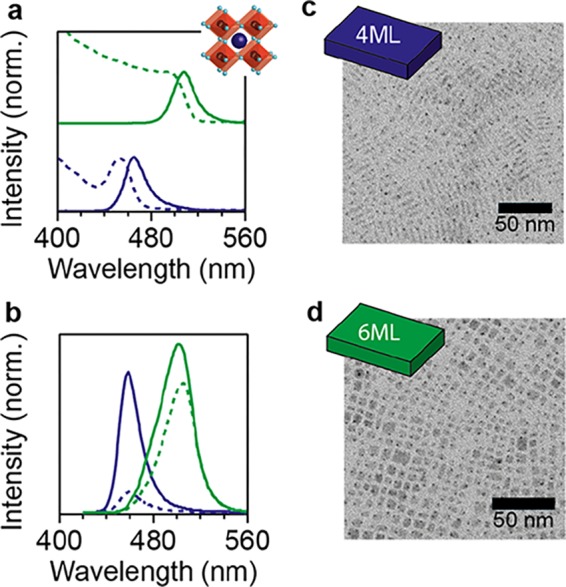
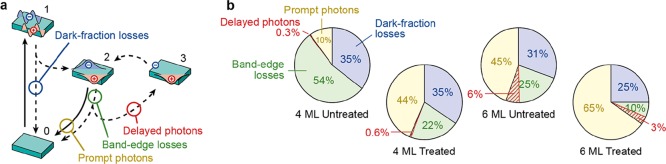
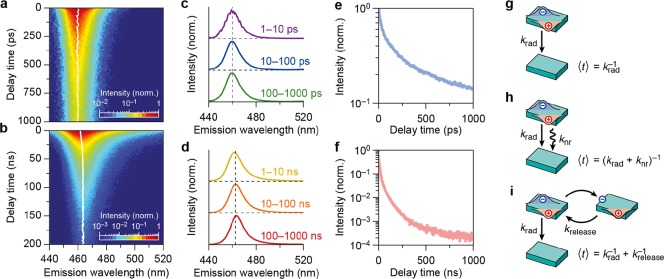
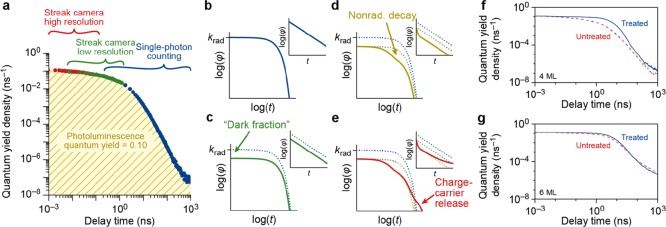
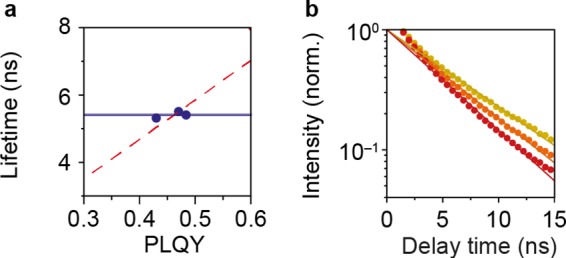
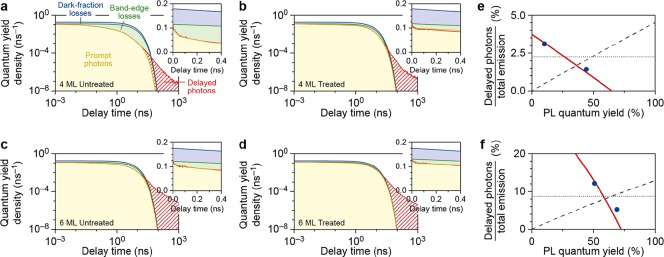
Metal-halide perovskite nanocrystals show promise as the future active material in photovoltaics, lighting, and other optoelectronic applications. The appeal of these materials is largely due to the robustness of the optoelectronic properties to structural defects. The photoluminescence quantum yield (PLQY) of most types of perovskite nanocrystals is nevertheless below unity, evidencing the existence of nonradiative charge-carrier decay channels. In this work, we experimentally elucidate the nonradiative pathways in CsPbBr nanoplatelets, before and after chemical treatment with PbBr that improves the PLQY. A combination of picosecond streak camera and nanosecond time-correlated single-photon counting measurements is used to probe the excited-state dynamics over 6 orders of magnitude in time. We find that up to 40% of the nanoplatelets from a synthesis batch are entirely nonfluorescent and cannot be turned fluorescent through chemical treatment. The other nanoplatelets show fluorescence, but charge-carrier trapping leads to losses that are prevented by chemical treatment. Interestingly, even without chemical treatment, some losses due to trapping are mitigated because trapped carriers spontaneously detrap on nanosecond-to-microsecond timescales. Our analysis shows that multiple nonradiative pathways are active in perovskite nanoplatelets, which are affected differently by chemical treatment with PbBr. More generally, our work highlights that in-depth studies using a combination of techniques are necessary to understand nonradiative pathways in fluorescent nanocrystals. Such understanding is essential to optimize synthesis and treatment procedures.
金属卤化物钙钛矿纳米晶体有望成为未来光伏、照明及其他光电子应用中的活性材料。这些材料的吸引力很大程度上源于其光电性质对结构缺陷的稳健性。然而,大多数类型的钙钛矿纳米晶体的光致发光量子产率(PLQY)仍低于1,这表明存在非辐射电荷载流子衰减通道。在这项工作中,我们通过实验阐明了用PbBr进行化学处理前后CsPbBr纳米片晶中的非辐射途径,该处理提高了PLQY。我们结合使用皮秒条纹相机和纳秒时间相关单光子计数测量来探测6个数量级时间范围内的激发态动力学。我们发现,一批合成的纳米片晶中高达40%完全不发荧光,且无法通过化学处理变为荧光状态。其他纳米片晶显示出荧光,但电荷载流子捕获会导致损失,而化学处理可防止这种损失。有趣的是,即使未经化学处理,一些由捕获导致的损失也会减轻,因为捕获的载流子会在纳秒到微秒的时间尺度上自发脱捕。我们的分析表明,多种非辐射途径在钙钛矿纳米片晶中起作用,它们受PbBr化学处理的影响各不相同。更普遍地说,我们的工作强调,使用多种技术进行深入研究对于理解荧光纳米晶体中的非辐射途径是必要的。这种理解对于优化合成和处理程序至关重要。