School of Tropical Medicine and Global Health, Nagasaki University, Nagasaki, Japan.
Department of Dermatology, National Center for Global Health and Medicine, Tokyo, Japan.
PLoS Negl Trop Dis. 2020 May 18;14(5):e0008291. doi: 10.1371/journal.pntd.0008291. eCollection 2020 May.
Skin-related neglected tropical diseases (skin NTDs) occur against a background of a very high prevalence of common skin diseases in sub-Saharan Africa. In this study, we examined the knowledge, attitude and practices (KAP) and the impact of common skin diseases in children living in a leprosy and Buruli ulcer (BU) co-endemic district in a west African country of Côte d'Ivoire, in order to help inform disease control efforts for skin NTDs.
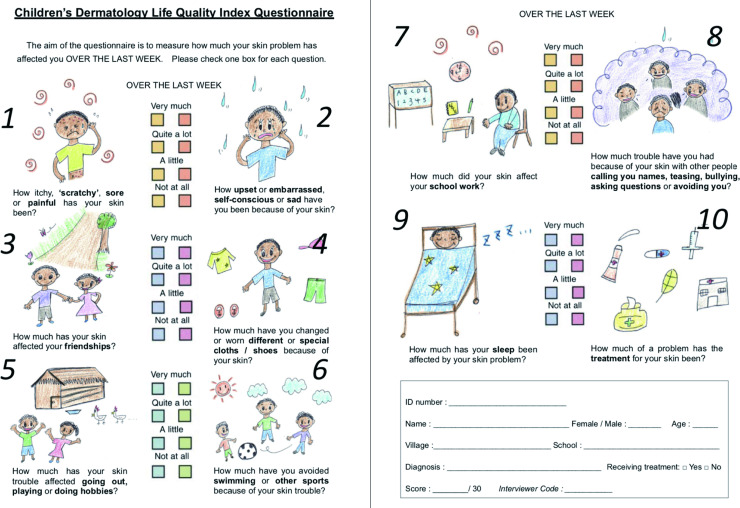
Fourteen focus group discussions (FGDs) with schoolchildren, 5 FGDs with parents of a child affected with skin disease(s), and 27 in-depth semi-structured interviews with key personnel were conducted. The Children's Dermatology Quality of Life Index (CDLQI) questionnaire was applied to 184 schoolchildren with skin diseases. We found that there was ignorance or neglect towards skin diseases in general, due to their high prevalence and also the perceived minimal impact on children's daily lives. While the median score for the CDLQI questionnaire was 5 (IQR 2-9) out of 30, a range of scores was observed. Symptoms such as pruritus and experiencing bullying by classmates contributed to reduction in their quality of life. Poor hygiene was considered as a major cause of skin diseases.
CONCLUSIONS/SIGNIFICANCE: Despite their high impact on affected populations, we observed a high level of ignorance and neglect toward common skin diseases. There is a critical need to increase awareness of skin diseases, or skin health promotion, which supports changing of the health-seeking behaviour for skin conditions. This will aid in early detection and treatment of the skin NTDs, in addition to providing benefits for those affected by other skin diseases. Educational opportunities should be utilized to their utmost. One would be associated with water, sanitation, and hygiene (WASH) strategies, but careful messages need to be developed and delivered.
撒哈拉以南非洲地区常见皮肤病的发病率极高,在此背景下出现了与皮肤有关的被忽视热带病(皮肤 NTD)。在这项研究中,我们检查了在科特迪瓦一个麻风病和布鲁里溃疡(BU)流行区生活的儿童的知识、态度和实践(KAP),以及常见皮肤病的影响,以便为皮肤 NTD 的疾病控制工作提供信息。
对在校儿童进行了 14 次焦点小组讨论(FGD),对患有皮肤病的儿童的父母进行了 5 次 FGD,对关键人员进行了 27 次深入的半结构化访谈。对 184 名患有皮肤病的学童进行了儿童皮肤病生活质量指数(CDLQI)问卷评估。我们发现,由于皮肤疾病的高发病率以及对儿童日常生活的潜在影响较小,普遍存在对皮肤疾病的忽视或忽视。虽然 CDLQI 问卷的中位数得分为 30 分中的 5 分(IQR 2-9),但观察到的分数范围很广。瘙痒和被同学欺负等症状会降低他们的生活质量。不良卫生习惯被认为是皮肤疾病的主要原因。
结论/意义:尽管常见皮肤病对受影响人群的影响很大,但我们观察到人们对常见皮肤病存在高度的无知和忽视。迫切需要提高对皮肤疾病的认识,或者促进皮肤健康,这有助于改变对皮肤状况的求医行为。这将有助于早期发现和治疗皮肤 NTD,以及为其他受皮肤疾病影响的人提供好处。应充分利用教育机会。一个将与水、环境卫生和个人卫生(WASH)策略相关联,但需要制定和传递谨慎的信息。