Section of Specialized Endocrinology, Department of Endocrinology, Oslo University Hospital, Oslo, Norway.
Faculty of Medicine, University of Oslo, Oslo, Norway.
J Clin Endocrinol Metab. 2020 Aug 1;105(8):2587-94. doi: 10.1210/clinem/dgaa281.
Gonadotroph pituitary neuroendocrine tumors (PitNETs) can express follicle-stimulating hormone (FSH) and luteinizing hormone (LH) or be hormone negative, but they rarely secrete hormones. During tumor development, epithelial cells develop a mesenchymal phenotype. This process is characterized by decreased membranous E-cadherin and translocation of E-cadherin to the nucleus. Estrogen receptors (ERs) regulate both E-cadherin and FSH expression and secretion. Whether the hormone status of patients with gonadotroph PitNETs is regulated by epithelial-to-mesenchymal transition (EMT) and ERs is unknown.
To study the effect of EMT on hormone expression in gonadotroph nonfunctioning (NF)-PitNETs.
Molecular and clinical analyses of 105 gonadotroph PitNETs. Immunohistochemical studies and real-time quantitative polymerase chain reaction were performed for FSH, LH, E-cadherin, and ERα. Further analyses included blood samples, clinical data, and radiological images.
All patients were operated on in the same tertiary referral center.
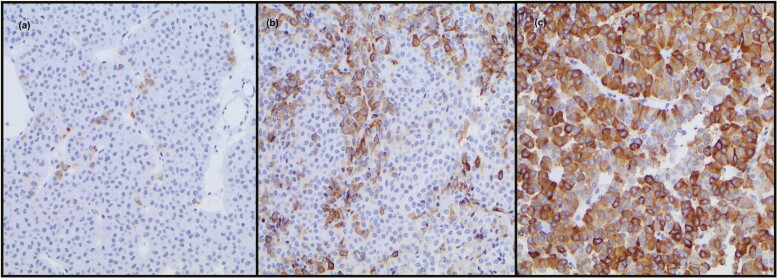
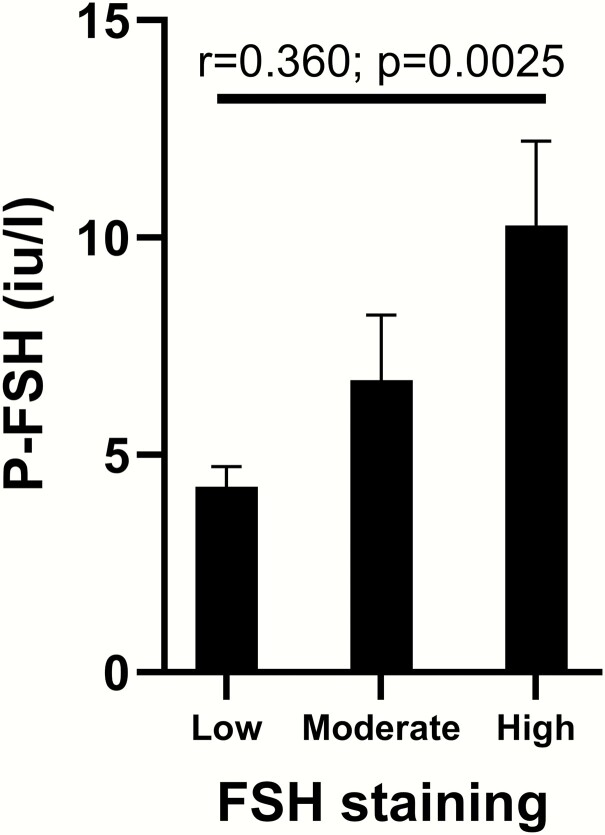
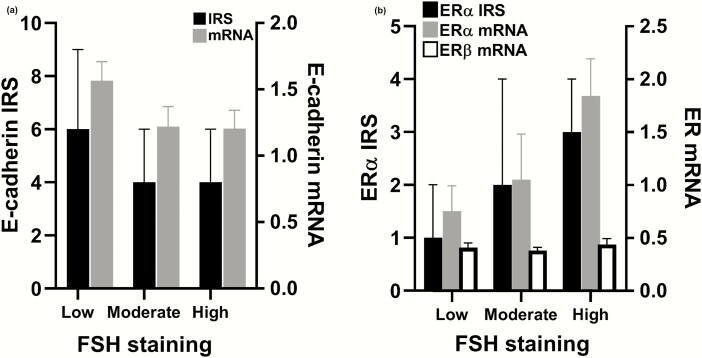
NF-PitNET with high FSH expression had decreased immunohistochemical staining for membranous E-cadherin (P < .0001) and increased staining for nuclear E-cadherin (P < .0001). Furthermore, high FSH expression was associated with increased ERα staining (P = .0002) and ERα mRNA (P = .0039). Circulating levels of plasma-FSH (P-FSH) correlated with FSH staining in gonadotroph NF-PitNET (P = .0025). Tumor size and invasiveness was not related to FSH staining, E-cadherin, or ERα. LH expression was not associated with E-cadherin or ERα.
In gonadotroph PitNETs, FSH staining is related to E-cadherin, ERα expression, and circulating levels of P-FSH. There was no association between FSH staining and invasiveness. The clinical significance of these findings will be investigated in ongoing prospective studies.
促性腺激素垂体神经内分泌肿瘤(PitNETs)可以表达卵泡刺激素(FSH)和黄体生成素(LH)或激素阴性,但它们很少分泌激素。在肿瘤发展过程中,上皮细胞表现出间充质表型。这个过程的特点是膜 E-钙黏蛋白减少,E-钙黏蛋白向核内易位。雌激素受体(ERs)调节 E-钙黏蛋白和 FSH 的表达和分泌。促性腺激素分泌性 PitNETs 患者的激素状态是否受上皮间质转化(EMT)和 ERs 调节尚不清楚。
研究 EMT 对促性腺激素无功能(NF)-PitNETs 中激素表达的影响。
对 105 例促性腺激素 PitNETs 进行分子和临床分析。进行了 FSH、LH、E-钙黏蛋白和 ERα 的免疫组织化学研究和实时定量聚合酶链反应。进一步的分析包括血液样本、临床数据和影像学图像。
所有患者均在同一三级转诊中心接受手术。
高 FSH 表达的 NF-PitNET 膜 E-钙黏蛋白免疫组化染色减少(P<0.0001),核 E-钙黏蛋白染色增加(P<0.0001)。此外,高 FSH 表达与 ERα 染色增加(P=0.0002)和 ERα mRNA 增加(P=0.0039)相关。循环血浆 FSH(P-FSH)水平与促性腺激素 NF-PitNET 的 FSH 染色相关(P=0.0025)。肿瘤大小和侵袭性与 FSH 染色、E-钙黏蛋白或 ERα 无关。LH 表达与 E-钙黏蛋白或 ERα 无关。
在促性腺激素 PitNETs 中,FSH 染色与 E-钙黏蛋白、ERα 表达和循环 P-FSH 水平有关。FSH 染色与侵袭性之间无相关性。这些发现的临床意义将在正在进行的前瞻性研究中进行调查。