Université Catholique de Louvain, Alzheimer Dementia, Avenue Mounier 53, SSS/IONS/CEMO-Bte B1.53.03, B-1200 Brussels, Belgium.
Institute of Neuroscience, Alzheimer Dementia, Avenue Mounier 53, SSS/IONS/CEMO-Bte B1.53.03, B-1200 Brussels, Belgium.
Cells. 2020 May 14;9(5):1215. doi: 10.3390/cells9051215.
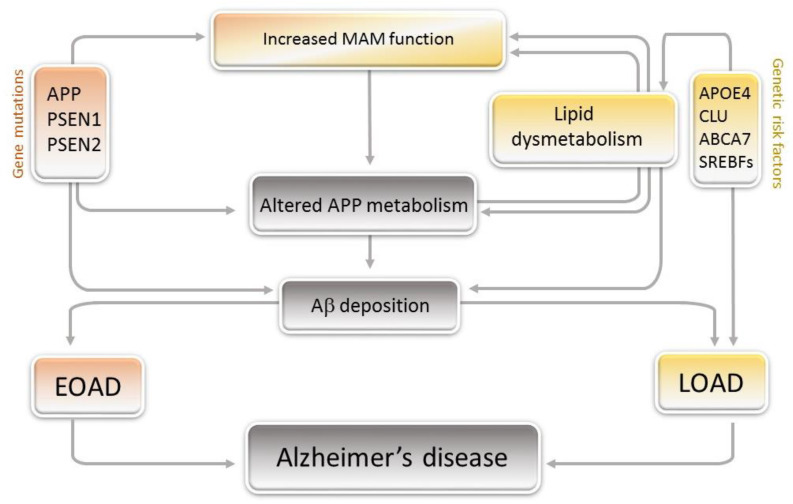
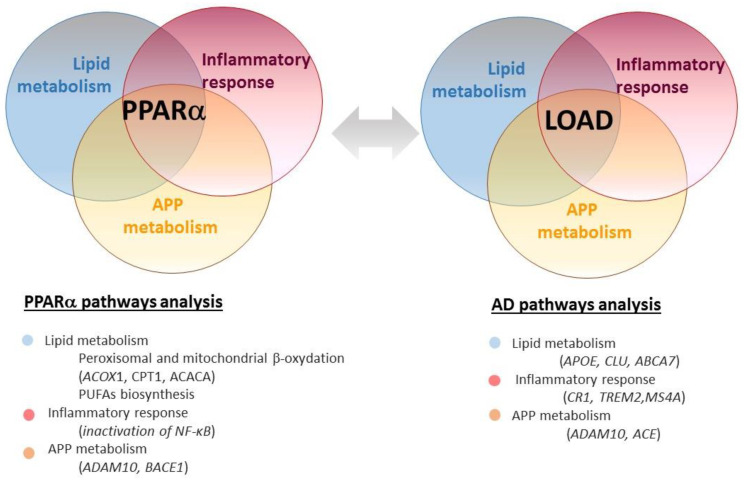
Alzheimer's disease (AD) is the leading cause of dementia in the elderly. Mutations in genes encoding proteins involved in amyloid-β peptide (Aβ) production are responsible for inherited AD cases. The amyloid cascade hypothesis was proposed to explain the pathogeny. Despite the fact that Aβ is considered as the main culprit of the pathology, most clinical trials focusing on Aβ failed and suggested that earlier interventions are needed to influence the course of AD. Therefore, identifying risk factors that predispose to AD is crucial. Among them, the epsilon 4 allele of the gene that encodes the major brain lipid carrier and metabolic disorders such as obesity and type 2 diabetes were identified as AD risk factors, suggesting that abnormal lipid metabolism could influence the progression of the disease. Among lipids, fatty acids (FAs) play a fundamental role in proper brain function, including memory. Peroxisome proliferator-activated receptor α (PPARα) is a master metabolic regulator that regulates the catabolism of FA. Several studies report an essential role of PPARα in neuronal function governing synaptic plasticity and cognition. In this review, we explore the implication of lipid metabolism in AD, with a special focus on PPARα and its potential role in AD therapy.
阿尔茨海默病(AD)是老年人痴呆的主要原因。编码参与淀粉样β肽(Aβ)产生的蛋白质的基因突变负责遗传性 AD 病例。淀粉样蛋白级联假说被提出以解释发病机制。尽管 Aβ被认为是病理学的主要罪魁祸首,但大多数专注于 Aβ的临床试验都失败了,并表明需要更早的干预来影响 AD 的病程。因此,确定导致 AD 的风险因素至关重要。其中,载脂蛋白 E 基因的ε4 等位基因编码大脑中的主要脂质载体和代谢紊乱,如肥胖和 2 型糖尿病,被确定为 AD 的风险因素,这表明异常的脂质代谢可能会影响疾病的进展。在脂质中,脂肪酸(FAs)在适当的大脑功能中起着重要作用,包括记忆。过氧化物酶体增殖物激活受体α(PPARα)是一种主要的代谢调节剂,可调节 FA 的分解代谢。有几项研究报告了 PPARα在调节突触可塑性和认知的神经元功能中的重要作用。在这篇综述中,我们探讨了脂质代谢在 AD 中的意义,特别关注了 PPARα及其在 AD 治疗中的潜在作用。