Unitat Trastorns Cognitius, Cognition and Behaviour Study Group, Hospital Universitari Santa Maria, IRBLleida, Rovira Roure No 44. 25198, Lleida, Spain.
Department of Experimental Medicine, University of Lleida, IRBLleida, Lleida, Spain.
Geroscience. 2024 Feb;46(1):683-696. doi: 10.1007/s11357-023-00989-x. Epub 2023 Nov 24.
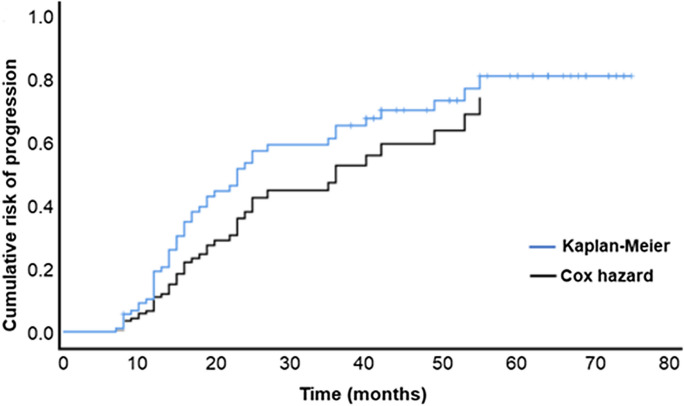
Genetic, metabolic, and clinical evidence links lipid dysregulation to an increased risk of Alzheimer's disease (AD). However, the role of lipids in the pathophysiological processes of AD and its clinical progression is unclear. We investigated the association between cerebrospinal fluid (CSF) lipidome and the pathological hallmarks of AD, progression from mild cognitive impairment (MCI) to AD, and the rate of cognitive decline in MCI patients. The CSF lipidome was analyzed by liquid chromatography coupled to mass spectrometry in an LC-ESI-QTOF-MS/MS platform for 209 participants: 91 AD, 92 MCI, and 26 control participants. The MCI patients were followed up for a median of 58 (± 12.5) months to evaluate their clinical progression to AD. Forty-eight (52.2%) MCI patients progressed to AD during follow-up. We found that higher CSF levels of hexacosanoic acid and ceramide Cer(d38:4) were associated with an increased risk of amyloid beta 42 (Aβ42) positivity in CSF, while levels of phosphatidylethanolamine PE(40:0) were associated with a reduced risk. Higher CSF levels of sphingomyelin SM(30:1) were positively associated with pathological levels of phosphorylated tau in CSF. Cholesteryl ester CE(11D3:1) and an unknown lipid were recognized as the most associated lipid species with MCI to AD progression. Furthermore, TG(O-52:2) was identified as the lipid most strongly associated with the rate of progression. Our results indicate the involvement of membrane and intracellular neutral lipids in the pathophysiological processes of AD and the progression from MCI to AD dementia. Therefore, CSF neutral lipids can be used as potential prognostic markers for AD.
遗传、代谢和临床证据表明,脂质失调与阿尔茨海默病(AD)风险增加有关。然而,脂质在 AD 的病理生理过程及其临床进展中的作用尚不清楚。我们研究了脑脊液(CSF)脂质组与 AD 的病理标志物、从轻度认知障碍(MCI)到 AD 的进展以及 MCI 患者认知能力下降的速度之间的关系。采用液相色谱-电喷雾串联质谱(LC-ESI-QTOF-MS/MS)平台分析 CSF 脂质组,共纳入 209 名参与者:91 名 AD 患者、92 名 MCI 患者和 26 名对照参与者。对 MCI 患者进行了中位时间为 58(±12.5)个月的随访,以评估其向 AD 的临床进展情况。在随访期间,有 48(52.2%)名 MCI 患者进展为 AD。我们发现,CSF 中二十六烷酸和神经酰胺 Cer(d38:4)水平升高与 CSF 中 Aβ42 阳性的风险增加相关,而磷酸乙醇胺 PE(40:0)水平降低与风险降低相关。CSF 中神经鞘磷脂 SM(30:1)水平升高与 CSF 中磷酸化 tau 的病理水平呈正相关。胆固醇酯 CE(11D3:1)和一种未知脂质被认为与 MCI 向 AD 进展最相关。此外,甘油三酯(TG)(O-52:2)被鉴定为与进展速度最相关的脂质。我们的研究结果表明,膜和细胞内中性脂质参与了 AD 的病理生理过程以及从 MCI 到 AD 痴呆的进展。因此,CSF 中性脂质可用作 AD 的潜在预后标志物。