Medical Scientist Training Program, University of Cincinnati College of Medicine, Cincinnati, OH; Department of Environmental Health, University of Cincinnati College of Medicine, Cincinnati, OH.
Department of Pediatrics, University of Cincinnati College of Medicine, Cincinnati, OH; Division of Biostatistics and Epidemiology, Cincinnati Children's Hospital Medical Center, Cincinnati, OH.
J Pediatr. 2020 Jul;222:52-58.e1. doi: 10.1016/j.jpeds.2020.03.052. Epub 2020 May 15.
To categorize newborn infants in Hamilton County, Ohio by late pregnancy fetal opioid exposure status and to assess their first-year healthcare utilization.
We used a population-based cohort of 41 136 live births from 2014-2017 and analyzed healthcare encounters in the first year of life from electronic health records. We prospectively assessed for the presence of opioids in maternal urine collected at delivery and for a diagnosis of newborn neonatal abstinence syndrome (NAS). At birth, infants were classified as unexposed to opioids, exposed to opioids and diagnosed with NAS, or subclinically exposed to opioids (exposure that did not result in NAS).
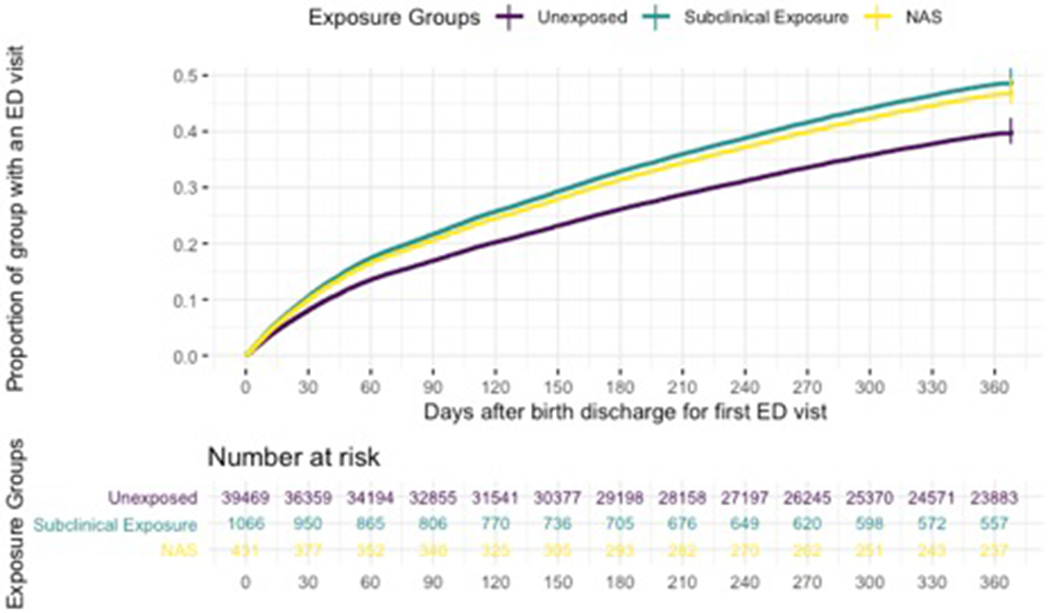
The prevalence of newborn opioid exposure was 37 per 1000 births. The duration of the hospital birth encounter was significantly longer for infants with subclinical exposure compared with unexposed infants (10% increase; 95% CI, 7%-13%). However, duration for infants with subclinical exposure was shorter compared to those with NAS. Neither subclinical exposure nor NAS was associated with total emergency department visits. Subclinical exposure was associated with increased odds of having at least 1 hospitalization in the first year. However, the total length of stay for hospitalizations was 82% that of the unexposed group (95% CI, 75%-89%). Infants with NAS had a 213% longer total length of stay compared with the unexposed group (95% CI, 191%-237%).
Subclinical and overt opioid exposure among newborn infants was associated with increased first-year healthcare utilization. From 2014 to 2017, this cost the Hamilton County healthcare system an estimated $1 109 452 for longer birth encounters alone.
根据俄亥俄州汉密尔顿县晚期妊娠胎儿阿片类药物暴露状况对新生儿进行分类,并评估其第一年的医疗保健利用情况。
我们使用了 2014 年至 2017 年期间的 41136 例活产儿的基于人群的队列,并从电子健康记录中分析了他们生命第一年的医疗保健接触情况。我们前瞻性地评估了分娩时收集的产妇尿液中是否存在阿片类药物,并评估了新生儿戒断综合征(NAS)的诊断。在出生时,婴儿分为未暴露于阿片类药物、暴露于阿片类药物且诊断为 NAS 或亚临床暴露于阿片类药物(暴露但未导致 NAS)。
新生儿阿片类药物暴露的患病率为每 1000 例出生 37 例。与未暴露于阿片类药物的婴儿相比,亚临床暴露婴儿的住院分娩接触时间明显延长(增加 10%;95%CI,7%-13%)。然而,亚临床暴露婴儿的接触时间比 NAS 婴儿短。亚临床暴露或 NAS 均与急诊就诊次数无关。亚临床暴露与第一年至少有 1 次住院的可能性增加相关。然而,住院总住院时间为未暴露组的 82%(95%CI,75%-89%)。与未暴露组相比,NAS 婴儿的总住院时间延长了 213%(95%CI,191%-237%)。
新生儿亚临床和显性阿片类药物暴露与第一年医疗保健利用率增加有关。2014 年至 2017 年,仅由于分娩时间延长,汉密尔顿县医疗系统估计为此支付了 110.9452 万美元。