Research Institute for Interdisciplinary Science and Graduate School of Natural Science and Technology, Okayama University, Okayama, 700-8530, Japan.
Graduate School of Biostudies, Kyoto University, Kyoto, 606-8502, Japan.
Nat Commun. 2020 May 18;11(1):2481. doi: 10.1038/s41467-020-16324-3.
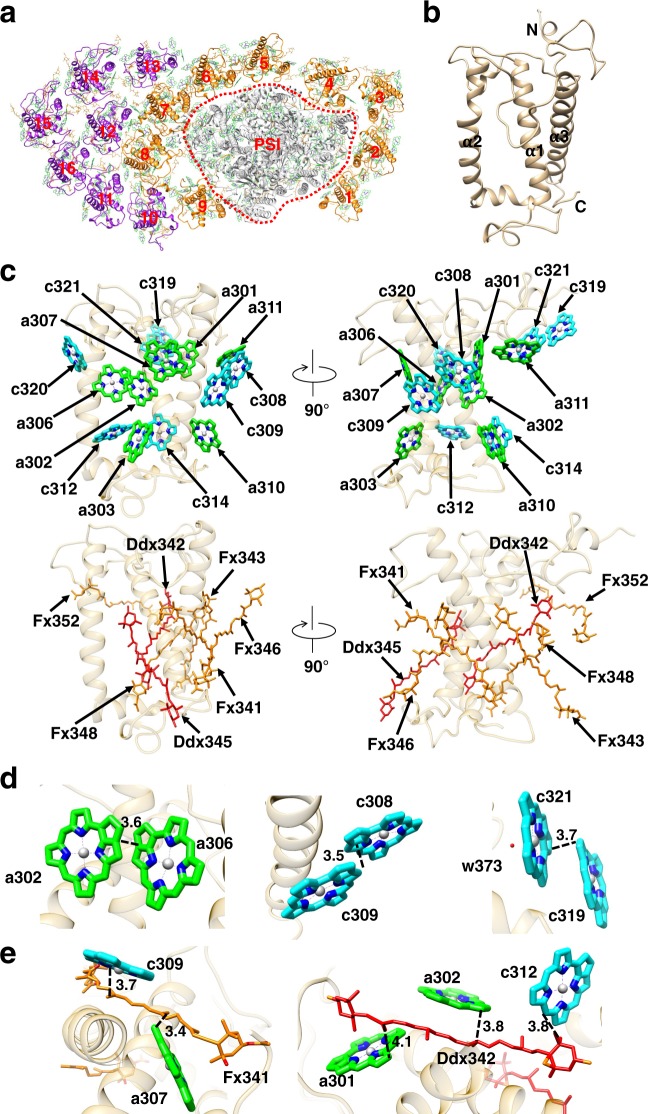
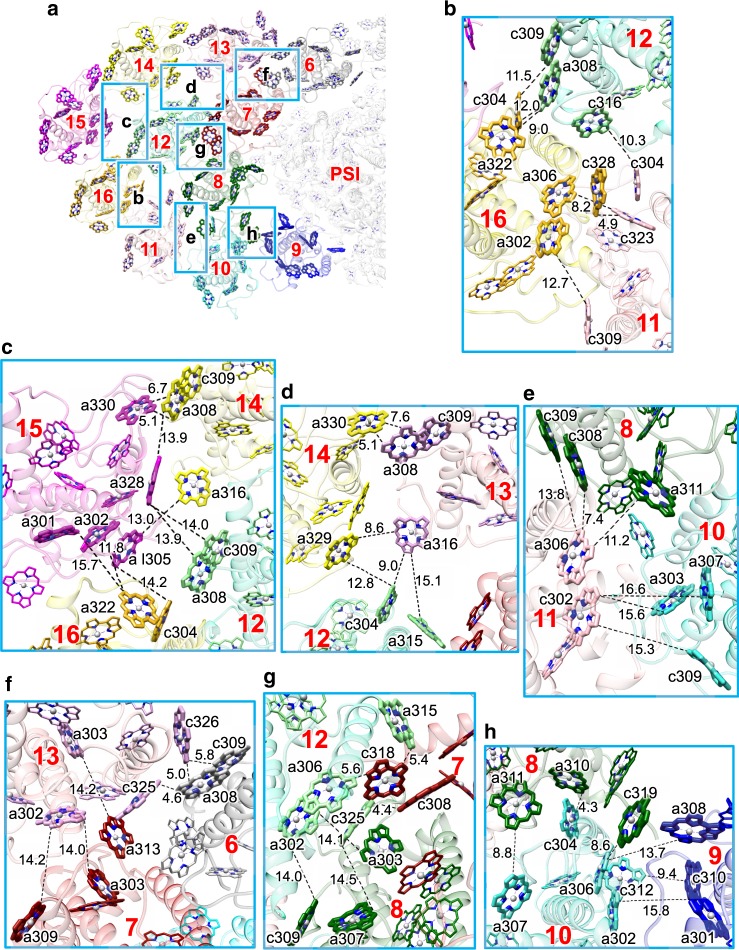
Photosynthetic light-harvesting complexes (LHCs) play a pivotal role in collecting solar energy for photochemical reactions in photosynthesis. One of the major LHCs are fucoxanthin chlorophyll a/c-binding proteins (FCPs) present in diatoms, a group of organisms having important contribution to the global carbon cycle. Here, we report a 2.40-Å resolution structure of the diatom photosystem I (PSI)-FCPI supercomplex by cryo-electron microscopy. The supercomplex is composed of 16 different FCPI subunits surrounding a monomeric PSI core. Each FCPI subunit showed different protein structures with different pigment contents and binding sites, and they form a complicated pigment-protein network together with the PSI core to harvest and transfer the light energy efficiently. In addition, two unique, previously unidentified subunits were found in the PSI core. The structure provides numerous insights into not only the light-harvesting strategy in diatom PSI-FCPI but also evolutionary dynamics of light harvesters among oxyphototrophs.
光合作用光捕获复合物(LHCs)在收集太阳能用于光合作用中的光化学反应方面起着至关重要的作用。其中一种主要的 LHC 是存在于硅藻中的叶黄素叶绿素 a/c 结合蛋白(FCPs),硅藻是对全球碳循环有重要贡献的一类生物。在这里,我们通过冷冻电子显微镜报告了硅藻光系统 I(PSI)-FCP 超复合物的 2.40-Å 分辨率结构。该超复合物由 16 个不同的 FCP 亚基围绕一个单体 PSI 核心组成。每个 FCP 亚基表现出不同的蛋白质结构,具有不同的色素含量和结合位点,它们与 PSI 核心一起形成一个复杂的色素-蛋白质网络,以有效地捕获和传递光能。此外,在 PSI 核心中还发现了两个以前未被识别的独特亚基。该结构不仅为硅藻 PSI-FCP 中的光捕获策略提供了许多深入的了解,也为光能收集器在好氧光合生物中的进化动态提供了许多深入的了解。