Department of Diagnosis and Surgery, School of Dentistry at Araraquara, UNESP- São Paulo State University, Araraquara, 14801385, SP, Brazil.
Department of Morphology, Genetics, Orthodontics and Pediatric Dentistry, School of Dentistry at Araraquara, UNESP- São Paulo State University, Araraquara, 14801385, SP, Brazil.
Sci Rep. 2020 May 18;10(1):8145. doi: 10.1038/s41598-020-65042-9.
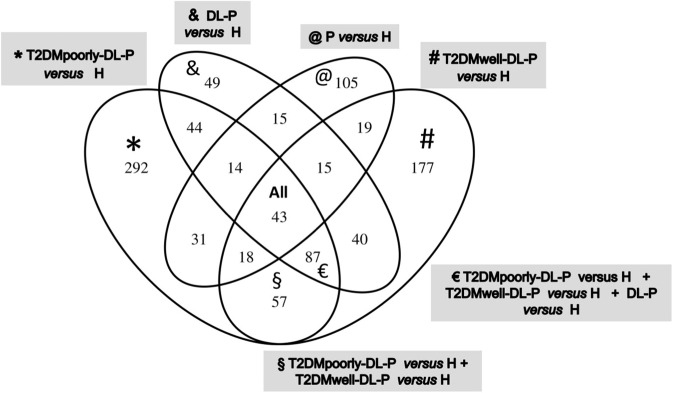
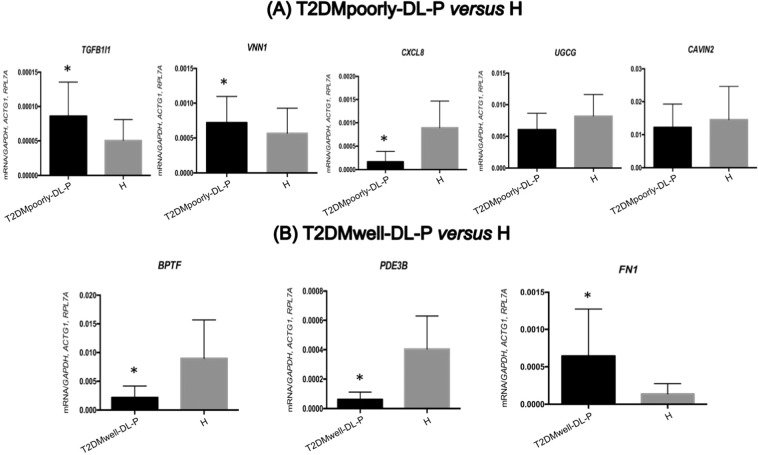
Type 2 diabetes mellitus (T2DM), dyslipidemia and periodontitis are frequently associated pathologies; however, there are no studies showing the peripheral blood transcript profile of these combined diseases. Here we identified the differentially expressed genes (DEGs) of circulating lymphocytes and monocytes to reveal potential biomarkers that may be used as molecular targets for future diagnosis of each combination of these pathologies (compared to healthy patients) and give insights into the underlying molecular mechanisms of these diseases. Study participants (n = 150) were divided into groups: (H) systemically and periodontal healthy (control group); (P) with periodontitis, but systemically healthy; (DL-P) with dyslipidemia and periodontitis; (T2DMwell-DL-P) well-controlled type 2 diabetes mellitus with dyslipidemia and periodontitis; and (T2DMpoorly-DL-P) poorly-controlled type 2 diabetes mellitus with dyslipidemia and periodontitis. We preprocessed the microarray data using the Robust Multichip Average (RMA) strategy, followed by the RankProd method to identify candidates for DEGs. Furthermore, we performed functional enrichment analysis using Ingenuity Pathway Analysis and Gene Set Enrichment Analysis. DEGs were submitted to pairwise comparisons, and selected DEGs were validated by quantitative polymerase chain reaction. Validated DEGs verified from T2DMpoorly-DL-P versus H were: TGFB1I1, VNN1, HLADRB4 and CXCL8; T2DMwell-DL-P versus H: FN1, BPTF and PDE3B; DL-P versus H: DAB2, CD47 and HLADRB4; P versus H: IGHDL-P, ITGB2 and HLADRB4. In conclusion, we identified that circulating lymphocytes and monocytes of individuals simultaneously affected by T2DM, dyslipidemia and periodontitis, showed an altered molecular profile mainly associated to inflammatory response, immune cell trafficking, and infectious disease pathways. Altogether, these results shed light on novel potential targets for future diagnosis, monitoring or development of targeted therapies for patients sharing these conditions.
2 型糖尿病(T2DM)、血脂异常和牙周炎常合并发生,但目前尚无研究表明这些合并疾病的外周血转录谱。在这里,我们鉴定了循环淋巴细胞和单核细胞中的差异表达基因(DEGs),以揭示可能作为未来每种合并疾病(与健康患者相比)的分子靶标的潜在生物标志物,并深入了解这些疾病的潜在分子机制。研究参与者(n=150)分为以下几组:(H)全身和牙周健康(对照组);(P)患有牙周炎,但全身健康;(DL-P)患有血脂异常和牙周炎;(T2DMwell-DL-P)血脂异常和牙周炎控制良好的 2 型糖尿病;(T2DMpoorly-DL-P)血脂异常和牙周炎控制不佳的 2 型糖尿病。我们使用 Robust Multichip Average(RMA)策略预处理微阵列数据,然后使用 RankProd 方法鉴定 DEGs 的候选基因。此外,我们使用 Ingenuity Pathway Analysis 和 Gene Set Enrichment Analysis 进行功能富集分析。我们对 DEGs 进行了两两比较,并通过定量聚合酶链反应验证了选定的 DEGs。从 T2DMpoorly-DL-P 与 H 的比较中验证的 DEGs 有:TGFB1I1、VNN1、HLADRB4 和 CXCL8;T2DMwell-DL-P 与 H 相比:FN1、BPTF 和 PDE3B;DL-P 与 H 相比:DAB2、CD47 和 HLADRB4;P 与 H 相比:IGHDL-P、ITGB2 和 HLADRB4。总之,我们发现同时患有 2 型糖尿病、血脂异常和牙周炎的个体的循环淋巴细胞和单核细胞表现出改变的分子谱,主要与炎症反应、免疫细胞迁移和传染病途径有关。总之,这些结果为未来针对这些合并疾病的患者的诊断、监测或靶向治疗的开发提供了新的潜在靶点。