Nalesso Federico, Cattarin Leda, Gobbi Laura, Fragasso Antonio, Garzotto Francesco, Calò Lorenzo Arcangelo
Department of Medicine, Nephrology, Dialysis and Transplantation Unit, University of Padova, Padova, Italy.
Healthcare Directorate Unit, Veneto Institute of Oncology IOV-IRCCS, Padova, Italy.
Int J Nephrol Renovasc Dis. 2020 Apr 24;13:85-96. doi: 10.2147/IJNRD.S198222. eCollection 2020.
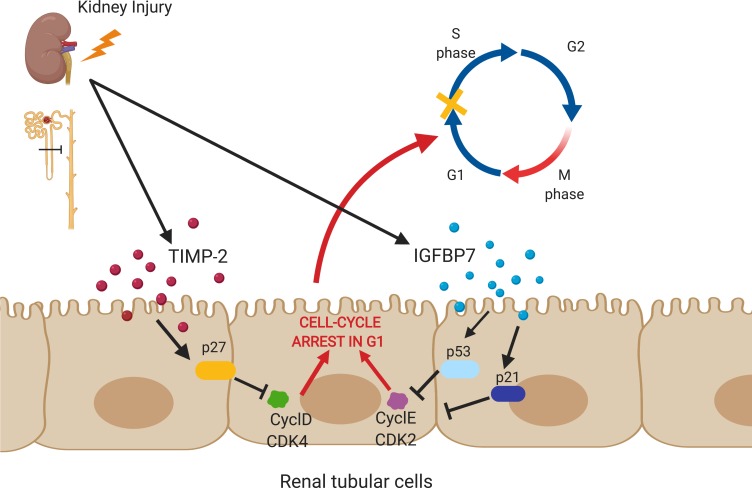
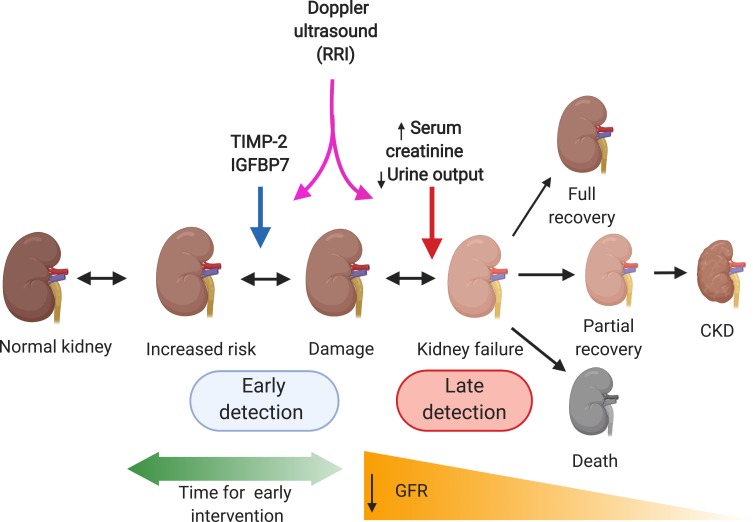
Acute kidney injury (AKI) is a common complication in critically ill patients in the intensive settings with increased risks of short- and long-term complications and mortality. AKI is also associated with an increased length of stay in intensive care units (ICU) and worse kidney function recovery at hospital discharge. The management of AKI is one of the major challenges for nephrologists and intensivists overall for its early diagnosis. The current KDIGO criteria used to define AKI include the serum creatinine and urinary output that are neither sensitive nor specific markers of kidney function, since they can be altered only after hours from the kidney injury. In order to allow an early AKI detection, in the last years, several studies focused on the identification of new biomarkers. Among all these markers, urinary insulin-like growth factor-binding protein (IGFBP-7) and tissue inhibitor of metalloproteinase (TIMP-2) have been proven as the best-performing and have been proposed as a predictive tool for the AKI detection in the critical settings in order to perform an early diagnosis. Patients undergoing major surgery, cardiac surgery, those with hemodynamic instability or those with sepsis are believed to be the top priority patient populations for the biomarker test. In this view, the urinary [TIMP-2] x [IGFBP-7] becomes an important tool for the early detection of patients at high risk for AKI and its integration with the local ICU experience has to provide a multidisciplinary management of AKI with the institution of a rapid response team in order to assess patients and customize AKI management.
急性肾损伤(AKI)是重症监护病房中危重症患者常见的并发症,其短期和长期并发症及死亡风险均增加。AKI还与重症监护病房(ICU)住院时间延长以及出院时肾功能恢复较差有关。由于AKI早期诊断困难,其管理是肾病学家和重症医学专家面临的主要挑战之一。目前用于定义AKI的KDIGO标准包括血清肌酐和尿量,但它们既不是肾功能的敏感指标也不是特异性指标,因为只有在肾脏损伤数小时后它们才会发生变化。为了能够早期检测AKI,近年来,多项研究聚焦于新型生物标志物的识别。在所有这些标志物中,尿胰岛素样生长因子结合蛋白(IGFBP - 7)和金属蛋白酶组织抑制剂(TIMP - 2)已被证明是表现最佳的,并被提议作为危重症环境中AKI检测的预测工具,以便进行早期诊断。接受大手术、心脏手术的患者,血流动力学不稳定的患者或患有脓毒症的患者被认为是生物标志物检测的首要患者群体。从这个角度来看,尿 [TIMP - 2]×[IGFBP - 7] 成为早期检测AKI高危患者的重要工具,并将其与当地ICU经验相结合,必须通过建立快速反应团队对AKI进行多学科管理,以便评估患者并定制AKI管理方案。