Cell Biology, Immunology, and Microbiology Graduate Program, Graduate School of Biomedical Sciences, University of North Texas Health Science Center, Fort Worth, TX, United States.
Department of Hematopoietic Biology and Malignancy, The University of Texas MD Anderson Cancer Center, Houston, TX, United States.
Front Immunol. 2020 Apr 30;11:773. doi: 10.3389/fimmu.2020.00773. eCollection 2020.
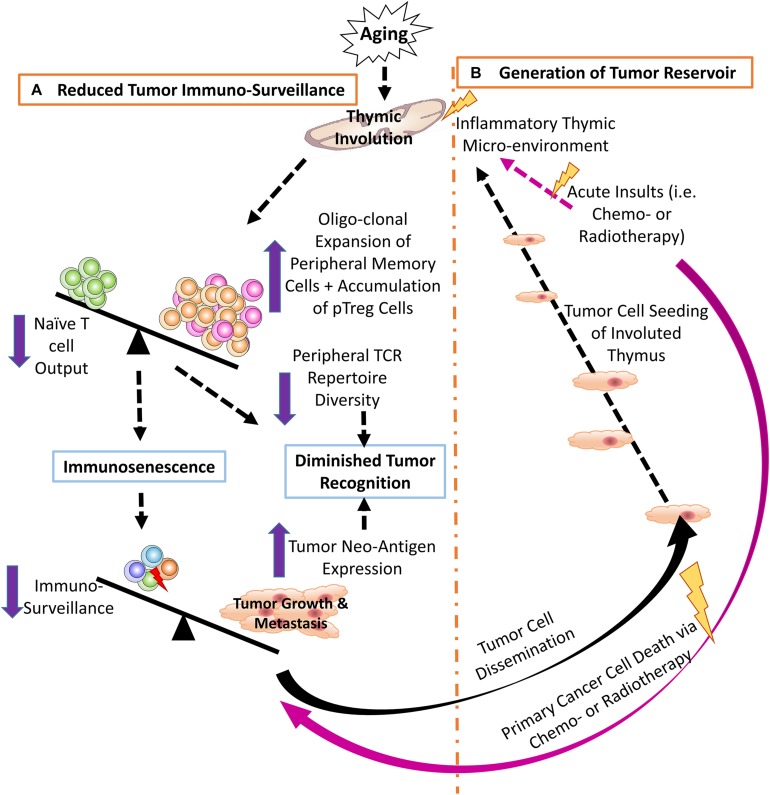
The thymus is the central lymphoid organ for T cell development, a cradle of T cells, and for central tolerance establishment, an educator of T cells, maintaining homeostatic cellular immunity. T cell immunity is critical to control cancer occurrence, relapse, and antitumor immunity. Evidence on how aberrant thymic function influences cancer remains largely insufficient, however, there has been recent progress. For example, the involuted thymus results in reduced output of naïve T cells and a restricted T cell receptor (TCR) repertoire, inducing immunosenescence and potentially dampening immune surveillance of neoplasia. In addition, the involuted thymus relatively enhances regulatory T (Treg) cell generation. This coupled with age-related accumulation of Treg cells in the periphery, potentially provides a supportive microenvironment for tumors to escape T cell-mediated antitumor responses. Furthermore, acute thymic involution from chemotherapy can create a tumor reservoir, resulting from an inflammatory microenvironment in the thymus, which is suitable for disseminated tumor cells to hide, survive chemotherapy, and become dormant. This may eventually result in cancer metastatic relapse. On the other hand, if thymic involution is wisely taken advantage of, it may be potentially beneficial to antitumor immunity, since the involuted thymus increases output of self-reactive T cells, which may recognize certain tumor-associated self-antigens and enhance antitumor immunity, as demonstrated through depletion of autoimmune regulator () gene in the thymus. Herein, we briefly review recent research progression regarding how altered thymic function modifies T cell immunity against tumors.
胸腺是 T 细胞发育的中枢淋巴器官,是 T 细胞的摇篮,也是建立中枢耐受的场所,是 T 细胞的教育者,维持着细胞免疫的体内平衡。T 细胞免疫对于控制癌症的发生、复发和抗肿瘤免疫至关重要。然而,关于异常胸腺功能如何影响癌症的证据仍然远远不够,尽管最近取得了一些进展。例如,退化的胸腺导致幼稚 T 细胞输出减少和 T 细胞受体(TCR)库受限,诱导免疫衰老,并可能抑制肿瘤的免疫监视。此外,退化的胸腺相对增加了调节性 T(Treg)细胞的生成。再加上外周衰老相关的 Treg 细胞的积累,这可能为肿瘤提供了一个支持性的微环境,使其逃避 T 细胞介导的抗肿瘤反应。此外,化疗引起的急性胸腺退化会导致肿瘤库的形成,这是由于胸腺中的炎症微环境,使播散的肿瘤细胞能够隐匿、耐受化疗并进入休眠状态。这最终可能导致癌症转移复发。另一方面,如果明智地利用胸腺退化,它可能对抗肿瘤免疫有益,因为退化的胸腺增加了自身反应性 T 细胞的输出,这些 T 细胞可能识别某些与肿瘤相关的自身抗原,并增强抗肿瘤免疫,正如通过在胸腺中耗尽自身免疫调节因子()基因所证明的那样。本文简要综述了最近关于改变的胸腺功能如何改变 T 细胞免疫对抗肿瘤的研究进展。