
评估电流转向对帕金森病患者输送总电能和活动能力的影响。
Assessing the effect of current steering on the total electrical energy delivered and ambulation in Parkinson's disease.
机构信息
Department of Physiology and Pharmacology, Western University, London, ON, N6A 5C1, Canada.
Department of Clinical Neurological Sciences, Western University, London, ON, N6A 3K7, Canada.
出版信息
Sci Rep. 2020 May 19;10(1):8256. doi: 10.1038/s41598-020-64250-7.
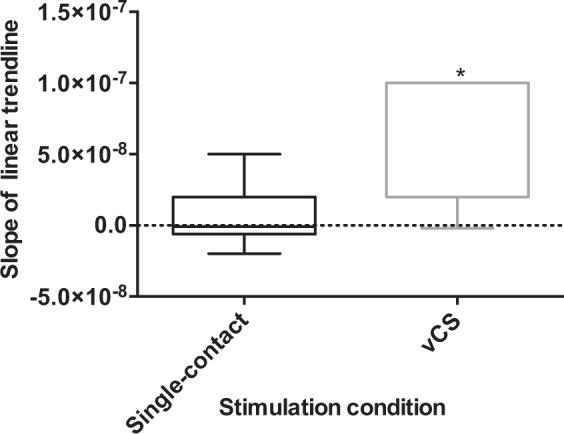
Vertical current steering (vCS) divides current between multiple contacts, which reduces radial spread to fine-tune the electric field shape and improves neuroanatomical targeting. vCS may improve the variable responsiveness of Parkinsonian gait to conventional deep brain stimulation. We hypothesized that vCS elicits greater improvement in ambulation in Parkinson's disease patients compared to conventional, single-contact stimulation. vCS was implemented with divisions of 70%/30% and 50%/50% and compared to single-contact stimulation with four therapeutic window amplitudes in current-controlled systems. Walking at a self-selected pace was evaluated in seven levodopa-responsive patients. Integrative measures of gait and stimulation parameters were assessed with the functional ambulation performance (FAP) score and total electrical energy delivered (TEED), respectively. A two-tailed Wilcoxon matched-pairs signed rank test assessed the effect of each stimulation condition on FAP and TEED and compared regression slopes; further, a two-tailed Spearman test identified correlations. vCS significantly lowered the TEED (P < 0.0001); however, FAP scores were not different between conditions (P = 0.786). Compared to single-contact stimulation, vCS elicited higher FAP scores with lower TEED (P = 0.031). FAP and TEED were positively correlated in vCS (P = 2.000 × 10, r = 0.397) and single-contact stimulation (P = 0.034, r = 0.205). Therefore, vCS and single-contact stimulation improved ambulation similarly but vCS reduced the TEED and side-effects at higher amplitudes.
垂直电流转向 (vCS) 将电流分配到多个触点之间,从而减少了电流的径向扩散,使电场形状更加精细,并改善了神经解剖学靶向。vCS 可能会改善帕金森病患者对传统深部脑刺激的可变反应性。我们假设 vCS 比传统的单触点刺激更能提高帕金森病患者的步行能力。vCS 采用 70%/30%和 50%/50%的分割,并与电流控制系统中的四个治疗窗口幅度的单触点刺激进行比较。在七个对左旋多巴有反应的患者中,以自我选择的速度进行行走评估。使用功能步行表现 (FAP) 评分和总电能输送 (TEED) 分别评估步态和刺激参数的综合指标。采用双侧 Wilcoxon 匹配对符号秩检验评估每种刺激条件对 FAP 和 TEED 的影响,并比较回归斜率;此外,采用双侧 Spearman 检验确定相关性。vCS 显著降低了 TEED(P<0.0001);然而,条件之间的 FAP 评分没有差异(P=0.786)。与单触点刺激相比,vCS 以较低的 TEED 产生了更高的 FAP 评分(P=0.031)。vCS 和单触点刺激中,FAP 和 TEED 呈正相关(P=2.000×10,r=0.397)和单触点刺激(P=0.034,r=0.205)。因此,vCS 和单触点刺激同样改善了步行能力,但 vCS 降低了 TEED 和高振幅时的副作用。


 Zotero 插件