Zhang Jiangtao, Tan Yuanqiang, Bao Tao, Xu Yangli, Xiao Xiangwu, Jiang Shengqiang
Institute of Manufacturing Engineering, Huaqiao University, Xiamen 361021, China.
National & Local Joint Engineering Research Center for Intelligent Manufacturing Technology of Brittle Material Products, Huaqiao University, Xiamen 361021, China.
Materials (Basel). 2020 May 15;13(10):2285. doi: 10.3390/ma13102285.
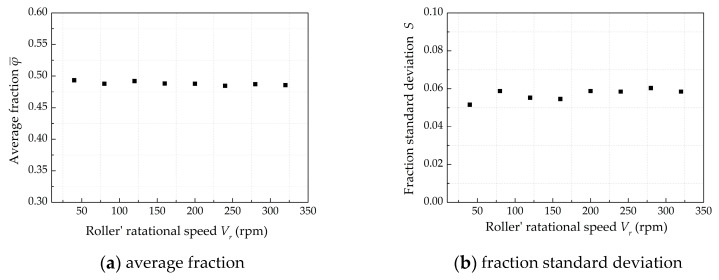
The powder-bed with uniform and high density that determined by the spreading process parameters is the key factor for fabricating high performance parts in Additive Manufacturing (AM) process. In this work, Discrete Element Method (DEM) was deployed in order to simulate AlO ceramic powder roller-spreading. The effects of roller-spreading parameters include translational velocity , roller's rotational speed , roller's diameter and powder layer thickness on powder-bed density were analyzed. The results show that the increased translational velocity of roller leads to poor powder-bed density. However, the larger roller's diameter will improve powder-bed density. Moreover, the roller's rotational speed has little effect on powder-bed density. Layer thickness is the most significant influencing factor on powder-bed density. When layer thickness is 50 μm, most of particles are pushed out of the build platform forming a lot of voids. However, when the layer thickness is greater than 150 μm, the powder-bed becomes more uniform and denser. This work can provide a reliable basis for roller-spreading parameters optimization.
由铺展工艺参数决定的均匀且高密度的粉末床是增材制造(AM)工艺中制造高性能零件的关键因素。在这项工作中,采用离散元法(DEM)来模拟AlO陶瓷粉末的辊涂铺展过程。分析了辊涂铺展参数,包括平移速度、辊的转速、辊的直径和粉末层厚度对粉末床密度的影响。结果表明,辊平移速度的增加会导致粉末床密度变差。然而,较大的辊直径会提高粉末床密度。此外,辊的转速对粉末床密度影响很小。层厚是对粉末床密度影响最显著的因素。当层厚为50μm时,大多数颗粒被推出成型平台,形成许多空隙。然而,当层厚大于150μm时,粉末床变得更加均匀和致密。这项工作可为辊涂铺展参数优化提供可靠依据。