Libring Sarah, Shinde Aparna, Chanda Monica K, Nuru Maryam, George Heather, Saleh Aya M, Abdullah Ammara, Kinzer-Ursem Tamara L, Calve Sarah, Wendt Michael K, Solorio Luis
Weldon School of Biomedical Engineering, Purdue University, West Lafayette, IN 47907, USA.
Department of Medicinal Chemistry and Molecular Pharmacology, Purdue University, West Lafayette, IN 47907, USA.
Cancers (Basel). 2020 May 17;12(5):1270. doi: 10.3390/cancers12051270.
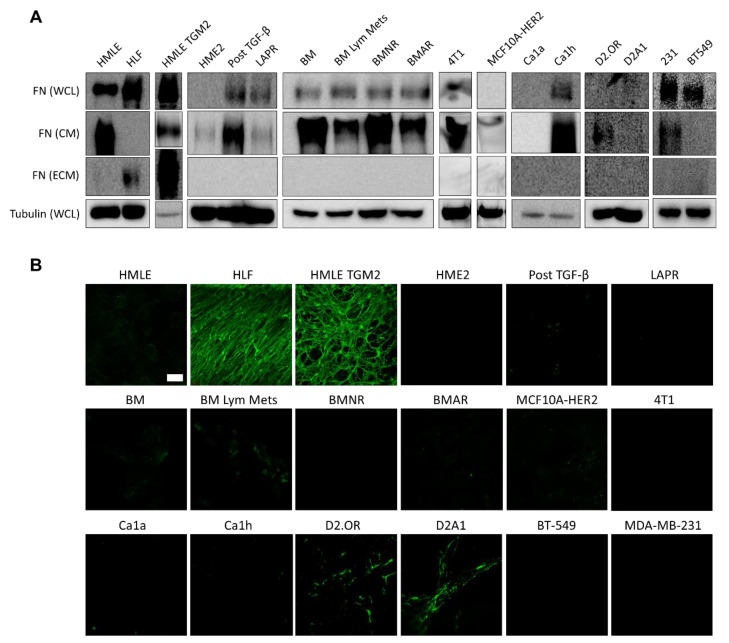
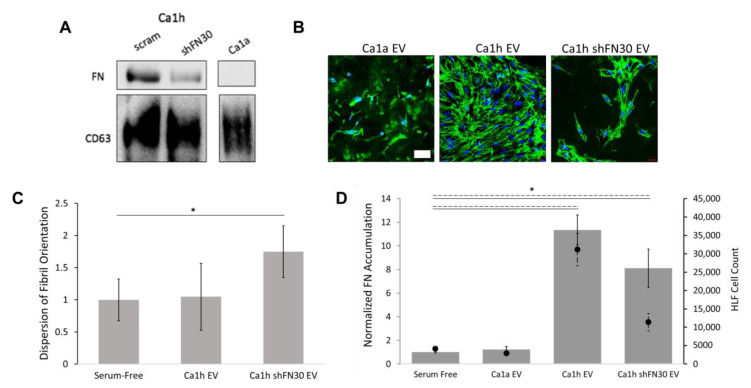
In breast cancer (BC), tissue stiffening via fibronectin (FN) and collagen accumulation is associated with advanced disease progression at both the primary tumor and metastatic sites. Here, we evaluate FN production in 15 BC cell lines, representing a variety of subtypes, phenotypes, metastatic potentials, and chemotherapeutic sensitivities. We demonstrate that intracellular and soluble FN is initially lost during tumorigenic transformation but is rescued in all lines with epithelial-mesenchymal plasticity (EMP). Importantly, we establish that no BC cell line was able to independently organize a robust FN matrix. Non-transformed mammary epithelial cells were also unable to deposit FN matrices unless transglutaminase 2, a FN crosslinking enzyme, was overexpressed. Instead, BC cells manipulated the FN matrix production of fibroblasts in a phenotypic-dependent manner. In addition, varied accumulation levels were seen depending if the fibroblasts were conditioned to model paracrine signaling or endocrine signaling of the metastatic niche. In the former, fibroblasts conditioned by BC cultures with high EMP resulted in the largest FN matrix accumulation. In contrast, mesenchymal BC cells produced extracellular vesicles (EV) that resulted in the highest levels of matrix formation by conditioned fibroblasts. Overall, we demonstrate a dynamic relationship between tumor and stromal cells within the tumor microenvironment, in which the levels and fibrillarization of FN in the extracellular matrix are modulated during the particular stages of disease progression.
在乳腺癌(BC)中,通过纤连蛋白(FN)和胶原蛋白积累导致的组织硬化与原发肿瘤和转移部位的疾病进展相关。在此,我们评估了15种BC细胞系中FN的产生情况,这些细胞系代表了多种亚型、表型、转移潜能和化疗敏感性。我们证明,在致瘤转化过程中,细胞内和可溶性FN最初会丢失,但在所有具有上皮-间质可塑性(EMP)的细胞系中又会恢复。重要的是,我们确定没有一种BC细胞系能够独立组织形成强大的FN基质。未转化的乳腺上皮细胞也无法沉积FN基质,除非转谷氨酰胺酶2(一种FN交联酶)过表达。相反,BC细胞以表型依赖的方式操纵成纤维细胞的FN基质产生。此外,根据成纤维细胞是否被处理以模拟转移微环境的旁分泌信号或内分泌信号,会观察到不同的积累水平。在前一种情况下,用具有高EMP的BC培养物处理的成纤维细胞导致最大的FN基质积累。相比之下,间充质BC细胞产生的细胞外囊泡(EV)导致经处理的成纤维细胞形成的基质水平最高。总体而言,我们证明了肿瘤微环境中肿瘤细胞与基质细胞之间的动态关系,其中细胞外基质中FN的水平和纤维化在疾病进展的特定阶段受到调节。