Folkhälsan Institute of Genetics, Folkhälsan Research Center, Helsinki, Finland.
Faculdade de Ciências Médicas da Santa Casa de São Paulo, São Paulo, Brazil.
Cardiovasc Diabetol. 2020 May 19;19(1):68. doi: 10.1186/s12933-020-01038-z.
ABO blood groups have previously been associated with cardiovascular disease (CVD) in the general population. This study aimed to investigate the potential relationship between ABO blood groups and CVD in individuals with type 1 diabetes according to diabetic nephropathy (DN) status.
Adults with type 1 diabetes (4531 individuals) from the FinnDiane Study were evaluated. DN was determined by two out of three measurements of urinary albumin excretion rate. Albuminuria was defined as an excretion rate above 20 µg/min. CVD events were identified by linking the data with the Finnish Care Register for Health Care and the Finnish Cause of Death Register. Follow-up ranged from the baseline visit until a CVD event, death or the end of 2017. The impact of ABO blood groups on CVD risk was estimated by multivariable Cox-regression analyses adjusted for traditional risk factors.
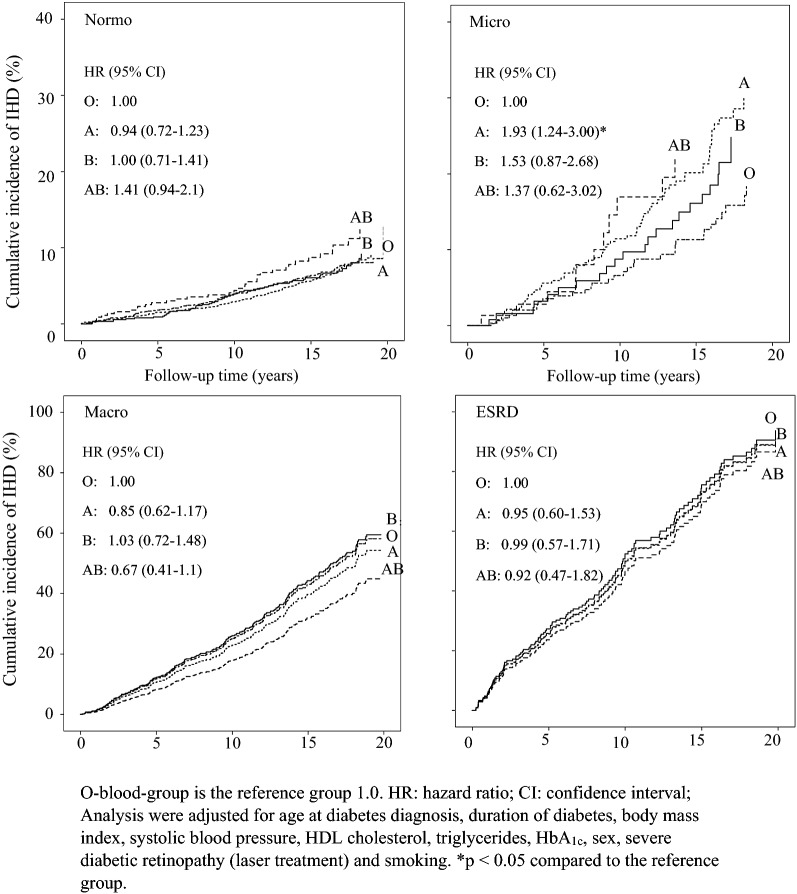
At baseline, the median age was 38.5 (IQR 29.2-47.9) years, 47.5% were female and median duration of diabetes was 20.9 (11.4-30.7) years. There were 893 incident ischemic heart disease (IHD) events, 301 ischemic strokes (IS), and 415 peripheral artery disease (PAD) events during a median follow up of 16.5 (IQR 12.8-18.6) years. The A blood group showed the highest risk of IHD versus the O blood group, when microalbuminuria was present. Comparing the population with microalbuminuria with those with normoalbuminuria, only the A blood group elevated the risk of IHD. This increased risk was neither explained by the FUT2 secretor phenotype nor by the A-genotype distribution. The risk of IS or PAD was no different among the ABO blood groups regardless of diabetic nephropathy stage.
The A blood group is a risk factor for IHD in individuals with type 1 diabetes and microalbuminuria.
ABO 血型先前与普通人群的心血管疾病(CVD)相关。本研究旨在根据糖尿病肾病(DN)状态,调查 1 型糖尿病个体中 ABO 血型与 CVD 之间的潜在关系。
评估来自 FinnDiane 研究的成年 1 型糖尿病患者(4531 人)。DN 通过 3 次尿白蛋白排泄率测量中的 2 次确定。白蛋白尿定义为排泄率高于 20μg/min。通过将数据与芬兰保健登记册和芬兰死因登记册链接,确定 CVD 事件。随访时间从基线访视开始,直至发生 CVD 事件、死亡或 2017 年底。使用多变量 Cox 回归分析调整传统危险因素来估计 ABO 血型对 CVD 风险的影响。
在基线时,中位年龄为 38.5(IQR 29.2-47.9)岁,47.5%为女性,糖尿病病程的中位数为 20.9(11.4-30.7)年。在中位随访 16.5(IQR 12.8-18.6)年后,发生 893 例缺血性心脏病(IHD)事件、301 例缺血性脑卒中(IS)和 415 例外周动脉疾病(PAD)事件。与 O 血型相比,存在微量白蛋白尿时,A 血型的 IHD 风险最高。将微量白蛋白尿患者与正常白蛋白尿患者进行比较时,只有 A 血型会增加 IHD 的风险。这种风险增加既不能由 FUT2 分泌表型,也不能由 A 基因型分布来解释。无论糖尿病肾病阶段如何,ABO 血型与 IS 或 PAD 的风险均无差异。
A 血型是伴有微量白蛋白尿的 1 型糖尿病患者发生 IHD 的一个危险因素。