Department of Economics, University of Waterloo, Waterloo, ON, Canada N2L 3G1.
Center for Health Policy/Primary Care and Outcomes Research, Department of Medicine, Stanford University, Stanford, CA 94305
Proc Natl Acad Sci U S A. 2020 Jun 2;117(22):12011-12016. doi: 10.1073/pnas.1910160117. Epub 2020 May 19.
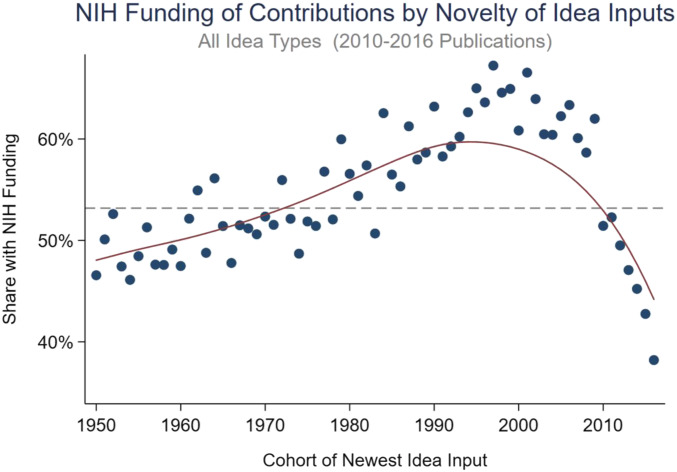
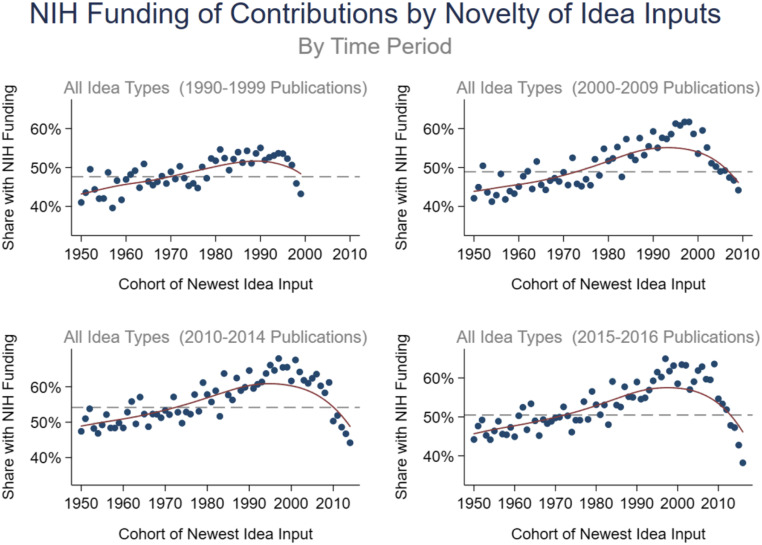
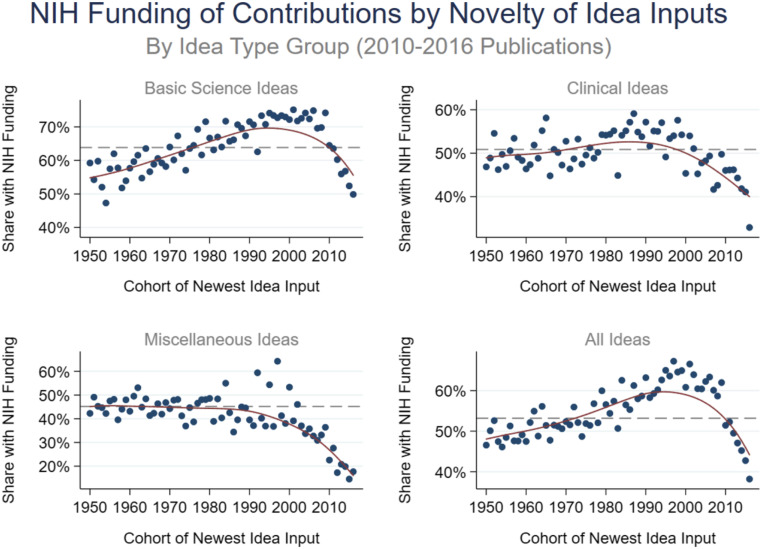
The National Institutes of Health (NIH) plays a critical role in funding scientific endeavors in biomedicine. Funding innovative science is an essential element of the NIH's mission, but many have questioned the NIH's ability to fulfill this aim. Based on an analysis of a comprehensive corpus of published biomedical research articles, we measure whether the NIH succeeds in funding work with novel ideas, which we term edge science. We find that edge science is more often NIH funded than less novel science, but with a delay. Papers that build on very recent ideas are NIH funded less often than are papers that build on ideas that have had a chance to mature for at least 7 y. We have three further findings. First, the tendency to fund edge science is mostly limited to basic science. Papers that build on novel clinical ideas are not more often NIH funded than are papers that build on well-established clinical knowledge. Second, novel papers tend to be NIH funded more often because there are more NIH-funded papers in innovative areas of investigation, rather than because the NIH funds innovative papers within research areas. Third, the NIH's tendency to have funded papers that build on the most recent advances has declined over time. In this regard, NIH funding has become more conservative despite initiatives to increase funding for innovative projects. Given our focus on published papers, the results reflect both the funding preferences of the NIH and the composition of the applications it receives.
美国国立卫生研究院(NIH)在资助生物医学科学研究方面发挥着至关重要的作用。资助创新科学是 NIH 使命的一个基本要素,但许多人质疑 NIH 实现这一目标的能力。基于对已发表的生物医学研究文章的综合语料库的分析,我们衡量 NIH 是否成功资助了具有新颖想法的工作,我们将其称为前沿科学。我们发现,前沿科学比不太新颖的科学更常得到 NIH 的资助,但有延迟。基于最近想法的论文比基于至少已经成熟了 7 年的想法的论文获得 NIH 资助的机会更少。我们还有三个进一步的发现。首先,资助前沿科学的倾向主要限于基础科学。基于新颖临床想法的论文并没有比基于成熟临床知识的论文更常获得 NIH 的资助。其次,新颖的论文往往更常获得 NIH 的资助,是因为创新研究领域的 NIH 资助论文更多,而不是因为 NIH 在研究领域内资助创新论文。第三,NIH 资助那些基于最新进展的论文的倾向随着时间的推移而下降。在这方面,尽管有增加创新项目资助的举措,但 NIH 的资助变得更加保守。鉴于我们专注于已发表的论文,这些结果反映了 NIH 的资助偏好以及它所收到的申请的组成。