Shenzhen Key Laboratory of Marine Microbiome Engineering, Institute for Advanced Study, Shenzhen University, Shenzhen, China.
Key Laboratory of Optoelectronic Devices and Systems of Ministry of Education and Guangdong Province, College of Optoelectronic Engineering, Shenzhen University, Shenzhen, China.
mBio. 2020 May 19;11(3):e00417-20. doi: 10.1128/mBio.00417-20.
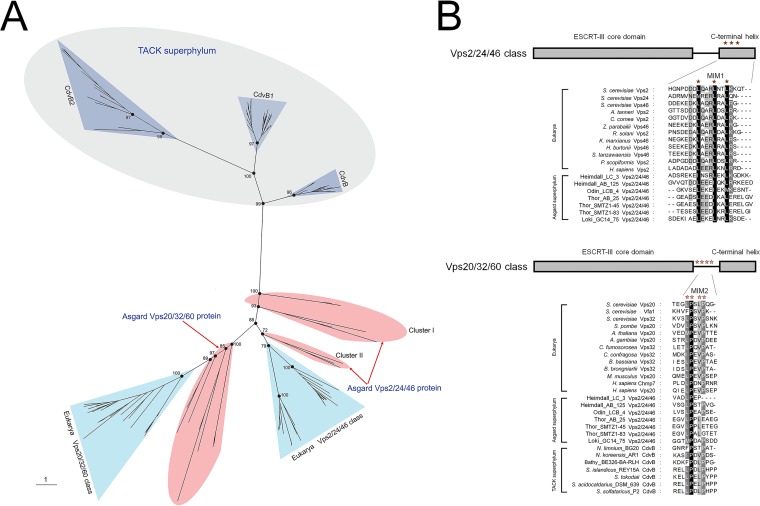
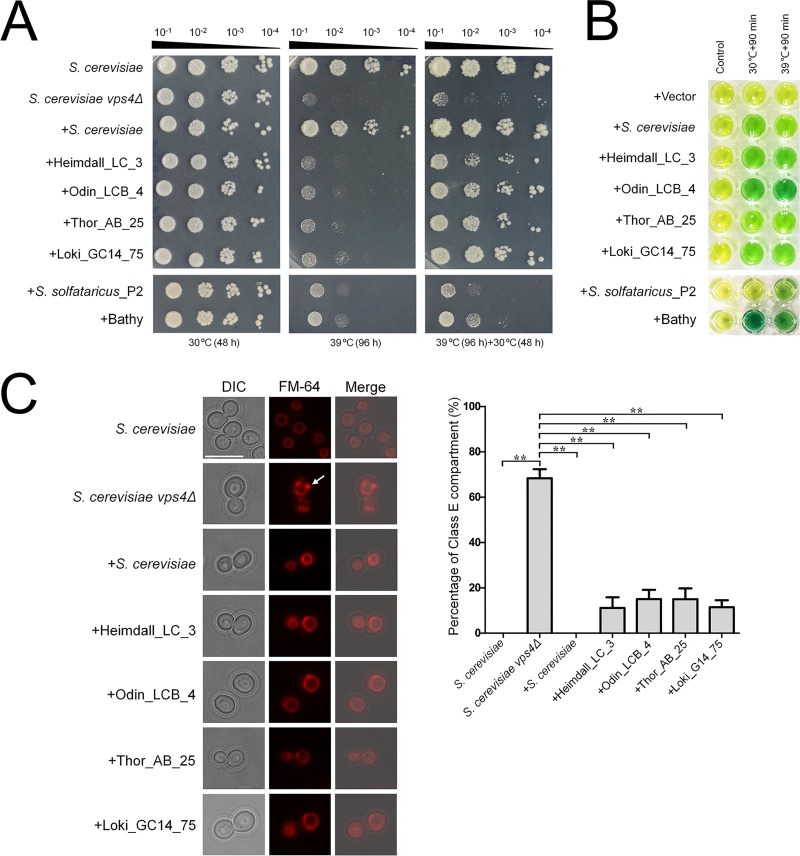
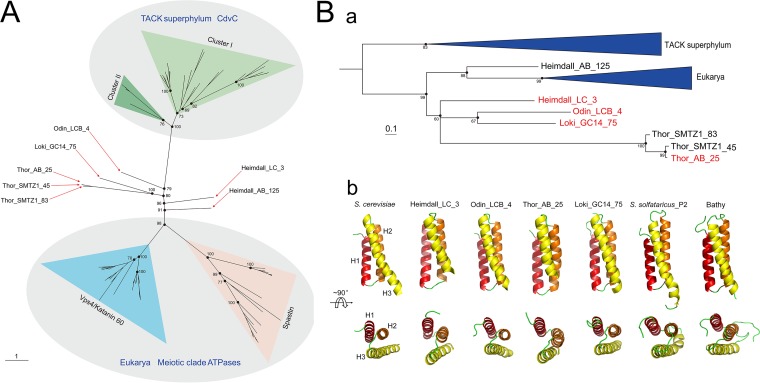
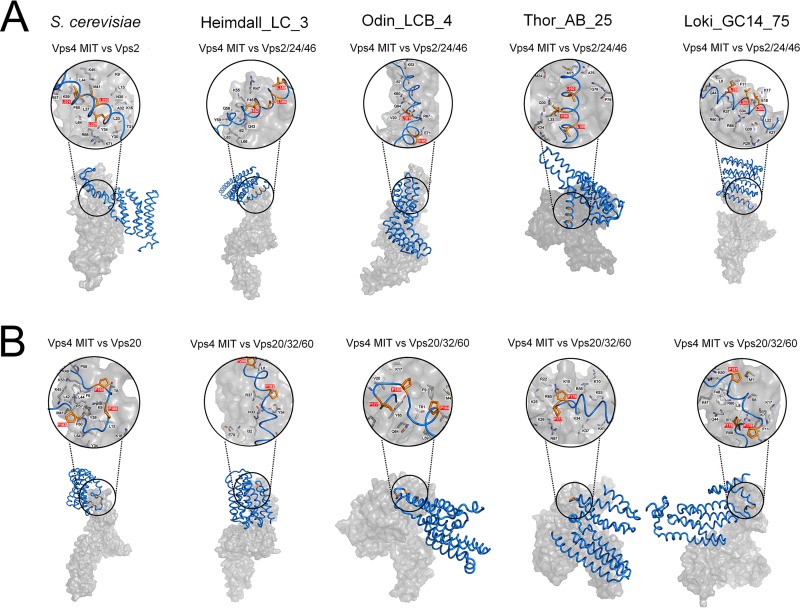
The emergence of the endomembrane system is a key step in the evolution of cellular complexity during eukaryogenesis. The endosomal sorting complex required for transport (ESCRT) machinery is essential and required for the endomembrane system functions in eukaryotic cells. Recently, genes encoding eukaryote-like ESCRT protein components have been identified in the genomes of Asgard archaea, a newly proposed archaeal superphylum that is thought to include the closest extant prokaryotic relatives of eukaryotes. However, structural and functional features of Asgard ESCRT remain uncharacterized. Here, we show that Vps4, Vps2/24/46, and Vps20/32/60, the core functional components of the Asgard ESCRT, coevolved eukaryote-like structural and functional features. Phylogenetic analysis shows that Asgard Vps4, Vps2/24/46, and Vps20/32/60 are closely related to their eukaryotic counterparts. Molecular dynamics simulation and biochemical assays indicate that Asgard Vps4 contains a eukaryote-like microtubule-interacting and transport (MIT) domain that binds the distinct type 1 MIT-interacting motif and type 2 MIT-interacting motif in Vps2/24/46 and Vps20/32/60, respectively. The Asgard Vps4 partly, but much more efficiently than homologs from other archaea, complements the null mutant of , further supporting the functional similarity between the membrane remodeling machineries of Asgard archaea and eukaryotes. Thus, this work provides evidence that the ESCRT complexes from Asgard archaea and eukaryotes are evolutionarily related and functionally similar. Thus, despite the apparent absence of endomembranes in Asgard archaea, the eukaryotic ESCRT seems to have been directly inherited from an Asgard ancestor, to become a key component of the emerging endomembrane system. The discovery of Asgard archaea has changed the existing ideas on the origins of eukaryotes. Researchers propose that eukaryotic cells evolved from Asgard archaea. This hypothesis partly stems from the presence of multiple eukaryotic signature proteins in Asgard archaea, including homologs of ESCRT proteins that are essential components of the endomembrane system in eukaryotes. However, structural and functional features of Asgard ESCRT remain unknown. Our study provides evidence that Asgard ESCRT is functionally comparable to the eukaryotic counterparts, suggesting that despite the apparent absence of endomembranes in archaea, eukaryotic ESCRT was inherited from an Asgard archaeal ancestor, alongside the emergence of endomembrane system during eukaryogenesis.
内体分选复合物运输所需(ESCRT)机制对于真核细胞的内体膜系统功能至关重要。最近,在被认为包含真核生物最接近的原核亲属的新提出的古菌超门 Asgard 古菌的基因组中,已经鉴定出编码真核样 ESCRT 蛋白成分的基因。然而,Asgard ESCRT 的结构和功能特征仍然未知。在这里,我们表明,Vps4、Vps2/24/46 和 Vps20/32/60 是 Asgard ESCRT 的核心功能成分,它们共同进化出了真核样的结构和功能特征。系统发育分析表明,Asgard Vps4、Vps2/24/46 和 Vps20/32/60 与它们的真核对应物密切相关。分子动力学模拟和生化分析表明,Asgard Vps4 含有一个真核样微管相互作用和运输(MIT)结构域,该结构域分别与 Vps2/24/46 和 Vps20/32/60 中的独特的 1 型 MIT 相互作用基序和 2 型 MIT 相互作用基序结合。Asgard Vps4 部分,但比其他古菌的同源物更有效,补充了 的缺失突变体,进一步支持 Asgard 古菌和真核生物的膜重塑机制之间的功能相似性。因此,这项工作提供了证据,证明 Asgard 古菌和真核生物的 ESCRT 复合物在进化上是相关的,并且在功能上是相似的。因此,尽管 Asgard 古菌中显然不存在内体膜,但真核 ESCRT 似乎是直接从 Asgard 祖先继承而来的,成为新兴内体膜系统的关键组成部分。Asgard 古菌的发现改变了人们对真核生物起源的现有认识。研究人员提出,真核细胞是从 Asgard 古菌进化而来的。这一假设部分源于 Asgard 古菌中存在多种真核特征蛋白,包括 ESCRT 蛋白的同源物,ESCRT 蛋白是真核生物内体膜系统的重要组成部分。然而,Asgard ESCRT 的结构和功能特征仍然未知。我们的研究提供了证据,证明 Asgard ESCRT 在功能上与真核对应物相当,这表明尽管古菌中显然不存在内体膜,但真核 ESCRT 是从 Asgard 古菌祖先那里继承而来的,与真核生物内体膜系统的出现一起出现。