Division of Oncology, Department of Medicine, Washington University School of Medicine, St. Louis, MO; and.
Siteman Cancer Center, Washington University, St. Louis, MO.
Blood. 2020 Jul 2;136(1):50-60. doi: 10.1182/blood.2019000942.
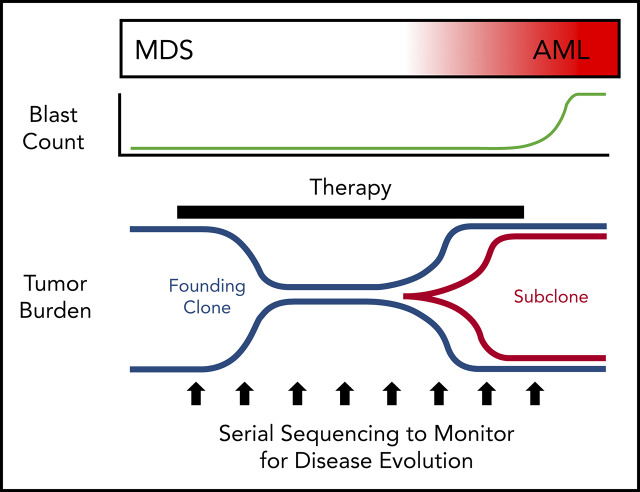
Our understanding of the genetics of acute myeloid leukemia (AML) development from myelodysplastic syndrome (MDS) has advanced significantly as a result of next-generation sequencing technology. Although differences in cell biology and maturation exist between MDS and AML secondary to MDS, these 2 diseases are genetically related. MDS and secondary AML cells harbor mutations in many of the same genes and functional categories, including chromatin modification, DNA methylation, RNA splicing, cohesin complex, transcription factors, cell signaling, and DNA damage, confirming that they are a disease continuum. Differences in the frequency of mutated genes in MDS and secondary AML indicate that the order of mutation acquisition is not random during progression. In almost every case, disease progression is associated with clonal evolution, typically defined by the expansion or emergence of a subclone with a unique set of mutations. Monitoring tumor burden and clonal evolution using sequencing provides advantages over using the blast count, which underestimates tumor burden, and could allow for early detection of disease progression prior to clinical deterioration. In this review, we outline advances in the study of MDS to secondary AML progression, with a focus on the genetics of progression, and discuss the advantages of incorporating molecular genetic data in the diagnosis, classification, and monitoring of MDS to secondary AML progression. Because sequencing is becoming routine in the clinic, ongoing research is needed to define the optimal assay to use in different clinical situations and how the data can be used to improve outcomes for patients with MDS and secondary AML.
由于下一代测序技术的发展,我们对骨髓增生异常综合征(MDS)发展为急性髓系白血病(AML)的遗传学有了显著的认识。尽管 MDS 和 MDS 继发的 AML 在细胞生物学和成熟方面存在差异,但这两种疾病在遗传学上是相关的。MDS 和继发的 AML 细胞中存在许多相同基因和功能类别的突变,包括染色质修饰、DNA 甲基化、RNA 剪接、黏合复合物、转录因子、细胞信号转导和 DNA 损伤,这证实了它们是一种疾病连续体。MDS 和继发的 AML 中突变基因的频率差异表明,在进展过程中,突变的获得顺序不是随机的。在几乎所有情况下,疾病进展都与克隆进化有关,通常定义为具有独特突变集的亚克隆的扩张或出现。使用测序监测肿瘤负担和克隆进化优于使用blast 计数,后者低估了肿瘤负担,并可能在临床恶化之前早期检测疾病进展。在这篇综述中,我们概述了 MDS 向继发性 AML 进展的研究进展,重点介绍了进展的遗传学,并讨论了将分子遗传学数据纳入 MDS 向继发性 AML 进展的诊断、分类和监测中的优势。由于测序在临床上变得越来越常规,因此需要进行持续的研究,以确定在不同临床情况下使用的最佳检测方法,以及如何使用这些数据来改善 MDS 和继发性 AML 患者的预后。