Bai Guangxu, Wang Hao, Han Wen, Cui Na
Department of Critical Care Medicine, Peking Union Medical College Hospital, Peking Union Medical College, Chinese Academy of Medical Sciences, Beijing, China.
Department of Clinical Laboratory, Peking Union Medical College Hospital, Peking Union Medical College, Chinese Academy of Medical Sciences, Beijing, China.
Front Microbiol. 2020 May 5;11:835. doi: 10.3389/fmicb.2020.00835. eCollection 2020.
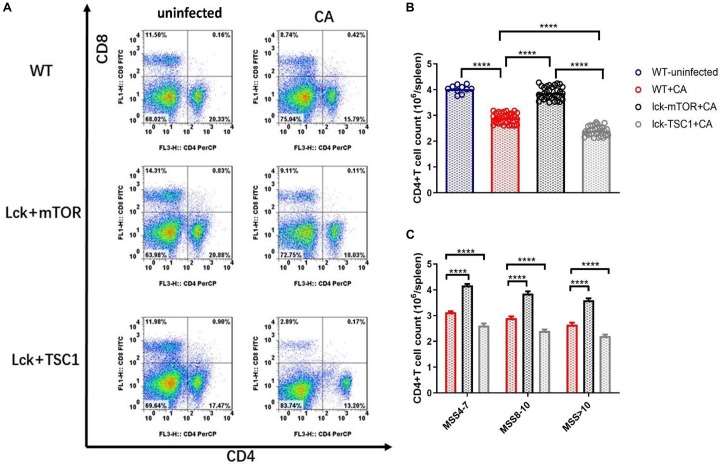
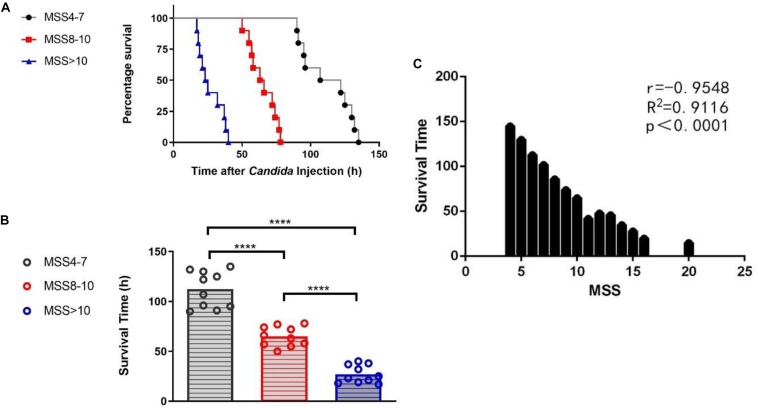
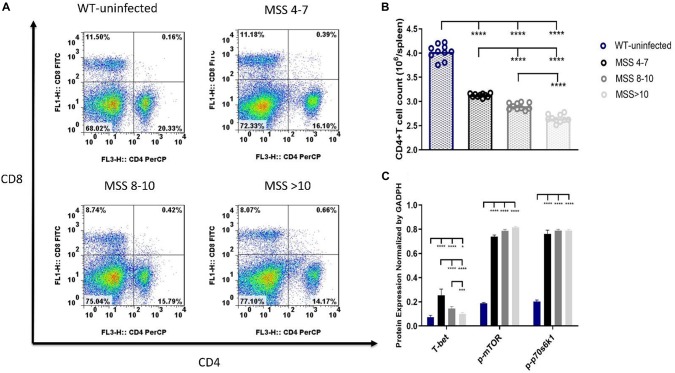
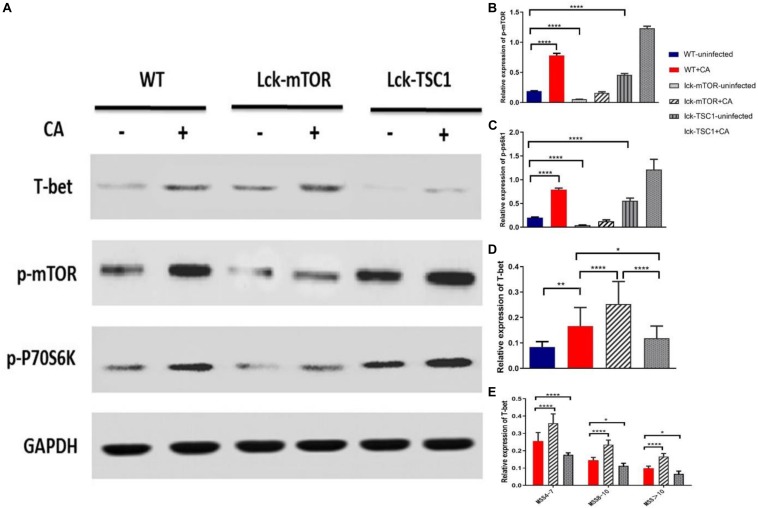
The sustained high morbidity and mortality of sepsis are mainly caused by compromise of host immunity. Clinically, it is often manifested as a significant decrease in CD4 T cell count, although the mechanism is unclear. We established a lethal mice sepsis model and used Murine Sepsis Score to group mice with different disease severity to establish the influence of T-bet expression on CD4 T cell count in sepsis. We found that CD4 T cell count decreased in -infected compared to uninfected mice, and the degree of decrease increased with aggravation of sepsis. Expression of T-bet similarly decreased with worsening of sepsis, but it was significantly enhanced in candidiasis in comparison of naïve state. To clarify its possible mechanism, we measured the activity of mammalian target of rapamycin (mTOR), which is a key regulator of T-bet expression. The mTOR pathway was activated after infection and its activity increased with progression of sepsis. We used mice with T-cell-specific knockout of or tuberous sclerosis complex ()1 to further inhibit or strengthen the mTOR signaling pathway. We found that deletion mice had a higher CD4 T cell count by regulating T-bet expression, and the result in deletion mice was reversed. These results demonstrate that T-bet expression mediated by the mTOR pathway influences the CD4 T cell count in mice with sepsis.
脓毒症持续的高发病率和死亡率主要是由宿主免疫功能受损引起的。临床上,其常表现为CD4 T细胞计数显著下降,尽管其机制尚不清楚。我们建立了致死性小鼠脓毒症模型,并使用小鼠脓毒症评分对不同疾病严重程度的小鼠进行分组,以确定T-bet表达对脓毒症中CD4 T细胞计数的影响。我们发现,与未感染小鼠相比,感染小鼠的CD4 T细胞计数下降,且下降程度随脓毒症的加重而增加。T-bet的表达同样随脓毒症的恶化而降低,但与未感染状态相比,在念珠菌感染中显著增强。为阐明其可能机制,我们检测了雷帕霉素靶蛋白(mTOR)的活性,mTOR是T-bet表达的关键调节因子。感染后mTOR通路被激活,其活性随脓毒症进展而增加。我们使用T细胞特异性敲除或结节性硬化复合物(TSC)1的小鼠进一步抑制或增强mTOR信号通路。我们发现,通过调节T-bet表达,敲除小鼠的CD4 T细胞计数更高,而敲除小鼠的结果则相反。这些结果表明,mTOR通路介导的T-bet表达影响脓毒症小鼠的CD4 T细胞计数。