Sjodin Bryson M F, Irvine Robyn L, Ford Adam T, Howald Gregg R, Russello Michael A
Department of Biology University of British Columbia Kelowna BC Canada.
Gwaii Haanas National Park Reserve National Marine Conservation Area Reserve and Haida Heritage Site Skidegate BC Canada.
Evol Appl. 2020 Jan 8;13(5):889-904. doi: 10.1111/eva.12907. eCollection 2020 May.
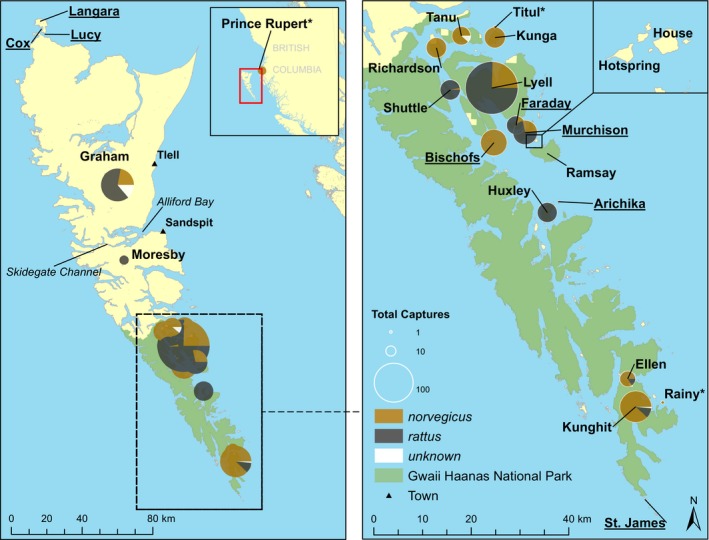
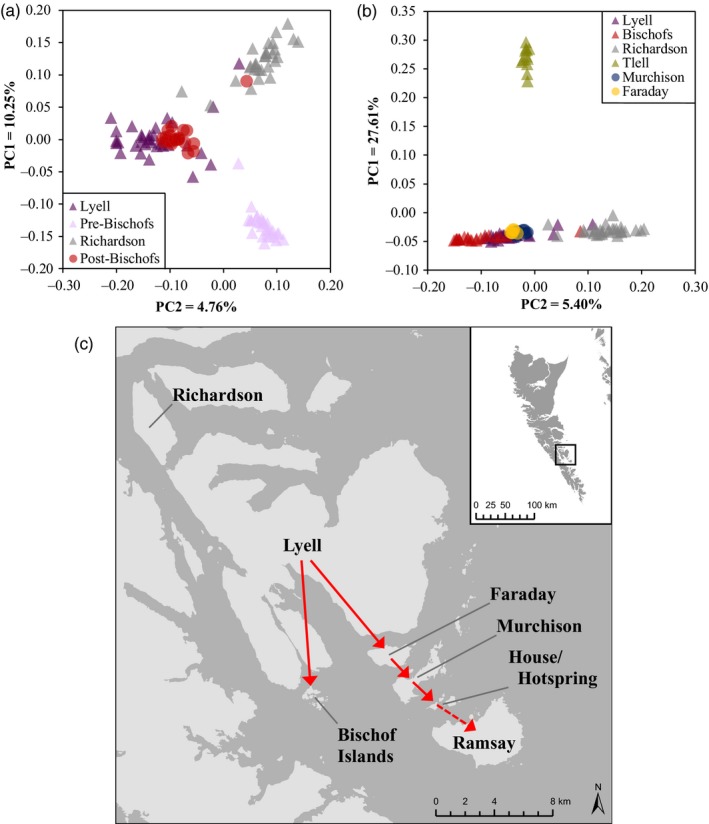
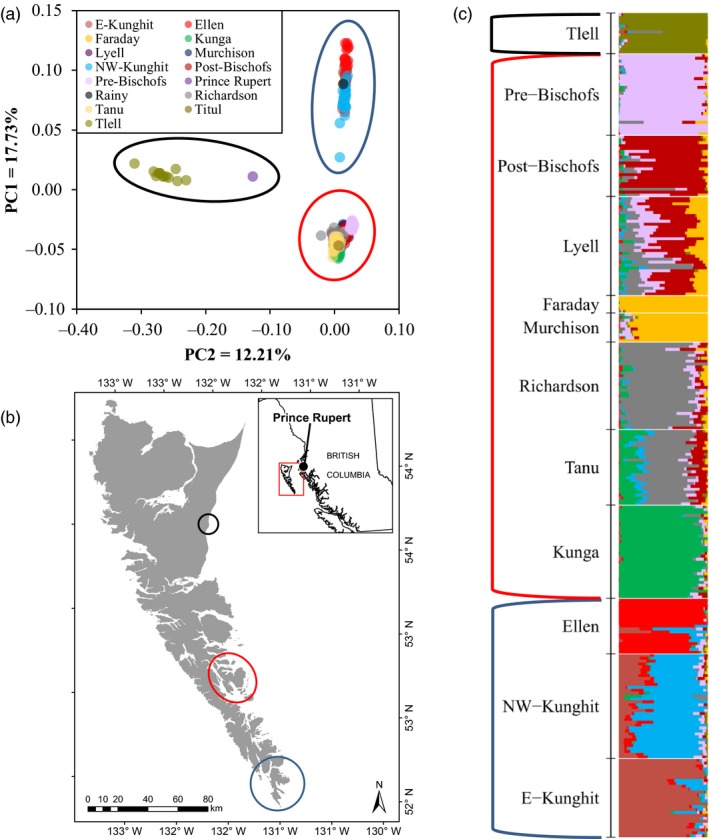
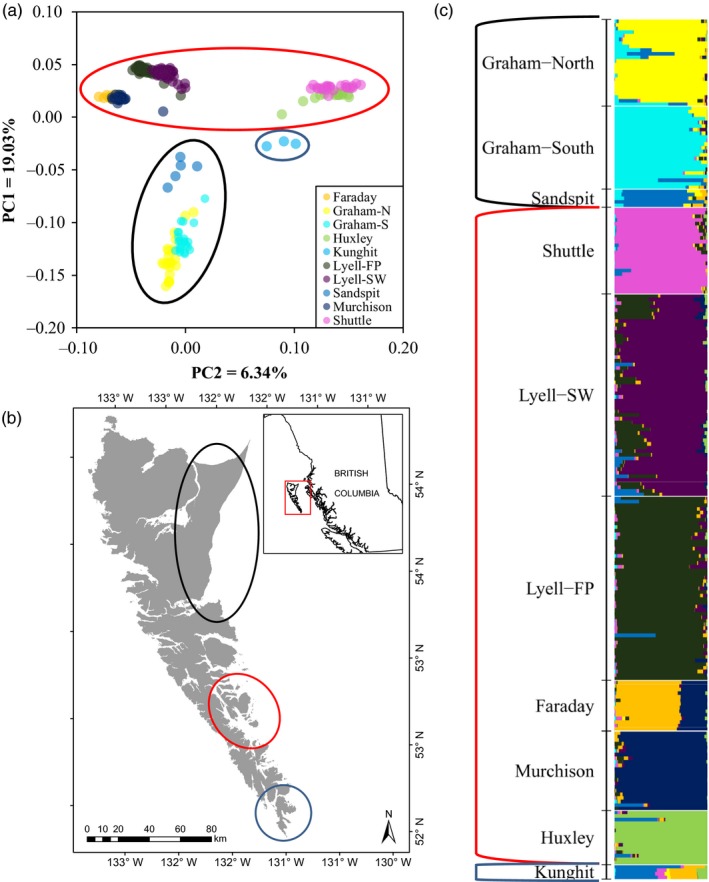
Invasive species have led to precipitous declines in biodiversity, especially in island systems. Brown () and black rats () are among the most invasive animals on the planet, with eradication being the primary tool for established island populations. The need for increased research for defining eradication units and monitoring outcomes has been highlighted as a means to maximize success. Haida Gwaii is an archipelago ~100 km off the northern coast of British Columbia, Canada, that hosts globally significant breeding populations of seabirds that are at risk due to invasive rats. Here, we paired sampling of brown ( = 287) and black ( = 291) rats across the Haida Gwaii archipelago with genotyping by sequencing (10,770-27,686 SNPs) to investigate patterns of population connectivity and infer levels/direction of gene flow among invasive rat populations in Haida Gwaii. We reconstructed three regional clusters for both species (north, central and south), with proximate populations within regions being largely more related than those that were more distant, consistent with predictions from island biogeography theory. Population assignment of recently detected individuals post-eradication on Faraday, Murchison and the Bischof Islands revealed all were re-invaders from Lyell Island, rather than being on-island survivors. Based on these results, we identified six eradication units constituting single or clusters of islands that would limit the potential for reinvasion, some of which will need to be combined with biosecurity measures. Overall, our results highlight the importance of targeted research prior to conducting eradications and demonstrate a framework for applying population genomics for guiding invasive species management in island systems.
入侵物种已导致生物多样性急剧下降,尤其是在岛屿系统中。棕鼠(Rattus norvegicus)和黑鼠(Rattus rattus)是地球上入侵性最强的动物之一,消灭它们是控制岛屿上已定居种群的主要手段。人们强调需要加强研究以确定消灭单元并监测结果,以此作为实现最大成功率的一种方式。海达瓜依是位于加拿大不列颠哥伦比亚省北部海岸约100公里外的一个群岛,这里有具有全球重要意义的海鸟繁殖种群,它们因入侵鼠类而面临风险。在此,我们对海达瓜依群岛上的棕鼠(n = 287)和黑鼠(n = 291)进行采样,并通过测序进行基因分型(10,770 - 27,686个单核苷酸多态性),以研究种群连通性模式,并推断海达瓜依入侵鼠种群之间基因流动的水平/方向。我们为这两个物种都重建了三个区域集群(北部、中部和南部),区域内相邻种群在很大程度上比距离较远的种群关系更密切,这与岛屿生物地理学理论的预测一致。对法拉第岛、默奇森岛和 Bischof 岛上根除行动后最近检测到的个体进行种群归属分析表明,所有个体都是从莱尔岛重新入侵的,而不是岛上的幸存者。基于这些结果,我们确定了六个消灭单元,它们由单个岛屿或岛屿集群组成,这将限制再次入侵的可能性,其中一些单元需要结合生物安全措施。总体而言,我们的结果突出了在进行根除行动之前进行针对性研究的重要性,并展示了一个应用种群基因组学来指导岛屿系统中入侵物种管理的框架。