Schou Mads F, Kristensen Torsten N, Hoffmann Ary A
Department of Chemistry and Bioscience Aalborg University Aalborg East Denmark.
Department of Biology Lund University Lund Sweden.
Evol Appl. 2020 Mar 6;13(5):1090-1102. doi: 10.1111/eva.12924. eCollection 2020 May.
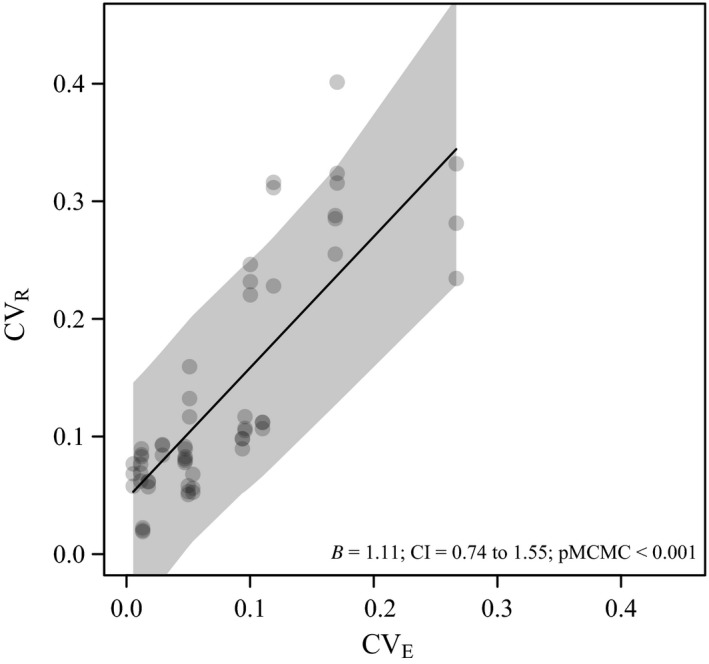
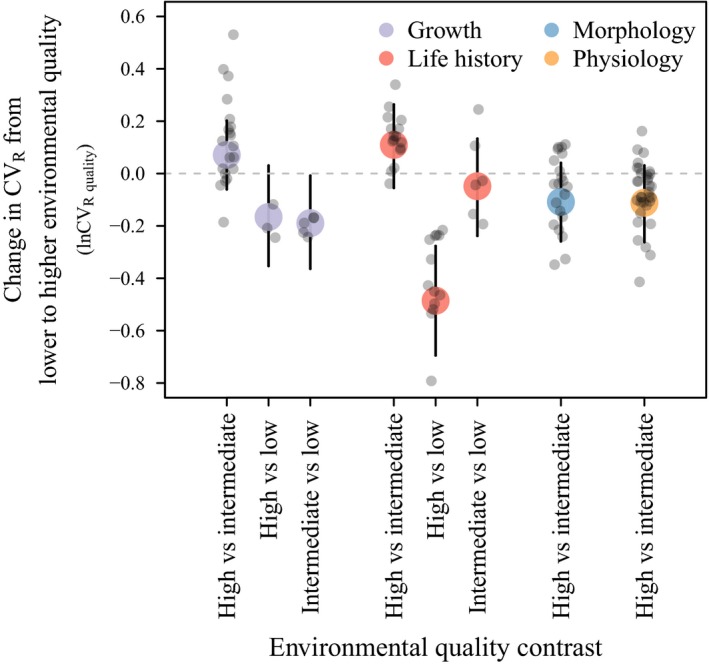
The variance in phenotypic trait values is a product of environmental and genetic variation. The sensitivity of traits to environmental variation has a genetic component and is likely to be under selection. However, there are few studies investigating the evolution of this sensitivity, in part due to the challenges of estimating the environmental variance. The livestock literature provides a wealth of studies that accurately partition components of phenotypic variance, including the environmental variance, in well-defined environments. These studies involve breeds that have been under strong selection on mean phenotype in optimal environments for many generations, and therefore represent an opportunity to study the potential evolution of trait sensitivity to environmental conditions. Here, we use literature on domestic cattle to examine the evolution of micro-environmental variance (CV-the coefficient of residual variance) by testing for differences in expression of CV in animals from the same breed reared in different environments. Traits that have been under strong selection did not follow a null expectation of an increase in CV in heterogenous environments (e.g., grazing), a pattern that may reflect evolution of increased uniformity in heterogeneous environments. When comparing CV across environments of different levels of optimality, here measured by trait mean, we found a reduction in CV in the more optimal environments for both life history and growth traits. Selection aimed at increasing trait means in livestock breeds typically occurs in the more optimal environments, and we therefore suspect that the decreased CV is a consequence of evolution of the expression of micro-environmental variance in this environment. Our results highlight the heterogeneity in micro-environmental variance across environments and point to possible connections to the intensity of selection on trait means.
表型性状值的方差是环境变异和遗传变异的产物。性状对环境变异的敏感性具有遗传成分,并且可能受到选择作用。然而,很少有研究调查这种敏感性的进化情况,部分原因是估计环境方差存在挑战。畜牧学文献提供了大量研究,这些研究在定义明确的环境中准确划分了表型方差的组成部分,包括环境方差。这些研究涉及在最佳环境中经过多代对平均表型进行强烈选择的品种,因此代表了一个研究性状对环境条件敏感性潜在进化的机会。在这里,我们利用关于家牛的文献,通过测试在不同环境中饲养的同一品种动物的残差方差系数(CV)表达差异,来研究微环境方差(CV)的进化。经过强烈选择的性状在异质环境(如放牧)中并没有遵循CV增加的零预期模式,这种模式可能反映了在异质环境中增加一致性的进化。当比较不同最优水平环境下的CV时,这里用性状均值来衡量,我们发现对于生活史和生长性状,在更优的环境中CV会降低。旨在提高家畜品种性状均值的选择通常发生在更优的环境中,因此我们怀疑CV的降低是该环境中微环境方差表达进化的结果。我们的结果突出了不同环境中微环境方差的异质性,并指出了与性状均值选择强度的可能联系。