Aghababaei Ziarati Mohammadreza, Taziki Mohammad Hosein, Hosseini Seyed Mehran
Department of Internal Medicine, Medical Faculty, Golestan University of Medical Sciences, Gorgan 4934174515, Golestan, Iran.
Department of Otolaryngology, Medical Faculty, Golestan University of Medical Sciences, Gorgan 4934174515, Golestan, Iran.
World J Cardiol. 2020 Apr 26;12(4):144-154. doi: 10.4330/wjc.v12.i4.144.
Caloric stimulation of the vestibular system is associated with autonomic response. The lateralization in the nervous system activities also involves the autonomic nervous system.
To compare the effect of the right and left ear caloric test on the cardiac sympathovagal tone in healthy persons.
This self-control study was conducted on 12 healthy male volunteers. The minimal ice water caloric test was applied for vestibular stimulation. This was done by irrigating 1 milliliter of 4 ± 2 °C ice water into the external ear canal in 1 s. In each experiment, only one ear was stimulated. For each ear, the pessimum position was considered as sham control and the optimum position was set as caloric vestibular stimulation of horizontal semicircular channel. The order of right or left caloric vestibular stimulation and the sequence of optimum or pessimum head position in each set were random. The recovery time between each calorie test was 5 min. The short-term heart rate variability (HRV) was used for cardiac sympathovagal tone metrics. All variables were compared using the analysis of variance.
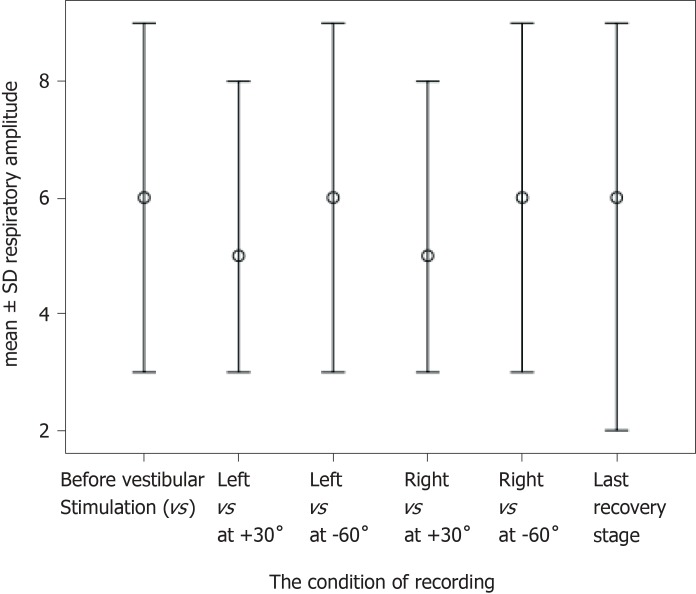
After caloric vestibular stimulation, the short-term time-domain and frequency-domain HRV indices as well as, the systolic and the diastolic arterial blood pressure, the respiratory rate and the respiratory amplitude, had no significant changes. These negative results were similar in the right and the left sides. Nystagmus duration of left caloric vestibular stimulations in the optimum and the pessimum positions had significant differences (., 72.14 ± 39.06 45.35 ± 35.65, < 0.01). Nystagmus duration of right caloric vestibular stimulations in the optimum and the pessimum positions had also significant differences (., 86.42 ± 67.20 50.71 ± 29.73, < 0.01). The time of the start of the nystagmus following caloric vestibular stimulation had no differences in both sides and both positions.
Minimal ice water caloric stimulation of the right and left vestibular system did not affect the cardiac sympathovagal balance according to HRV indices.
前庭系统的热量刺激与自主神经反应相关。神经系统活动的侧化也涉及自主神经系统。
比较健康人左右耳冷热试验对心脏交感迷走神经张力的影响。
本自我对照研究对12名健康男性志愿者进行。采用最小量冰水冷热试验进行前庭刺激。方法是在1秒内将1毫升4±2℃的冰水灌入外耳道。在每个实验中,仅刺激一只耳朵。对于每只耳朵,将最不适宜位置视为假对照,将最佳位置设定为水平半规管的冷热前庭刺激。每组中左右冷热前庭刺激的顺序以及最佳或最不适宜头部位置的顺序是随机的。每次冷热试验之间休息5分钟。采用短期心率变异性(HRV)评估心脏交感迷走神经张力指标。所有变量采用方差分析进行比较。
冷热前庭刺激后,短期时域和频域HRV指标以及收缩压、舒张压、呼吸频率和呼吸幅度均无显著变化。左右两侧的这些阴性结果相似。左侧冷热前庭刺激在最佳和最不适宜位置的眼震持续时间有显著差异(分别为72.14±39.06和45.35±35.65,P<0.01)。右侧冷热前庭刺激在最佳和最不适宜位置的眼震持续时间也有显著差异(分别为86.42±67.20和50.71±29.73,P<0.01)。冷热前庭刺激后眼震开始时间在两侧和两个位置均无差异。
根据HRV指标,左右前庭系统的最小量冰水冷热刺激不影响心脏交感迷走神经平衡。