Office of Research and Development, United States Environmental Protection Agency, Durham, NC, United States.
Front Public Health. 2020 May 5;8:143. doi: 10.3389/fpubh.2020.00143. eCollection 2020.
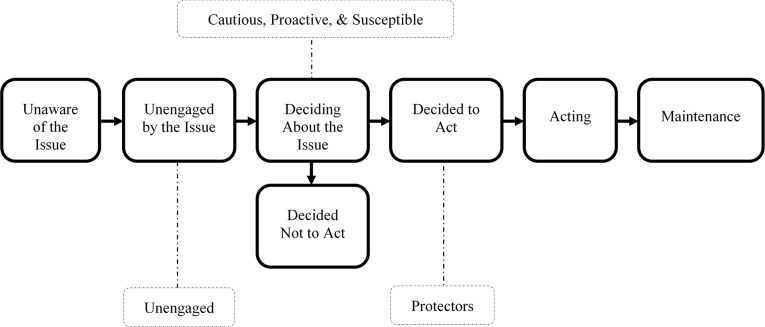
Central to public health risk communication is understanding the perspectives and shared values among individuals who need the information. Using the responses from a Smoke Sense citizen science project, we examined perspectives on the issue of wildfire smoke as a health risk in relation to an individual's preparedness to adopt recommended health behaviors. The Smoke Sense smartphone application provides wildfire-related health risk resources and invites participants to record their perspectives on the issue of wildfire smoke. Within the app, participants can explore current and forecasted daily air quality, maps of fire locations, satellite images of smoke plumes, and learn about health consequences of wildfire smoke. We used cluster analysis to identify perspective trait-clusters based on health status, experience with fire smoke, risk perception, self-efficacy, access to exposure-reducing resources, health information needs, and openness to health risk messaging. Differences between traits were examined based on demographics, health status, activity level and engagement with the app. We mapped these traits to the Precaution Adoption Process Model (PAPM) to indicate where each trait lies in adopting recommended health behaviors. Finally, we suggest messaging strategies that may be suitable for each trait. We determined five distinct perspective traits which included individuals who were and have decided to engage on the issue by adopting new behaviors to protect their health; individuals who were at a stage but differed based on risk perceptions and information needs; and the who did not perceive smoke as a health issue and were unlikely to change behavior in response to messaging. Across all five traits, the level of engagement and information needs differed substantially, but were not defined by demographics. Individuals in the trait had the highest level of engagement and the highest information needs. Messaging that emphasizes self-efficacy and benefits of reducing exposure may be effective in motivating individuals from the deciding stage to taking health protective action. Shared perspectives define an individual's propensity for acting on recommended health behaviors, therefore, health risk message content should be tailored based on these perspectives.
公共卫生风险沟通的核心是理解需要信息的个人的观点和共同价值观。本研究使用“感知烟雾”公民科学项目的回应,考察了个体对野火烟雾作为健康风险的看法与个体准备采取建议健康行为之间的关系。“感知烟雾”智能手机应用程序提供了与野火相关的健康风险资源,并邀请参与者记录他们对野火烟雾问题的看法。在应用程序中,参与者可以探索当前和预测的每日空气质量、火灾位置图、烟雾羽流的卫星图像,并了解野火烟雾对健康的影响。我们使用聚类分析基于健康状况、火灾烟雾体验、风险感知、自我效能、接触减少暴露资源、健康信息需求和对健康风险信息的开放性,识别基于健康状况、体验火灾烟雾、风险感知、自我效能、接触减少暴露资源、健康信息需求和对健康风险信息的开放性的观点特征群。根据人口统计学特征、健康状况、活动水平和对应用程序的参与度,研究了特征之间的差异。我们将这些特征映射到预防采用过程模型(PAPM)中,以表明每个特征在采取推荐的健康行为中的位置。最后,我们提出了适合每个特征的信息传递策略。我们确定了五个不同的观点特征,包括已经决定通过采取新的行为来保护自己健康来参与该问题的 个体;处于 阶段但基于风险感知和信息需求而有所不同的 个体;以及不认为烟雾是健康问题且不太可能对信息传递做出反应而改变行为的 个体。在所有五个特征中,参与度和信息需求水平差异很大,但不受人口统计学特征的定义。处于 特征的个体具有最高的参与度和最高的信息需求。强调自我效能和减少暴露的好处的信息传递可能有效地激励处于决策阶段的个体采取健康保护行动。共享的观点定义了个人采取建议健康行为的倾向,因此,健康风险信息内容应根据这些观点进行定制。