Department of Gynaecology, the Affiliated Huaian No.1 People's Hospital of Nanjing Medical University, No.6 Beijing West Road, Huaian, 223300, Jiangsu, China.
Biosci Rep. 2020 Jun 26;40(6). doi: 10.1042/BSR20193371.
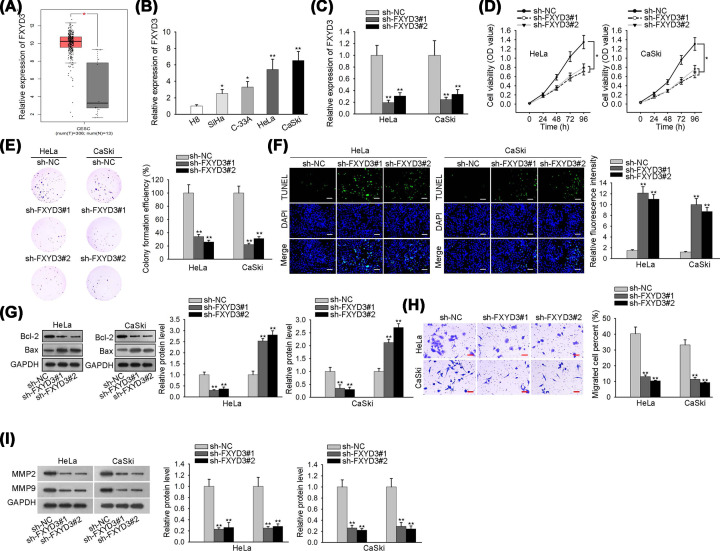
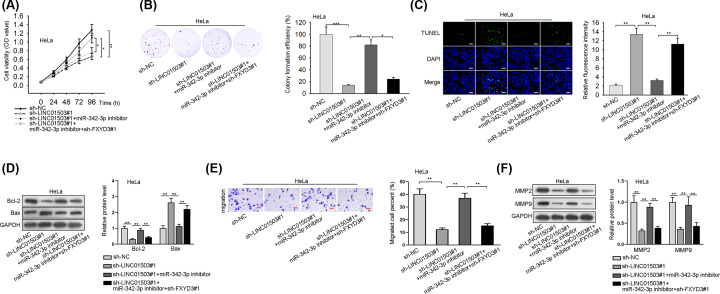
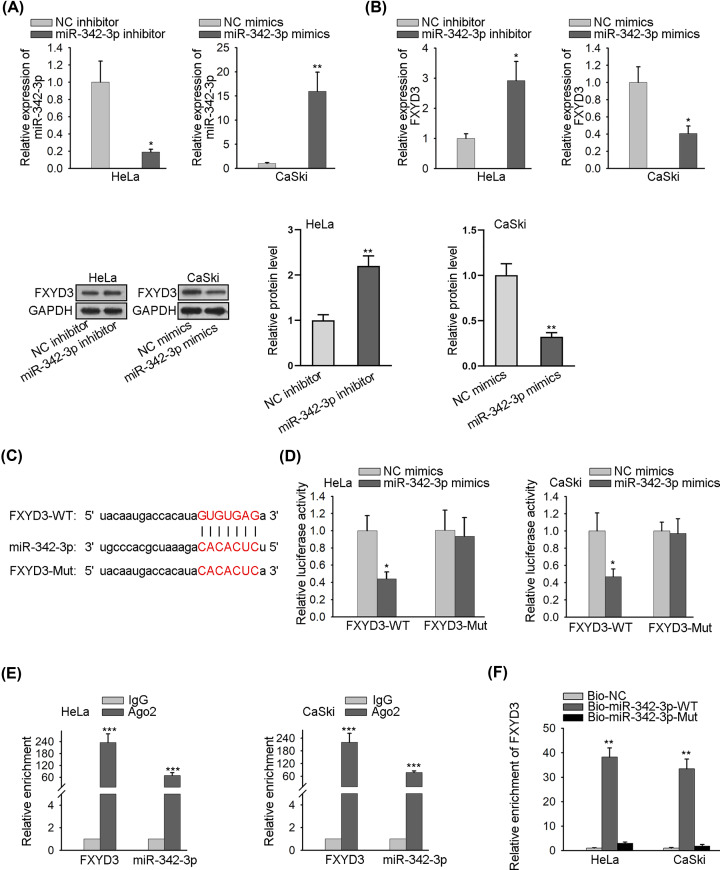
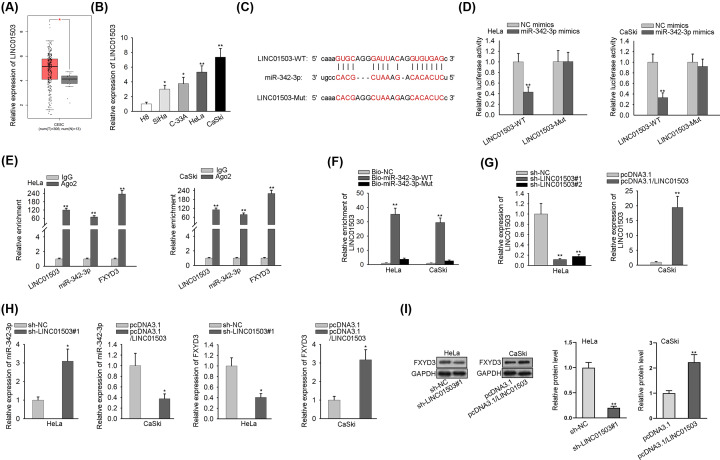
Cervical cancer (CC), an aggressive malignancy, has a high risk of relapse and death, mainly occurring in females. Accumulating investigations have confirmed the critical role of long noncoding RNAs (lncRNAs) in diverse cancers. LncRNA LINC01503 has been reported as an oncogene in several cancers. Nonetheless, its role and molecular mechanism in CC have not been explored. In the present study, we found that FXYD3 expression was considerably up-regulated in CC tissues and cells. Moreover, FXYD3 deficiency conspicuously hampered cell proliferation and migration while facilitated cell apoptosis in CC cells. Subsequently, molecular mechanism experiments implied that FXYD3 was a downstream target gene of miR-342-3p, and FXYD3 expression was reversely mediated by miR-342-3p. Moreover, we discovered that LINC01503 acted as the endogenous sponge for miR-342-3p. Besides, LINC01503 negatively regulated miR-342-3p expression and positively regulated FXYD3 expression in CC. Rescue assays revealed that LINC01503 depletion-induced repression on CC progression could be partly recovered by miR-342-3p inhibition, and then the co-transfection of sh-FXYD3#1 rescued this effect. Conclusively, LINC01503 aggravated CC progression through sponging miR-342-3p to mediate FXYD3 expression, providing promising therapeutic targets for CC patients.
宫颈癌(CC)是一种侵袭性恶性肿瘤,具有较高的复发和死亡风险,主要发生在女性。越来越多的研究证实,长链非编码 RNA(lncRNA)在多种癌症中发挥着关键作用。lncRNA LINC01503 已被报道为几种癌症的癌基因。然而,其在 CC 中的作用和分子机制尚未得到探索。在本研究中,我们发现 FXYD3 在 CC 组织和细胞中表达显著上调。此外,FXYD3 缺失显著抑制 CC 细胞的增殖和迁移,促进细胞凋亡。随后的分子机制实验表明,FXYD3 是 miR-342-3p 的下游靶基因,而 FXYD3 的表达受 miR-342-3p 的反向调节。此外,我们发现 LINC01503 作为 miR-342-3p 的内源性海绵分子。此外,LINC01503 在 CC 中负向调节 miR-342-3p 的表达,正向调节 FXYD3 的表达。挽救实验表明,LINC01503 耗竭抑制 CC 进展的作用可部分通过 miR-342-3p 抑制恢复,然后共转染 sh-FXYD3#1 可恢复此作用。综上所述,LINC01503 通过海绵 miR-342-3p 介导 FXYD3 表达,加重 CC 进展,为 CC 患者提供了有前景的治疗靶点。