International Laboratory for Brain, Music, and Sound Research, Montréal, Québec, H3C 3J7, Canada.
Department of Psychology, University of Montréal, Québec, H3C 3J7, Canada.
Sci Rep. 2020 May 20;10(1):8325. doi: 10.1038/s41598-020-65034-9.
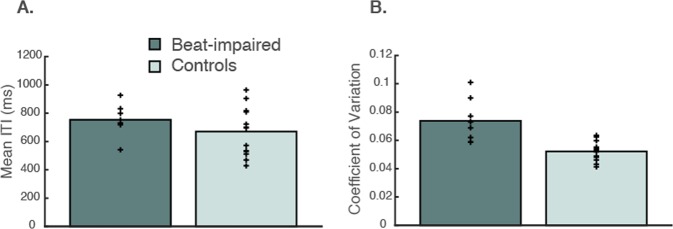
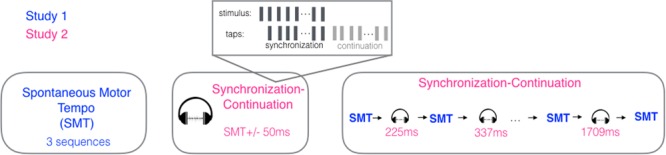
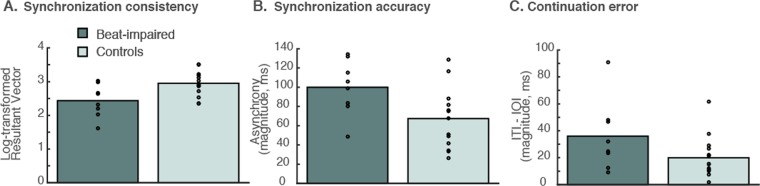
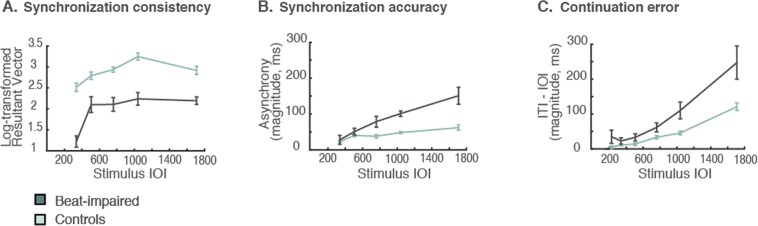
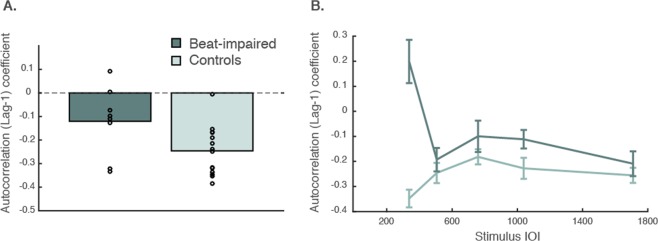
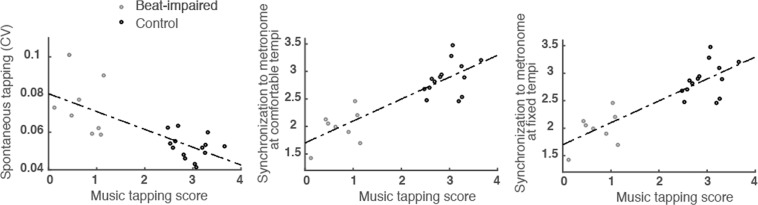
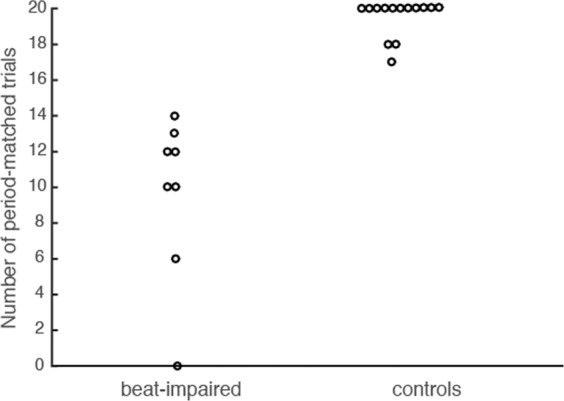
Humans have the capacity to match movements' timing with the beat of music. Yet some individuals show marked difficulties. The causes of these difficulties remain to be determined. Here, we investigate to what extend a beat synchronization deficit can be traced to basic timekeeping abilities. Eight beat-impaired individuals who were unable to successfully synchronize to the beat of music were compared to matched controls in their ability to tap a self-paced regular beat, to tap to a metronome spanning a large range of tempi (225-1709 ms inter-tone onsets), and to maintain the tempi after the sounds had ceased. Whether paced by a metronome or not, beat-impaired individuals showed poorer regularity (higher variability) in tapping, with an inability to synchronize at a fast tempo (225 ms between beats) or to sustain tapping at slow tempi (above 1 sec). Yet, they showed evidence of predictive and flexible processing. We suggest that the beat impairment is due to imprecise internal timekeeping mechanism.
人类有能力使动作的时间与音乐的节奏相匹配。然而,有些人却存在明显的困难。这些困难的原因尚待确定。在这里,我们研究了节拍同步缺陷在多大程度上可以追溯到基本的计时能力。我们将 8 名节拍障碍个体与匹配的对照组进行比较,观察他们在自我调节规则节拍的敲击能力、在节拍器上敲击跨越大范围拍速(225-1709ms 音之间的间隔)的能力,以及在声音停止后维持拍速的能力。无论是受节拍器还是其他因素的影响,节拍障碍个体在敲击时表现出较差的规律性(更高的可变性),无法在快速拍速(225ms 之间的节拍)下同步,也无法在慢速拍速(超过 1 秒)下维持敲击。然而,他们表现出了预测和灵活处理的迹象。我们认为,节拍障碍是由于内部计时机制不精确所致。