Center for Systems Integration and Sustainability, Department of Fisheries and Wildlife, Michigan State University, 1405 South Harrison Road, East Lansing, MI, 48823, USA.
US Geological Survey, Tennessee Cooperative Fishery Research Unit, Tennessee Technological University, Box 5114, Cookeville, TN, 38505, USA.
Nat Commun. 2020 May 20;11(1):2526. doi: 10.1038/s41467-020-14624-2.
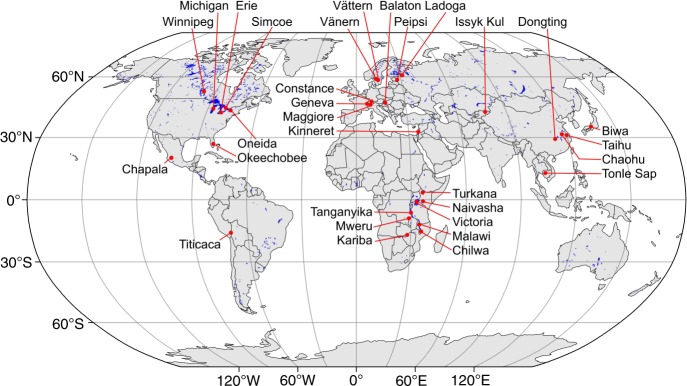
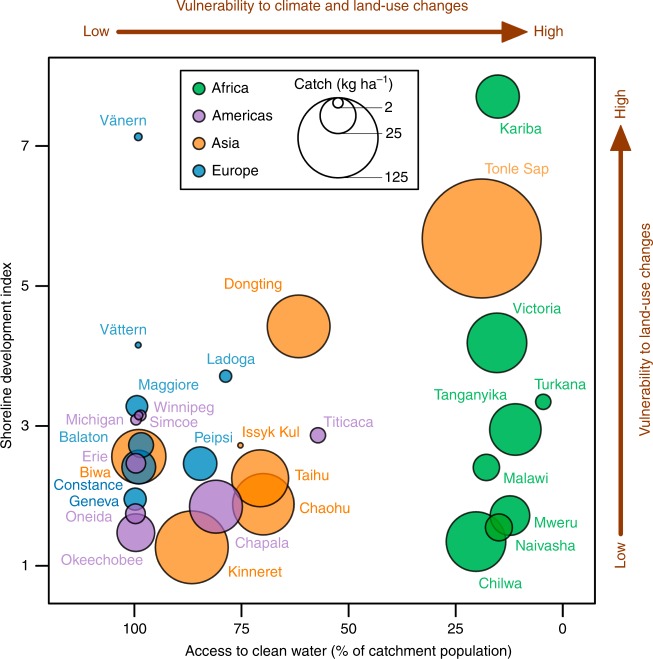
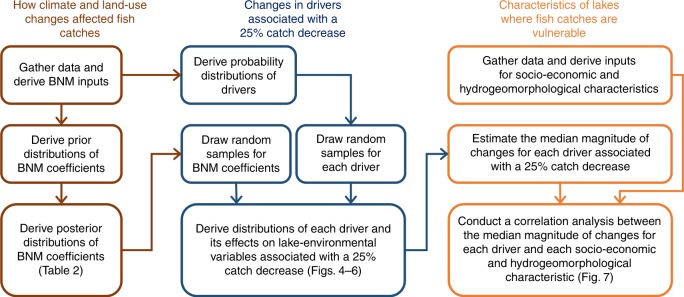
Globally, our knowledge on lake fisheries is still limited despite their importance to food security and livelihoods. Here we show that fish catches can respond either positively or negatively to climate and land-use changes, by analyzing time-series data (1970-2014) for 31 lakes across five continents. We find that effects of a climate or land-use driver (e.g., air temperature) on lake environment could be relatively consistent in directions, but consequential changes in a lake-environmental factor (e.g., water temperature) could result in either increases or decreases in fish catch in a given lake. A subsequent correlation analysis indicates that reductions in fish catch was less likely to occur in response to potential climate and land-use changes if a lake is located in a region with greater access to clean water. This finding suggests that adequate investments for water-quality protection and water-use efficiency can provide additional benefits to lake fisheries and food security.
尽管湖泊渔业对粮食安全和生计至关重要,但全球范围内,我们对其的了解仍然有限。在这里,我们通过分析五大洲 31 个湖泊的时间序列数据(1970-2014 年),表明鱼类捕捞量可以对气候和土地利用变化做出积极或消极的响应。我们发现,气候或土地利用驱动因素(例如空气温度)对湖泊环境的影响在方向上可能相对一致,但湖泊环境因素(例如水温)的 consequential 变化可能导致给定湖泊中的鱼类捕捞量增加或减少。随后的相关分析表明,如果湖泊所在地区能够更方便地获得清洁水,那么鱼类捕捞量减少的可能性就较小,这是对潜在气候和土地利用变化的响应。这一发现表明,为水质保护和用水效率进行充分投资可以为湖泊渔业和粮食安全带来额外的好处。