INSERM U1114, Cognitive Neuropsychology and Pathophysiology of Schizophrenia, University of Strasbourg, Strasbourg, France.
Department of Psychiatry and Psychotherapy, Medical Center-University of Freiburg, Faculty of Medicine, University of Freiburg, Freiburg, Germany.
PLoS One. 2020 May 20;15(5):e0232928. doi: 10.1371/journal.pone.0232928. eCollection 2020.
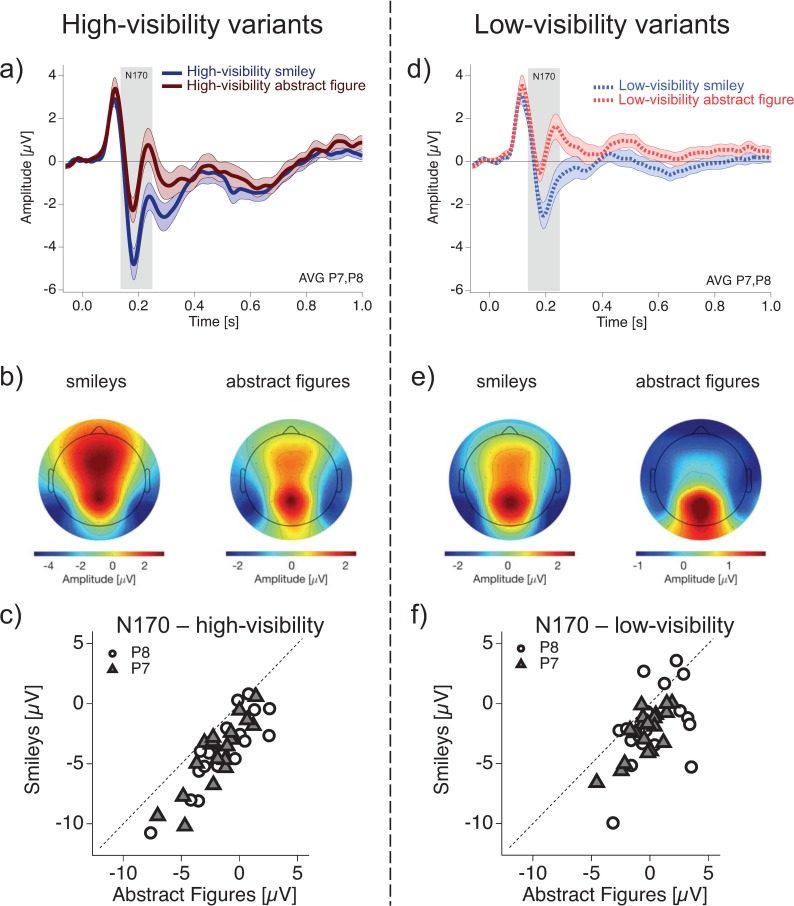
The information available through our senses is noisy, incomplete, and ambiguous. Our perceptual systems have to resolve this ambiguity to construct stable and reliable percepts. Previous EEG studies found large amplitude differences in two event-related potential (ERP) components 200 and 400 ms after stimulus onset when comparing ambiguous with disambiguated visual information ("ERP Ambiguity Effects"). These effects so far generalized across classical ambiguous figures from different visual categories at lower (geometry, motion) and intermediate (Gestalt perception) levels. The present study aimed to examine whether these ERP Effects are restricted to ambiguous figures or whether they also occur for different degrees of visibility. Smiley faces with low and high visibility of emotional expressions, as well as abstract figures with low and high visibility of a target curvature were presented. We thus compared ambiguity effects in geometric cube stimuli with visibility in emotional faces, and with visibility in abstract figures. ERP Effects were replicated for the geometric stimuli and very similar ERP Effects were found for stimuli with emotional face expressions but also for abstract figures. Conclusively, the ERP amplitude effects generalize across fundamentally different stimulus categories and show highly similar effects for different degrees of stimulus ambiguity and stimulus visibility. We postulate the existence of a high-level/meta-perceptual evaluation instance, beyond sensory details, that estimates the certainty of a perceptual decision. The ERP Effects may reflect differences in evaluation results.
通过我们的感官获得的信息是嘈杂的、不完整的和模糊的。我们的感知系统必须解决这种模糊性,以构建稳定可靠的感知。以前的 EEG 研究发现,当比较模糊和非模糊的视觉信息时,在刺激出现后 200 和 400 毫秒,两个事件相关电位(ERP)成分有很大的振幅差异(“ERP 模糊效应”)。这些效应迄今为止在较低(几何、运动)和中级(格式塔感知)水平的不同视觉类别的经典模糊图形中得到了广泛的推广。本研究旨在检验这些 ERP 效应是否仅限于模糊图形,或者它们是否也出现在不同的可见度下。呈现了具有低和高情绪表达可见度的笑脸以及具有低和高目标曲率可见度的抽象图形。因此,我们比较了几何立方体刺激的模糊效应与情绪面孔的可见度以及抽象图形的可见度。对于几何刺激,我们复制了 ERP 效应,并且对于具有情绪面部表情的刺激以及具有抽象图形的刺激,也发现了非常相似的 ERP 效应。结论是,ERP 幅度效应在根本不同的刺激类别之间推广,并在不同程度的刺激模糊性和刺激可见度下表现出非常相似的效果。我们假设存在一个超越感官细节的高级/元感知评估实例,该实例估计感知决策的确定性。ERP 效应可能反映了评估结果的差异。