Health e-Research Centre, School of Health Sciences, Faculty of Biology, Medicine and Health, The University of Manchester, Oxford Road, Manchester, M13 9PL, UK.
Greater Manchester Connected Health City, School of Health Sciences, Faculty of Biology, Medicine and Health, The University of Manchester, Oxford Road, Manchester, M13 9PL, UK.
BMC Med. 2020 May 21;18(1):118. doi: 10.1186/s12916-020-01581-2.
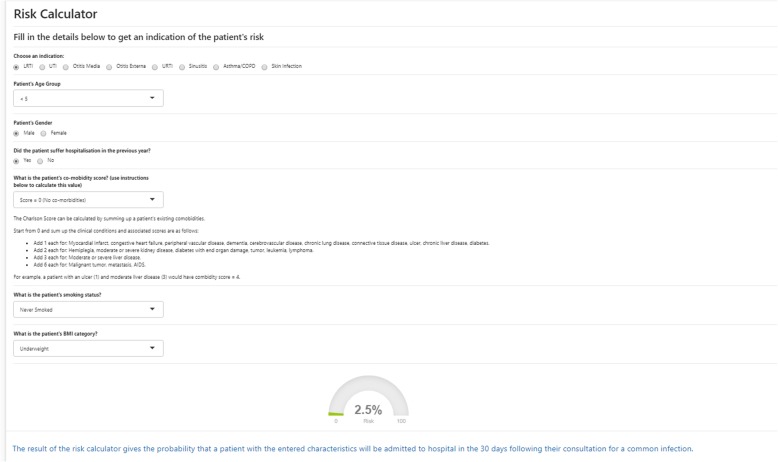
Antimicrobial resistance is driven by the overuse of antibiotics. This study aimed to develop and validate clinical prediction models for the risk of infection-related hospital admission with upper respiratory infection (URTI), lower respiratory infection (LRTI) and urinary tract infection (UTI). These models were used to investigate whether there is an association between the risk of an infection-related complication and the probability of receiving an antibiotic prescription.
The study used electronic health record data from general practices contributing to the Clinical Practice Research Datalink (CPRD GOLD) and Welsh Secure Anonymised Information Linkage (SAIL), both linked to hospital records. Patients who visited their general practitioner with an incidental URTI, LRTI or UTI were included and followed for 30 days for hospitalisation due to infection-related complications. Predictors included age, gender, clinical and medication risk factors, ethnicity and socioeconomic status. Cox proportional hazards regression models were used with predicted risks independently validated in SAIL.
The derivation and validation cohorts included 8.1 and 2.7 million patients in CPRD and SAIL, respectively. A total of 7125 (0.09%) hospital admissions occurred in CPRD and 7685 (0.28%) in SAIL. Important predictors included age and measures of comorbidity. Initial attempts at validating in SAIL (i.e. transporting the models with no adjustment) indicated the need to recalibrate the models for age and underlying incidence of infections; internal bootstrap validation of these updated models yielded C-statistics of 0.63 (LRTI), 0.69 (URTI) and 0.73 (UTI) indicating good calibration. For all three infection types, the rate of antibiotic prescribing was not associated with patients' risk of infection-related hospital admissions.
The risk for infection-related hospital admissions varied substantially between patients, but prescribing of antibiotics in primary care was not associated with risk of hospitalisation due to infection-related complications. Our findings highlight the potential role of clinical prediction models to help inform decisions of prescribing of antibiotics in primary care.
抗生素的过度使用导致了抗菌药物耐药性的产生。本研究旨在开发和验证上呼吸道感染(URTI)、下呼吸道感染(LRTI)和尿路感染(UTI)相关感染性入院风险的临床预测模型,并对这些模型进行验证。这些模型用于研究感染相关并发症的风险与抗生素处方开具之间是否存在关联。
本研究使用了来自参与临床实践研究数据链接(CPRD GOLD)和威尔士安全匿名信息链接(SAIL)的一般实践电子健康记录数据,这两个数据库都与医院记录相关联。纳入因偶发性 URTI、LRTI 或 UTI 就诊的患者,并在 30 天内对因感染相关并发症导致的住院情况进行随访。预测因子包括年龄、性别、临床和药物相关危险因素、种族和社会经济地位。采用 Cox 比例风险回归模型进行分析,并在 SAIL 中对预测风险进行独立验证。
CPRD 和 SAIL 中的推导队列和验证队列分别纳入了 810 万和 270 万患者。CPRD 中共有 7125 例(0.09%)住院,SAIL 中共有 7685 例(0.28%)住院。重要的预测因子包括年龄和共病严重程度的衡量指标。在 SAIL 中初步尝试验证(即不进行调整而直接移植模型)表明,需要对模型进行年龄和基础感染发生率的重新校准;对这些更新模型进行内部自举验证,得出 LRTI、URTI 和 UTI 的 C 统计量分别为 0.63、0.69 和 0.73,表明模型具有良好的校准度。对于所有三种感染类型,抗生素的开具与患者感染相关住院的风险均无关联。
患者之间感染相关住院的风险差异很大,但初级保健中抗生素的开具与感染相关并发症导致的住院风险无关。我们的研究结果突出了临床预测模型在帮助指导初级保健中抗生素开具决策方面的潜在作用。