Jin Shichao, Su Yanjun, Song Shilin, Xu Kexin, Hu Tianyu, Yang Qiuli, Wu Fangfang, Xu Guangcai, Ma Qin, Guan Hongcan, Pang Shuxin, Li Yumei, Guo Qinghua
1State Key Laboratory of Vegetation and Environmental Change, Institute of Botany, Chinese Academy of Sciences, Beijing, 100093 China.
2University of Chinese Academy of Sciences, No. 19A Yuquan Road, Beijing, 100049 China.
Plant Methods. 2020 May 13;16:69. doi: 10.1186/s13007-020-00613-5. eCollection 2020.
Precision agriculture is an emerging research field that relies on monitoring and managing field variability in phenotypic traits. An important phenotypic trait is biomass, a comprehensive indicator that can reflect crop yields. However, non-destructive biomass estimation at fine levels is unknown and challenging due to the lack of accurate and high-throughput phenotypic data and algorithms.
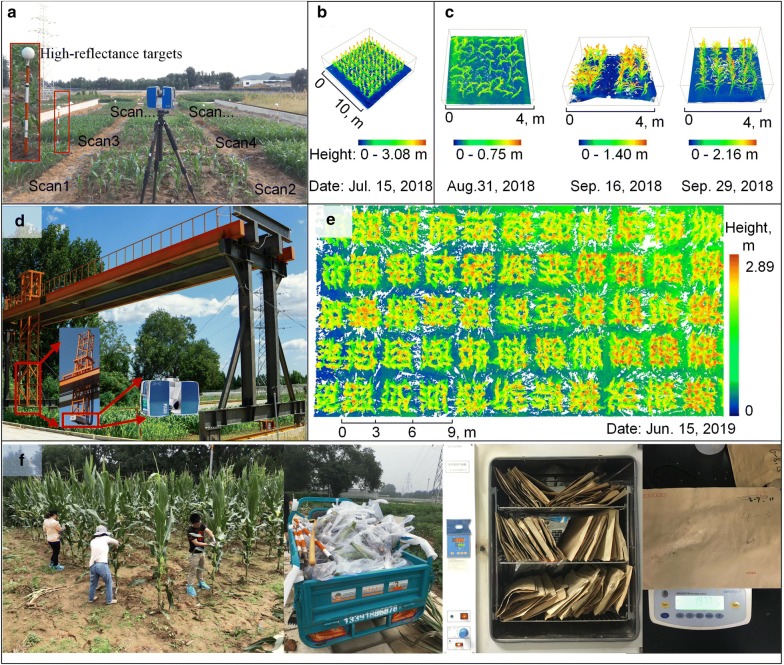
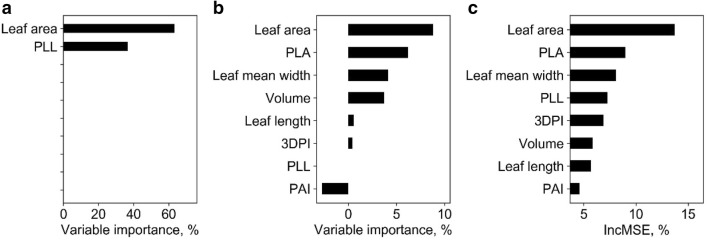
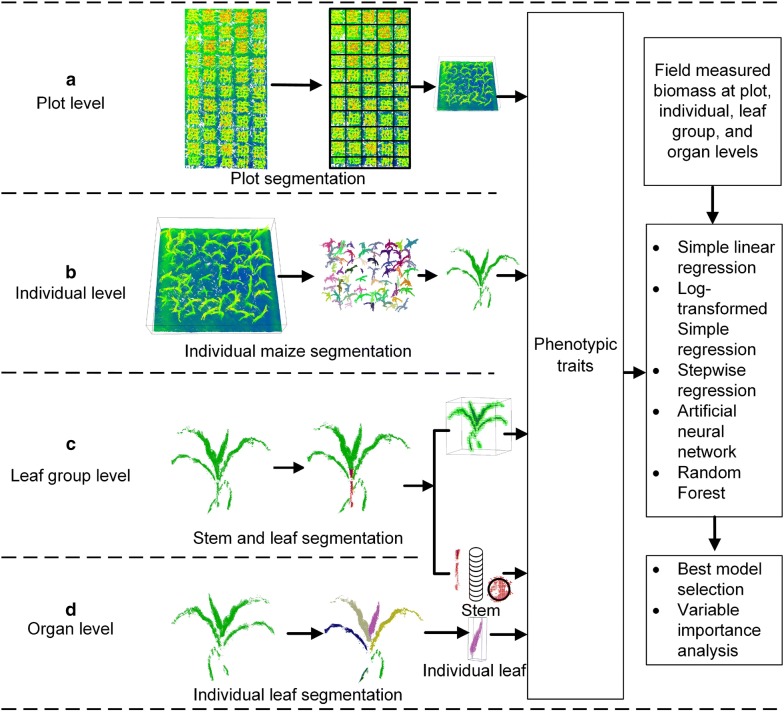
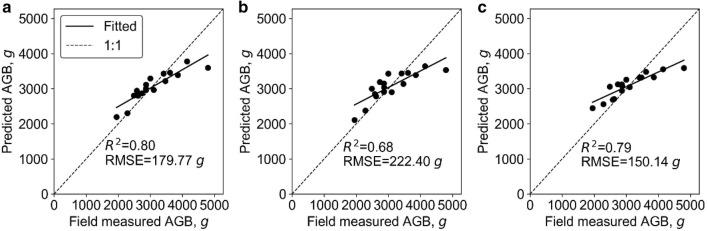
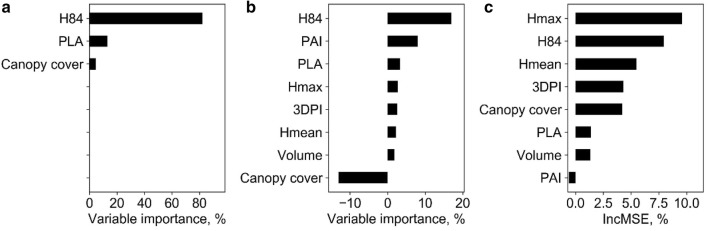
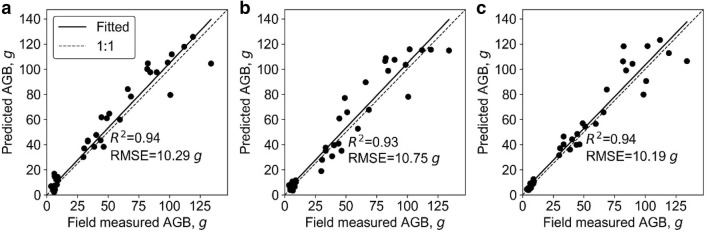
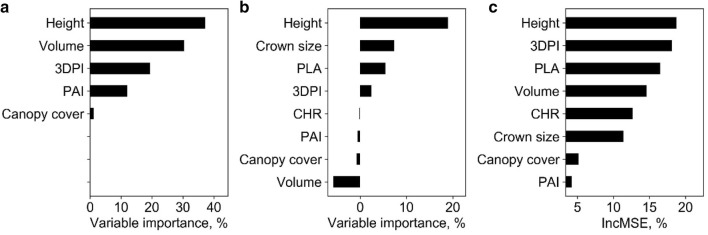
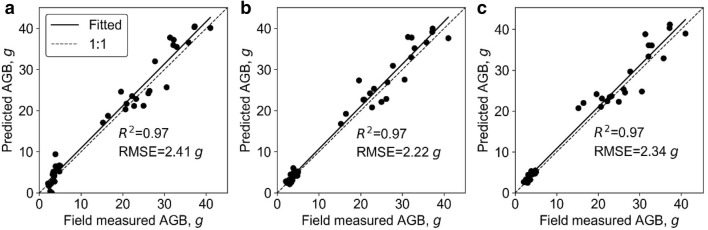
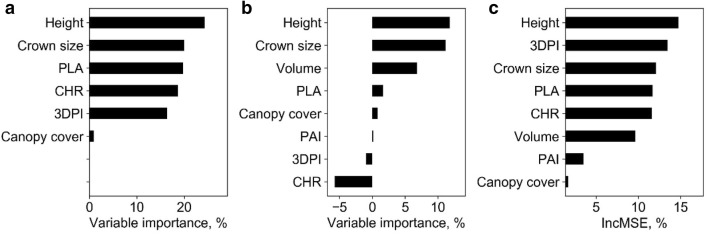
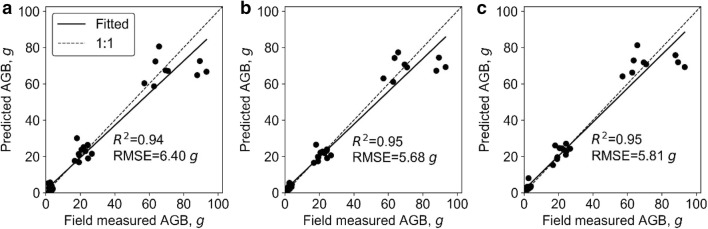
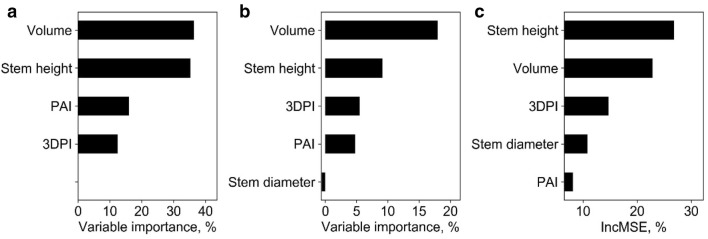
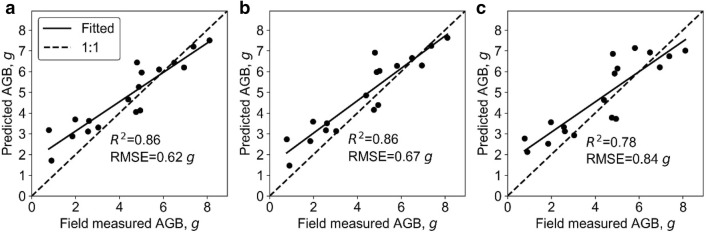
In this study, we evaluated the capability of terrestrial light detection and ranging (lidar) data in estimating field maize biomass at the plot, individual plant, leaf group, and individual organ (i.e., individual leaf or stem) levels. The terrestrial lidar data of 59 maize plots with more than 1000 maize plants were collected and used to calculate phenotypes through a deep learning-based pipeline, which were then used to predict maize biomass through simple regression (SR), stepwise multiple regression (SMR), artificial neural network (ANN), and random forest (RF). The results showed that terrestrial lidar data were useful for estimating maize biomass at all levels (at each level, R was greater than 0.80), and biomass estimation at leaf group level was the most precise (R = 0.97, RMSE = 2.22 g) among all four levels. All four regression techniques performed similarly at all levels. However, considering the transferability and interpretability of the model itself, SR is the suggested method for estimating maize biomass from terrestrial lidar-derived phenotypes. Moreover, height-related variables showed to be the most important and robust variables for predicting maize biomass from terrestrial lidar at all levels, and some two-dimensional variables (e.g., leaf area) and three-dimensional variables (e.g., volume) showed great potential as well.
We believe that this study is a unique effort on evaluating the capability of terrestrial lidar on estimating maize biomass at difference levels, and can provide a useful resource for the selection of the phenotypes and models required to estimate maize biomass in precision agriculture practices.
精准农业是一个新兴的研究领域,它依赖于对表型性状的田间变异性进行监测和管理。生物量是一个重要的表型性状,是能够反映作物产量的综合指标。然而,由于缺乏准确且高通量的表型数据和算法,在精细水平上进行无损生物量估计尚不清楚且具有挑战性。
在本研究中,我们评估了地面激光雷达数据在估计田间玉米生物量方面的能力,评估水平包括小区、单株、叶组和单个器官(即单片叶子或茎)水平。我们收集了59个玉米小区中1000多株玉米的地面激光雷达数据,并通过基于深度学习的流程来计算表型,然后通过简单回归(SR)、逐步多元回归(SMR)、人工神经网络(ANN)和随机森林(RF)来预测玉米生物量。结果表明,地面激光雷达数据在所有水平上都可用于估计玉米生物量(在每个水平上,R均大于0.80),并且在所有四个水平中,叶组水平的生物量估计最为精确(R = 0.97,RMSE = 2.22 g)。所有四种回归技术在各个水平上的表现相似。然而,考虑到模型本身的可转移性和可解释性,SR是从地面激光雷达衍生的表型估计玉米生物量的推荐方法。此外,与高度相关的变量在所有水平上都是从地面激光雷达预测玉米生物量最重要且最可靠的变量,一些二维变量(如叶面积)和三维变量(如体积)也显示出很大的潜力。
我们认为,本研究是评估地面激光雷达在不同水平上估计玉米生物量能力的一项独特工作,可为精准农业实践中估计玉米生物量所需的表型和模型选择提供有用资源。