Hayashi Asuka, Maehara Miki, Uchikura Ayuko, Matsunari Hitomi, Matsumura Kazuaki, Hyon Suong-Hyu, Sato Masato, Nagashima Hiroshi
Laboratory of Medical Bioengineering, School of Agriculture, Meiji University, 1-1-1 Higashimita, Tama, Kawasaki 214-8571, Japan.
Department of Orthopaedic Surgery, Surgical Science, Tokai University School of Medicine, 143 Shimokasuya, Isehara, Kanagawa 259-1193, Japan.
Regen Ther. 2020 May 14;14:215-221. doi: 10.1016/j.reth.2020.04.006. eCollection 2020 Jun.
Regenerative therapy using chondrocyte sheets is effective for osteoarthritis. The clinical application of chondrocyte sheet therapy is expected to be further advanced by the use of a feasible cryopreservation technique. Previously, we developed a chondrocyte sheet vitrification method; however, it was too complex to be used for routine clinical application. Here, we aimed to develop a prototype method for vitrifying chondrocyte sheets for clinical practice.
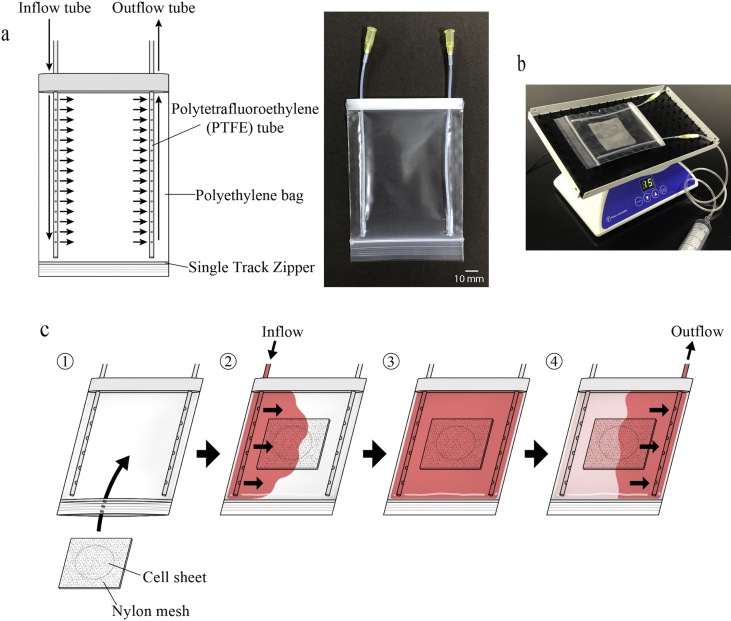
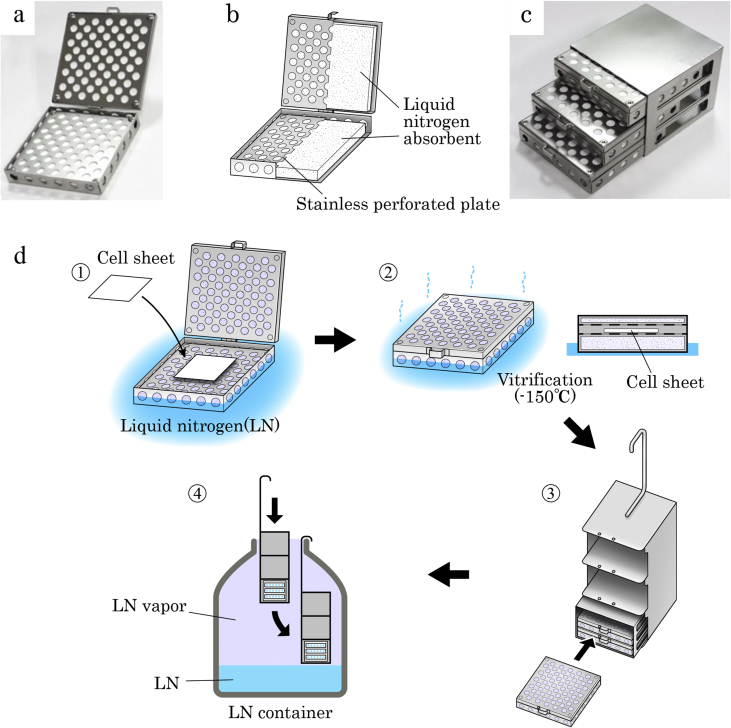
We developed a "circulating vitrification bag" as a container to process cell sheets for vitrification in an efficient and sanitary fashion. Moreover, we invented the "vitrification storage box", which is useful for the vitrification of cell sheets, long-term preservation, and transportation. These devices were used to vitrify rabbit chondrocyte sheets, which were then assessed for their structural characteristics and the viability of the component cells after rewarming.
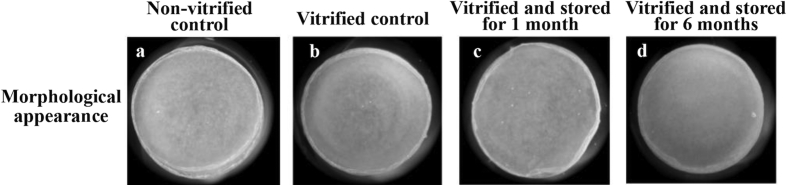
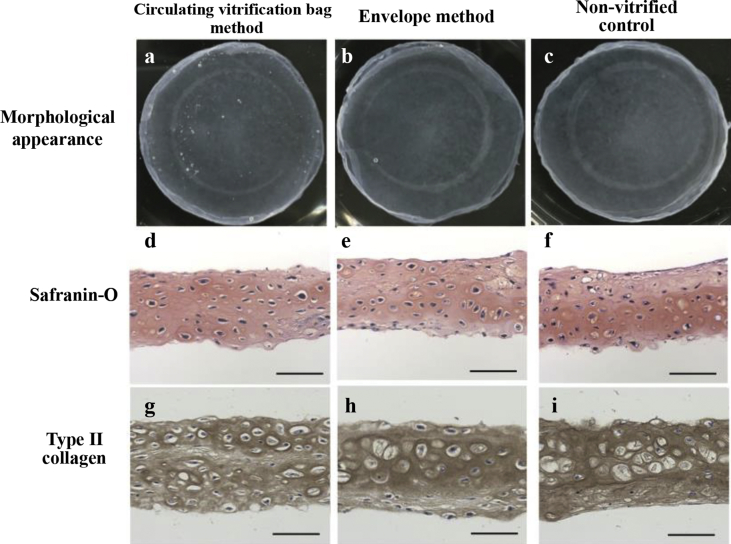
In all cell sheet samples (n = 7) vitrified by the circulating vitrification bag method, the integrity of the sheet structure was maintained, and the cell survival rate was similar to that of non-vitrified samples (91.0 ± 2.9% vs. 90.0 ± 3.0%). Proteoglycan and type II collagen, which are major components of cartilage, were densely and evenly distributed throughout the chondrocyte sheet subjected to vitrification similarly to that observed in the non-vitrified sheet. After long-term storage using the vitrification storage box, the cell sheets maintained normal structure and cell viability (survival rate: 81.2 ± 1.0% vs. 84.3 ± 1.8%) compared to the non-vitrified sheet.
Our results indicate that the circulating vitrification bag method is an effective approach for realizing the clinical application of vitrified chondrocyte sheets. The vitrification storage box is also useful for the long-term preservation of vitrified cell sheets, further enhancing the feasibility of the clinical application of cryopreserved chondrocyte sheets.
使用软骨细胞片的再生疗法对骨关节炎有效。通过使用可行的冷冻保存技术,有望进一步推进软骨细胞片疗法的临床应用。此前,我们开发了一种软骨细胞片玻璃化方法;然而,它过于复杂,无法用于常规临床应用。在此,我们旨在开发一种用于临床实践的软骨细胞片玻璃化原型方法。
我们开发了一种“循环玻璃化袋”作为容器,以高效、卫生的方式处理用于玻璃化的细胞片。此外,我们发明了“玻璃化储存盒”,它可用于细胞片的玻璃化、长期保存和运输。这些装置用于玻璃化兔软骨细胞片,然后在复温后评估其结构特征和组成细胞的活力。
在通过循环玻璃化袋法玻璃化的所有细胞片样本(n = 7)中,片层结构的完整性得以保持,细胞存活率与未玻璃化样本相似(91.0 ± 2.9% 对 90.0 ± 3.0%)。软骨的主要成分蛋白聚糖和II型胶原蛋白在玻璃化的软骨细胞片中密集且均匀地分布,与未玻璃化片层中观察到的情况相似。使用玻璃化储存盒进行长期保存后,与未玻璃化片层相比,细胞片保持了正常结构和细胞活力(存活率:81.2 ± 1.0% 对 84.3 ± 1.8%)。
我们的结果表明,循环玻璃化袋法是实现玻璃化软骨细胞片临床应用的有效方法。玻璃化储存盒也有助于玻璃化细胞片的长期保存,进一步提高了冷冻保存软骨细胞片临床应用的可行性。