Department of Respiratory and Critical Care Medicine, West China Hospital of Sichuan University, Chengdu, Sichuan, China.
West China School of Medicine, Sichuan University, Chengdu, Sichuan, China.
PLoS One. 2020 May 21;15(5):e0233732. doi: 10.1371/journal.pone.0233732. eCollection 2020.
Lung transplantation remains the only curative treatment for end-stage lung disease, conferring a better survival for some IPF patients, but whether they should receive double lung transplantation (DLT) or single lung transplantation (SLT) is still controversial. The aim of this study was to determine which type of lung transplantation was more effective and relatively safe in IPF patients by meta-analysis.
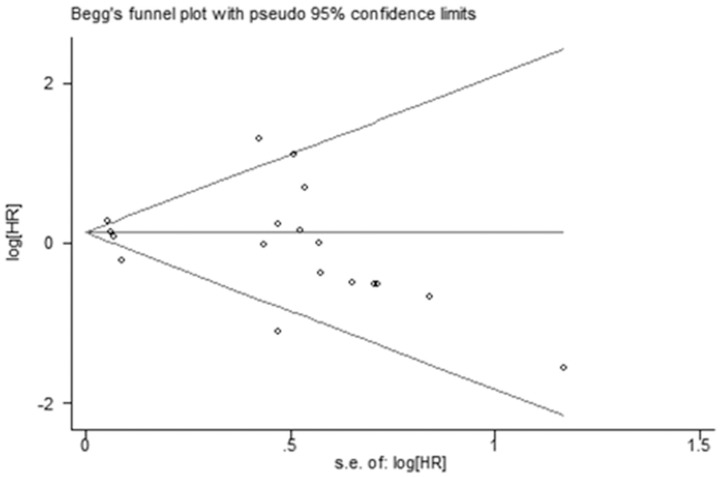
Publications comparing overall survival (OS) or other perioperative characteristics between IPF patients undergoing SLT and DLT were selected from electronic databases. The hazard ratios (HRs) were abstracted or calculated to evaluate the survival outcome. Odds ratios (ORs) or mean differences (MDs) were used to compare the causes of death or perioperative parameters. A random-effect model was used to combine data. Heterogeneity was quantified by means of an I2 with 95% confidence interval (95% CI). The publication bias was estimated using the Eggers test with Begg's funnel plots.
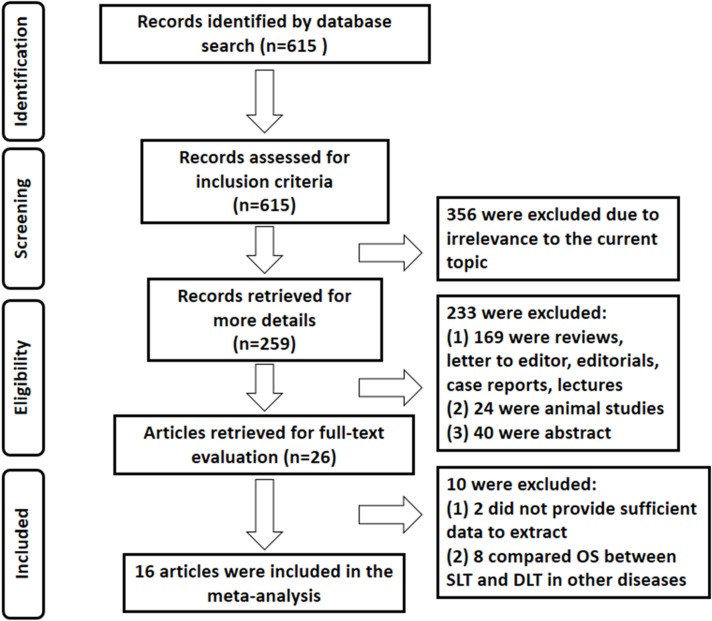
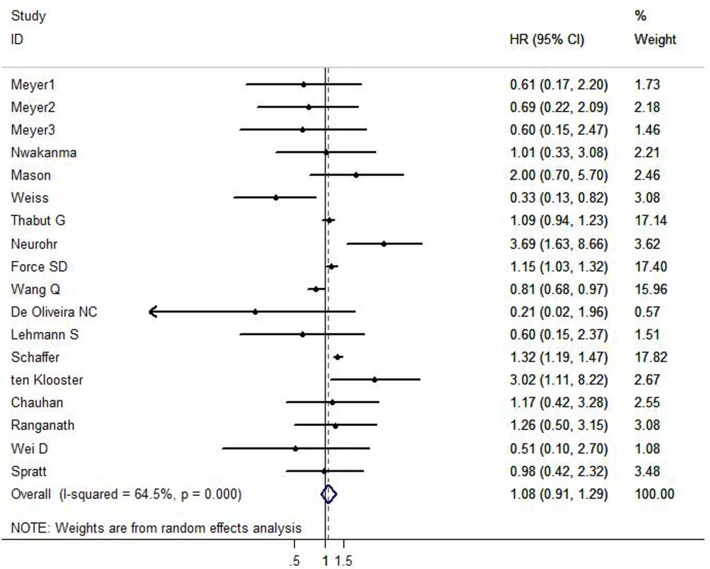
16 studies with 17,872 IPF cases who met the inclusion criteria were included in this meta-analysis. SLT was associated with declined post-transplant FEV1% (MD = -15.37, 95% CI:-22.28,-8.47; P<0.001), FVC % (MD = -12.52, 95% CI:-19.45,-5.59; P<0.001) and DLCO% (MD = -13.85, 95% CI:-20.42,-7.29; P<0.001), but no significant advantage of DLT over SLT was seen in the overall survival outcome (HR = 1.08, 95% CI: 0.91-1.29; P = 0.391). Subgroup analyses for studies of follow-up period ≥ 60 months also showed similar results (all P-values>0.05). Moreover, there was fewer deaths attributable to primary graft dysfunction in SLT recipients (OR = 0.31, 95% CI: 0.2-0.48; P<0.001), while more patients with SLT died of malignancy (OR = 3.44, 95% CI: 2.06-5.77; P<0.001).
Our findings suggest that DLT was associated with better postoperative pulmonary function, but there was no difference in long-term overall survival between patients undergoing DLT and SLT. However, further high-quality and large-scale studies are needed to confirm these findings.
肺移植仍然是治疗终末期肺部疾病的唯一根治方法,这为一些特发性肺纤维化(IPF)患者带来了更好的生存机会,但对于这些患者,应选择双肺移植(DLT)还是单肺移植(SLT)仍然存在争议。本研究旨在通过荟萃分析确定哪种类型的肺移植对 IPF 患者更有效且相对安全。
从电子数据库中选择比较 IPF 患者接受 SLT 和 DLT 后总体生存率(OS)或其他围手术期特征的出版物。提取或计算风险比(HRs)以评估生存结果。使用优势比(ORs)或均数差值(MDs)比较死亡原因或围手术期参数。使用随机效应模型合并数据。通过 95%置信区间(95%CI)的 I2 量化异质性。使用 Eggers 检验和 Begg 漏斗图估计发表偏倚。
纳入了这项荟萃分析的 16 项研究共有 17872 例符合纳入标准的 IPF 患者。与 DLT 相比,SLT 术后的 FEV1%(MD=-15.37,95%CI:-22.28,-8.47;P<0.001)、FVC%(MD=-12.52,95%CI:-19.45,-5.59;P<0.001)和 DLCO%(MD=-13.85,95%CI:-20.42,-7.29;P<0.001)较低,但在总体生存率方面,DLT 并未优于 SLT(HR=1.08,95%CI:0.91-1.29;P=0.391)。对于随访期≥60 个月的研究进行的亚组分析也得出了类似的结果(所有 P 值均>0.05)。此外,SLT 组因原发性移植物功能障碍导致的死亡人数较少(OR=0.31,95%CI:0.2-0.48;P<0.001),而 SLT 组更多患者死于恶性肿瘤(OR=3.44,95%CI:2.06-5.77;P<0.001)。
我们的研究结果表明,DLT 与术后肺功能更好相关,但 DLT 和 SLT 治疗的患者在长期总体生存率方面没有差异。然而,需要进一步进行高质量和大规模的研究来证实这些发现。