Key Laboratory of Carbohydrate Chemistry and Biotechnology Ministry of Education State Key Laboratory of Food Science and Technolog, Jiangnan University, Wuxi, 214122, China.
National Engineering Laboratory for Cereal Fermentation Technology, Jiangnan University, Wuxi, 214122, China.
Sci Rep. 2020 May 21;10(1):8415. doi: 10.1038/s41598-020-64814-7.
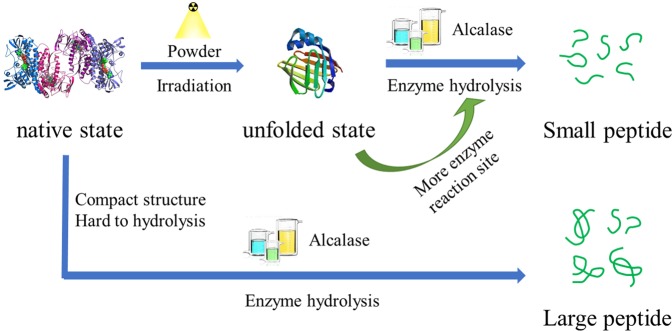
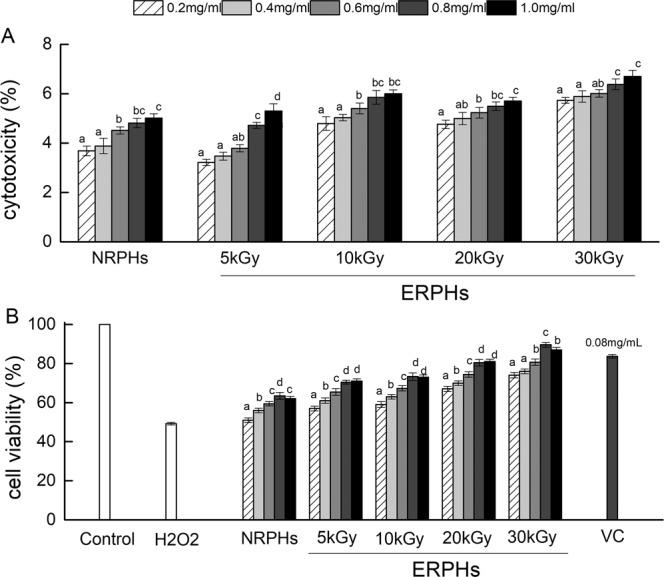
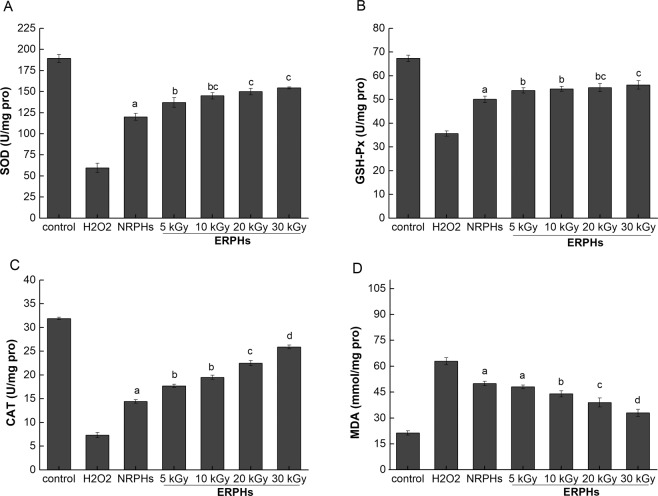
In this paper, electron beam irradiated rice protein hydrolysates (ERPHs) were assessed for their ability to prevent hydrogen peroxide-induced oxidative stress in human HepG-2 cells. The related mechanism was also studied by analyzing the structural changes. Cytotoxicity experiments showed that rice protein hydrolysates pretreated with electron beam irradiation (EBI) were not toxic to cells if appropriate concentrations were applied. Cell viability markedly increased when the cells were treated with ERPHs before HO induction. Furthermore, the ERPHs effectively suppressed HO-induced ROS production and lipid peroxidation and increased the protein expression levels of the intracellular antioxidant enzymes SOD, GSH-Px and CAT in HO-stressed HepG-2 cells. Consequently, the loss of mitochondrial membrane potential and cell apoptosis was alleviated. Circular dichroism analysis showed that pretreatment of rice protein with EBI significantly changed the secondary structure (the conversion of α-helices to random coils), which is beneficial to the improvement of its antioxidative activity. ERPHs exhibited stronger antioxidative effects than those without irradiation, possibly because of the difference in molecular weight distribution and amino acid composition. These findings indicate an efficient way to produce peptides with better antioxidant activity.
本文研究了电子束辐照大米蛋白水解物(ERPHs)对人 HepG-2 细胞中过氧化氢诱导的氧化应激的预防作用,并通过分析结构变化研究了相关机制。细胞毒性实验表明,适当浓度的电子束辐照预处理大米蛋白水解物(EBI)对细胞没有毒性。在诱导 HO 之前用 ERPHs 处理细胞,细胞活力明显增加。此外,ERPHs 能有效抑制 HO 诱导的 ROS 产生和脂质过氧化,增加 HO 应激 HepG-2 细胞内抗氧化酶 SOD、GSH-Px 和 CAT 的蛋白表达水平。因此,线粒体膜电位的丧失和细胞凋亡得到缓解。圆二色性分析表明,EBI 预处理大米蛋白显著改变了二级结构(α-螺旋向无规卷曲的转化),这有利于提高其抗氧化活性。与未经辐照的 ERPHs 相比,辐照后的 ERPHs 具有更强的抗氧化作用,这可能是由于分子量分布和氨基酸组成的差异。这些发现为生产具有更好抗氧化活性的肽提供了一种有效方法。